
Question 2
1. All casual workers are entitled for Employees Provident Fund coverage.
2. All casual workers are entitled for regular working hours and overtime payment.
3. The government can by a notification specify that an establishment or industry shall pay wages only through its bank account.
Which of the above statements are correct?
AOptions
BSolution
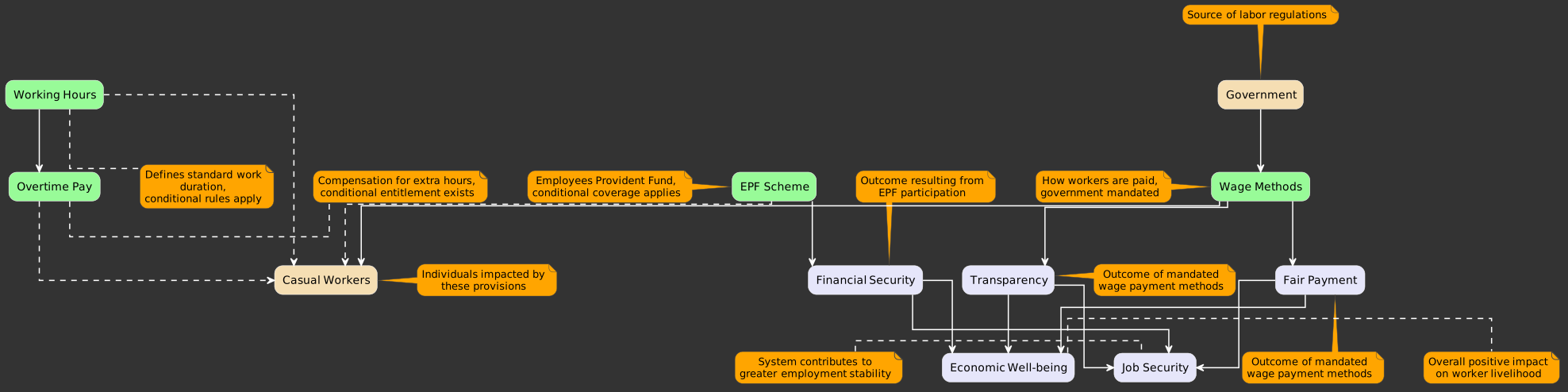
Statement 1: Not all casual workers are automatically entitled to Employees Provident Fund (EPF) coverage. The Employees' Provident Funds and Miscellaneous Provisions Act, 1952, applies to establishments employing 20 or more persons, and there are specific wage ceilings and conditions for eligibility. Workers in smaller establishments or those earning below certain thresholds might not be covered, making the blanket statement incorrect.
Statement 2: Labour laws in India, such as the Factories Act, 1948, and the Minimum Wages Act, 1948, along with the Contract Labour (Regulation and Abolition) Act, 1970, aim to ensure that all workers, including casual workers, are entitled to regular working hours and payment for overtime work, as well as minimum wages. This is a fundamental right to prevent exploitation.
Statement 3: The Payment of Wages Act, 1936, has provisions (specifically Section 6) that empower the appropriate government to specify, by notification, that wages must be paid to employees only through an account payee cheque or by crediting the wages in their bank account for certain establishments or industries. This measure promotes transparency and financial inclusion for workers.
Therefore, statements 2 and 3 are correct.
CStrategy
When answering questions about labor laws and worker entitlements, it's important to differentiate between general rights that apply broadly to all workers and specific benefits (like EPF) that might have conditions, thresholds, or applicability based on the type of establishment or employment. Be cautious of absolute terms like 'all'.
DSyllabus Analysis
This question falls under the Indian Economy, focusing on Labour Laws, Social Security provisions, and aspects of Industrial Relations in India.
EQuestion Analysis
Medium. It requires a nuanced understanding of various labor laws and their specific applicability to different categories of workers.