
Question 10
AOptions
BSolution
Inflation is primarily caused by an excessive increase in the money supply relative to the availability of goods and services, leading to too much money chasing too few goods (demand-pull inflation).
Let's analyze the options for financing a budget deficit:
A) Repayment of public debt: This involves the government paying back existing loans. It removes money from government hands and returns it to the public/creditors. It does not create new money and is generally not inflationary.
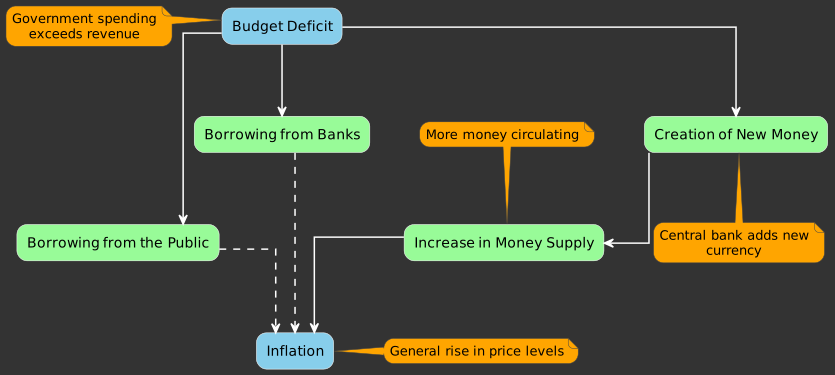
B) Borrowing from the public to finance a budget deficit: When the government borrows from the public (e.g., by issuing bonds), it essentially absorbs existing money from the economy. While it diverts funds that could have been used for private investment, it does not directly create new money or significantly increase the overall money supply. Its inflationary impact is relatively low.
C) Borrowing from the banks to finance a budget deficit: When the government borrows from commercial banks, banks might use their excess reserves or create new credit. This can lead to an increase in the money supply through the banking multiplier effect. This is more inflationary than borrowing from the public, but still involves the banking system.
D) Creation of new money to finance a budget deficit: This refers to the government directly asking the central bank to print new money or credit the government's account, essentially 'monetizing' the deficit. This directly injects new money into the economy without a corresponding increase in real output, leading to a direct and significant increase in the money supply and aggregate demand. This method is considered the most inflationary as it directly creates high-powered money.
Therefore, the creation of new money to finance a budget deficit is likely to be the most inflationary in its effects.
CStrategy
Understand the different ways a government can finance its budget deficit and their respective impacts on the money supply. Direct creation of new money by the central bank (often termed 'printing money' or 'monetization of deficit') is the most direct and potent cause of demand-pull inflation.
DSyllabus Analysis
This question falls under the Indian Economy, covering topics of Public Finance, Fiscal Policy, Monetary Policy, and Inflation.
EQuestion Analysis
Medium. It requires knowledge of deficit financing mechanisms and their inflationary consequences.