
Question 56
1. The Global Ocean Commission grants licences for seabed exploration and mining in international waters.
2. India has received licences for seabed mineral exploration in international waters.
3. 'Rare earth minerals' are present on seafloor in international waters.
Which of the statements given above are correct?
AOptions
BSolution
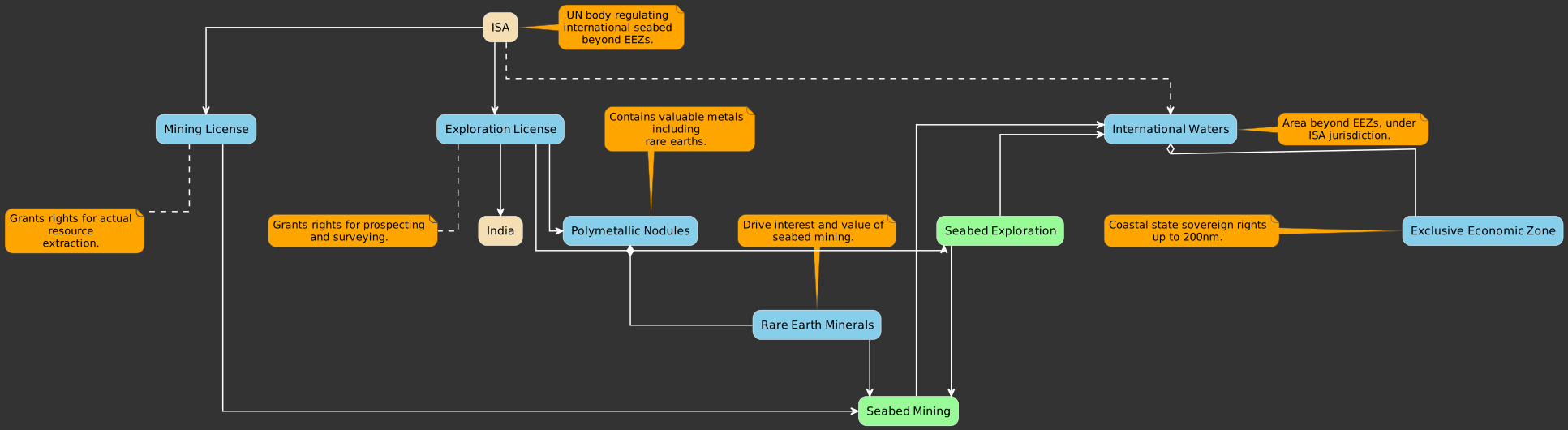
Statement 1 is incorrect: The International Seabed Authority (ISA), established under the United Nations Convention on the Law of the Sea (UNCLOS), is the autonomous international organization responsible for organizing and controlling all mineral-related activities in the international seabed area (the Area) beyond national jurisdiction. The Global Ocean Commission is an independent initiative that promotes governance of the high seas, but it does not grant licenses for seabed exploration and mining.
Statement 2 is correct: India has indeed received licenses for seabed mineral exploration in international waters. India holds a pioneer investor status with the ISA and has been allocated a polymetallic nodule site in the Central Indian Ocean Basin for exploration.
Statement 3 is correct: 'Rare earth minerals' (or Rare Earth Elements - REEs) are known to be present on the seafloor in international waters, often found within polymetallic nodules, cobalt-rich ferromanganese crusts, and seafloor massive sulfides. These deep-sea deposits are a significant potential source of REEs.
CStrategy
For questions on international bodies and resources, clearly differentiate between the roles and mandates of various organizations. Be aware of India's participation and interests in global initiatives (e.g., seabed mining, climate change). Keep abreast of developments in emerging resource frontiers. Always verify the specific functions of an organization named in a statement.
DSyllabus Analysis
This question falls under Environment & Ecology and International Relations, specifically related to Ocean Resources, International Organizations (UNCLOS, ISA), and India's role.
EQuestion Analysis
Medium. Statement 1 is a common factual trap, while statements 2 and 3 are more general knowledge about deep-sea resources.