
Question 72
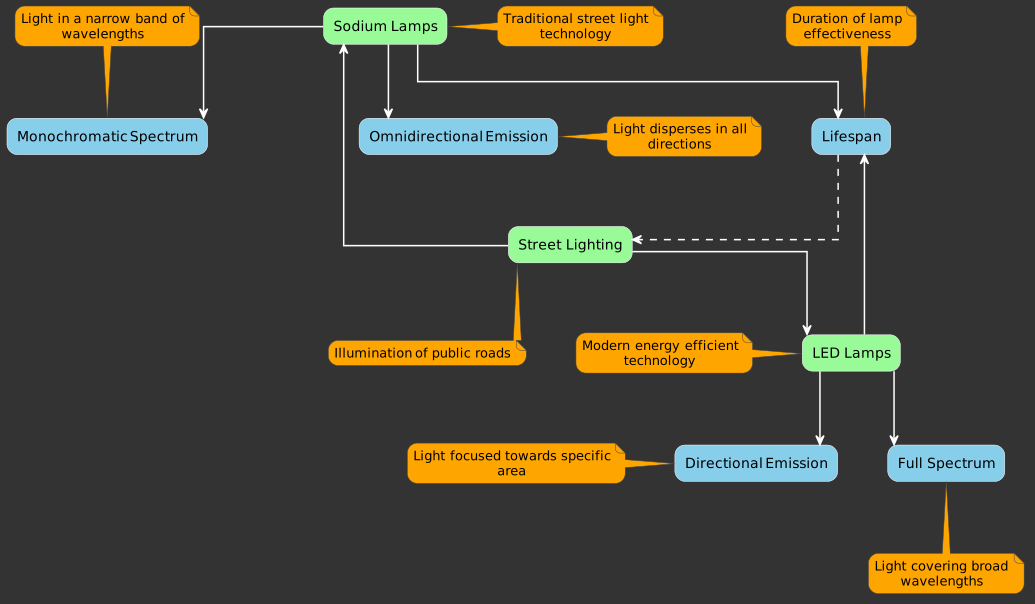
1. Sodium lamps produce light in 360 degrees but it is not so in the case of LED lamps.
2. As street-lights, sodium lamps have longer life span than LED lamps.
3. The spectrum of visible light from sodium lamps is almost monochromatic while LED lamps offer significant colour advantages in street-lighting.
Select the correct answer using the code given below.
AOptions
BSolution
Statement 1 is incorrect: While sodium lamps (like high-pressure sodium lamps) are inherently omnidirectional light sources, in street lighting applications, they are used within fixtures that employ reflectors and lenses to direct the light downwards onto the street, not in a full 360-degree spread to the environment. LED lamps are inherently directional emitters, meaning they produce light in a focused beam rather than all directions. This inherent directionality makes LEDs more efficient for directed lighting applications like street lights, as less light is wasted. However, the statement's phrasing comparing the *output* in a street lighting context can be misleading if it implies a desired 360-degree output for sodium lamps, or if it doesn't account for the optical design of the fixtures.
Statement 2 is incorrect: LED lamps generally have a significantly longer lifespan compared to traditional sodium lamps. LEDs typically last for 50,000 to 100,000 hours, whereas high-pressure sodium lamps usually have a lifespan of around 24,000 hours. This longer lifespan is a major advantage of LED street lights, reducing maintenance costs.
Statement 3 is correct: Sodium lamps, especially low-pressure sodium lamps, produce a monochromatic or nearly monochromatic yellow/orange light. This type of light offers very poor color rendering, making it difficult to distinguish colors accurately at night. LED lamps, in contrast, can produce white light across a full spectrum (different color temperatures), offering significantly better color advantages, improved visibility, and enhanced safety for street lighting applications.
CStrategy
For questions comparing technologies, focus on their key performance metrics and inherent characteristics. Differentiate between the inherent properties of the light source and how they are utilized or modified within a specific application (e.g., street light fixtures). Be precise about comparative advantages like lifespan and color rendering.
DSyllabus Analysis
This question falls under Science & Technology, specifically everyday Physics and Lighting Technologies.
EQuestion Analysis
Medium. Statement 1 can be tricky due to the distinction between the light source's inherent emission pattern and the fixture's output. Statement 2 and 3 are relatively straightforward comparative facts.