
Question 13
1. A bill amending the Constitution requires a prior recommendation of the President of India.
2. When a Constitution Amendment Bill is presented to the President of India, it is obligatory for the President of India to give his/her assent.
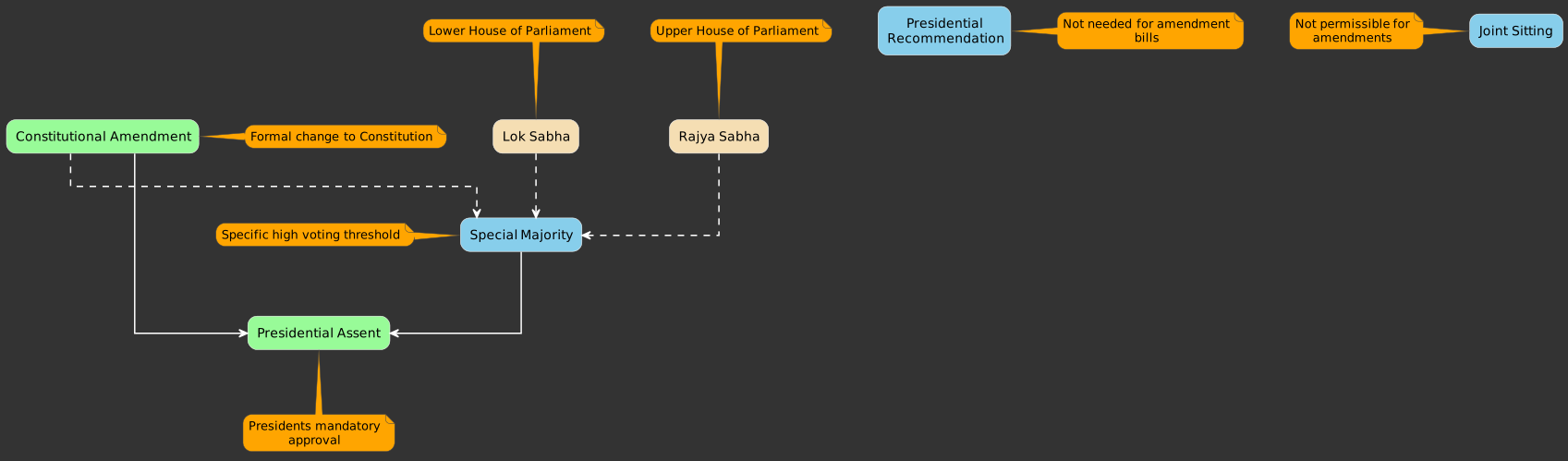
3. A Constitution Amendment Bill must be passed by both the Lok Sabha and the Rajya Sabha by a special majority and there is no provision for joint sitting.
Which of the statements given above are correct?
AOptions
BSolution
Let's analyze the statements regarding a bill amending the Constitution:
1. A bill amending the Constitution requires a prior recommendation of the President of India: A Bill for the amendment of the Constitution (under Article 368) can be introduced in either House of Parliament without the prior recommendation of the President. This is a key distinction from certain other types of bills (e.g., Money Bills). Therefore, statement 1 is incorrect.
2. When a Constitution Amendment Bill is presented to the President of India, it is obligatory for the President of India to give his/her assent: The 24th Constitutional Amendment Act of 1971 made it obligatory for the President to give assent to a Constitution Amendment Bill, meaning the President cannot withhold assent or return the bill for reconsideration. This statement is correct.
3. A Constitution Amendment Bill must be passed by both the Lok Sabha and the Rajya Sabha by a special majority and there is no provision for joint sitting: A Constitution Amendment Bill must be passed by each House of Parliament by a special majority (i.e., a majority of the total membership of the House and a majority of not less than two-thirds of the members of that House present and voting). There is no provision for a joint sitting of both Houses to resolve a deadlock over a Constitution Amendment Bill; if one House rejects the bill or proposes amendments not acceptable to the other, the bill fails. This statement is correct.
CStrategy
For questions on Constitutional Amendments, a thorough understanding of Article 368 is crucial. Pay close attention to the special majority requirements, the role of the President, and the absence of joint sitting provisions for such bills. Distinguish these from the procedures for ordinary bills.
DSyllabus Analysis
This question falls under Indian Polity, specifically Constitutional Amendments, legislative procedures, and the powers of the President.
EQuestion Analysis
Medium to Difficult. It tests detailed knowledge of the constitutional amendment procedure.