
Question 11
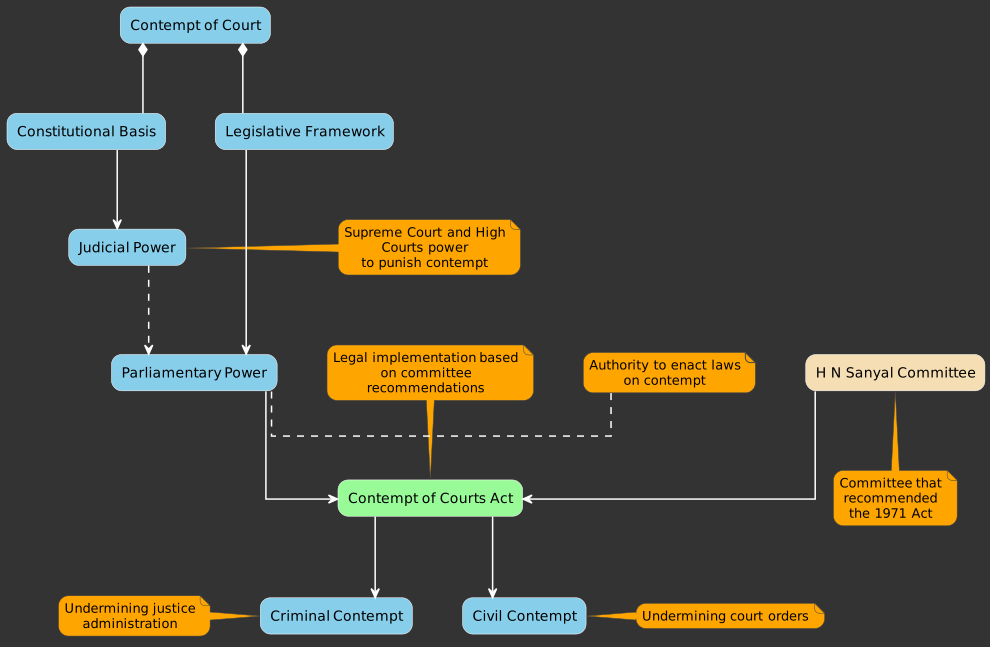
1. Pursuant to the report of H.N. Sanyal Committee, the Contempt of Courts Act, 1971 was passed.
2. The Constitution of India empowers the Supreme Court and the High Courts to punish for contempt of themselves.
3. The Constitution of India defines Civil Contempt and Criminal Contempt.
4. In India, the Parliament is vested with the powers to make laws on Contempt of Court.
Which of the statements given above is/are correct?
AOptions
BSolution
Let's evaluate each statement:
1. Pursuant to the report of H.N. Sanyal Committee, the Contempt of Courts Act, 1971 was passed: The H.N. Sanyal Committee was constituted in 1961 to examine the law relating to contempt of court. Based on its recommendations, the Contempt of Courts Act was enacted in 1971. This statement is correct.
2. The Constitution of India empowers the Supreme Court and the High Courts to punish for contempt of themselves: Article 129 of the Constitution declares the Supreme Court to be a court of record and vests it with the power to punish for its contempt. Similarly, Article 215 states that every High Court shall be a court of record and shall have all the powers of such a court, including the power to punish for contempt of itself. This statement is correct.
3. The Constitution of India defines Civil Contempt and Criminal Contempt: The Constitution of India does not define civil contempt and criminal contempt. These definitions are provided in Section 2 of the Contempt of Courts Act, 1971. This statement is incorrect.
4. In India, the Parliament is vested with the powers to make laws on Contempt of Court: Article 122 of the Constitution of India implicitly empowers Parliament to make laws for regulating the practice and procedure of the courts. Additionally, Entry 77 and Entry 78 of the Union List (List I of Seventh Schedule) give Parliament the power to make laws relating to the Supreme Court and High Courts, including their powers and jurisdiction. The Contempt of Courts Act, 1971, is an example of Parliament exercising this power. This statement is correct.
CStrategy
For questions on legal frameworks, differentiate clearly between what is explicitly mentioned in the Constitution and what is defined or regulated by specific Acts of Parliament. Also, being aware of important committees and their recommendations can be beneficial.
DSyllabus Analysis
This question falls under Indian Polity, specifically the Judiciary, Constitutional Law, and related statutes.
EQuestion Analysis
Medium to Difficult. It requires detailed knowledge of constitutional provisions and specific acts.