
Question 20
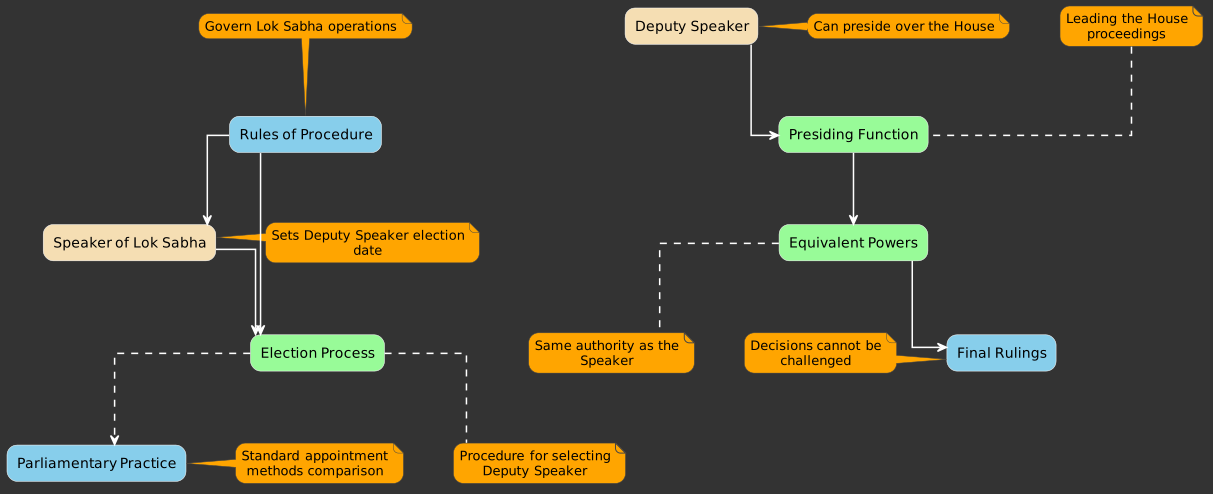
1. As per the Rules of Procedure and Conduct of Business in Lok Sabha, the election of Deputy Speaker shall be held on such date as the Speaker may fix.
2. There is a mandatory provision that the election of a candidate as Deputy Speaker of Lok Sabha shall be from either the principal opposition party or the ruling party.
3. The Deputy Speaker has the same power as of the Speaker when presiding over the sitting of the House and no appeal lies against his rulings.
4. The well established parliamentary practice regarding the appointment of Deputy Speaker is that the motion is moved by the Speaker and duly seconded by the Prime Minister.
Which of the statements given above are correct?
AOptions
BSolution
Let's analyze the statements regarding the Deputy Speaker of Lok Sabha:
1. As per the Rules of Procedure and Conduct of Business in Lok Sabha, the election of Deputy Speaker shall be held on such date as the Speaker may fix: Rule 8(1) of the Rules of Procedure and Conduct of Business in Lok Sabha states that the election of the Deputy Speaker shall be held on such date as the Speaker may fix. This statement is correct.
2. There is a mandatory provision that the election of a candidate as Deputy Speaker of Lok Sabha shall be from either the principal opposition party or the ruling party: There is no such mandatory provision in the Constitution or the Rules of Procedure. While it has become a convention since the 11th Lok Sabha (1996) that the post of Deputy Speaker goes to the principal opposition party, this is a convention, not a mandatory provision. Therefore, statement 2 is incorrect.
3. The Deputy Speaker has the same power as of the Speaker when presiding over the sitting of the House and no appeal lies against his rulings: When the Speaker's office is vacant or the Speaker is absent from a sitting of the House, the Deputy Speaker performs the duties of the Speaker and exercises all the powers of the Speaker. In such a scenario, their rulings have the same authority as the Speaker's and cannot be appealed against within the House. This statement is correct.
4. The well established parliamentary practice regarding the appointment of Deputy Speaker is that the motion is moved by the Speaker and duly seconded by the Prime Minister: The election of the Deputy Speaker is carried out by a motion moved by a member and seconded by another member of the House, and then put to a vote. It is not a practice that the motion is moved by the Speaker and seconded by the Prime Minister directly. Therefore, statement 4 is incorrect.
CStrategy
For questions on parliamentary functionaries, differentiate between constitutional provisions, rules of procedure, and established parliamentary conventions. Pay attention to the specific powers and election/appointment processes for each office.
DSyllabus Analysis
This question falls under Indian Polity, specifically Parliament, Lok Sabha, and its presiding officers.
EQuestion Analysis
Difficult. It requires detailed knowledge of Lok Sabha rules and conventions.