
Question 40
1. GPS and navigation systems could fail.
2. Tsunamis could occur at equatorial regions.
3. Power grids could be damaged.
4. Intense auroras could occur over much of the Earth.
5. Forest fires could take place over much of the planet.
6. Orbits of the satellites could be disturbed.
7. Shortwave radio communication of the aircraft flying over polar regions could be interrupted.
Select the correct answer using the code given below:
AOptions
BSolution
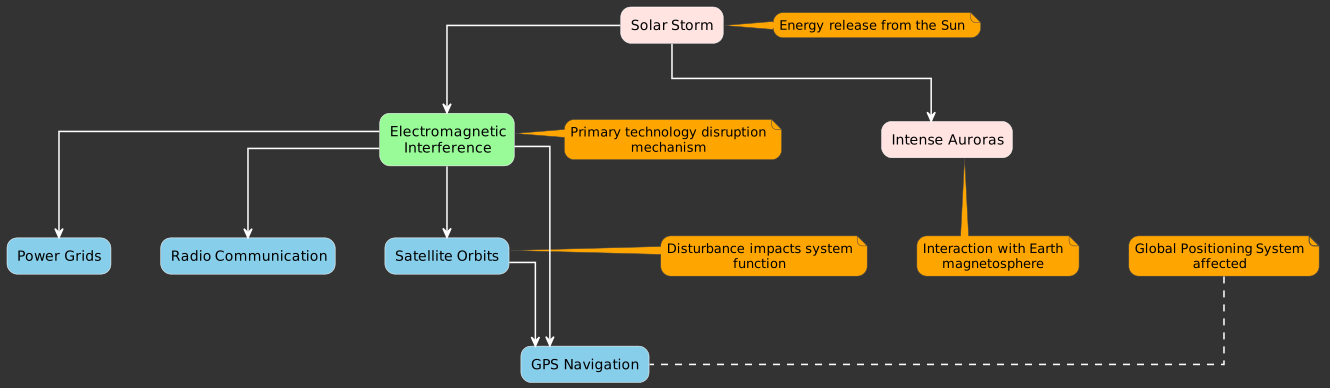
A major solar storm (solar flare or Coronal Mass Ejection - CME) releases charged particles and electromagnetic radiation that can interact with Earth's magnetosphere and atmosphere, leading to various effects:
1. GPS and navigation systems could fail: Correct. Solar storms can disrupt the ionosphere, affecting radio signals used by GPS satellites, leading to inaccuracies or complete outages of navigation and positioning systems.
2. Tsunamis could occur at equatorial regions: Incorrect. Tsunamis are caused by large-scale displacement of water, typically due to underwater earthquakes, volcanic eruptions, or landslides. Solar storms do not directly cause tsunamis.
3. Power grids could be damaged: Correct. Geomagnetic storms induced by solar flares can cause large currents in long power transmission lines, potentially leading to widespread power outages and damage to transformers.
4. Intense auroras could occur over much of the Earth: Correct. Solar storm particles interact with Earth's magnetic field and atmosphere, causing beautiful and intense auroras (Northern and Southern Lights). During strong storms, auroras can be seen at lower latitudes than usual.
5. Forest fires could take place over much of the planet: Incorrect. Solar storms do not directly cause forest fires. Forest fires are typically caused by human activity, lightning, or extreme heat and dryness.
6. Orbits of the satellites could be disturbed: Correct. Increased atmospheric drag caused by the heated and expanded upper atmosphere during solar storms can significantly affect the orbits of low-Earth orbit satellites, requiring re-boosting or leading to earlier re-entry.
7. Shortwave radio communication of the aircraft flying over polar regions could be interrupted: Correct. Polar regions are particularly vulnerable to solar storm effects due to the way Earth's magnetic field channels charged particles. This can lead to severe disruptions in high-frequency (shortwave) radio communications, crucial for aircraft flying over these areas.
Therefore, statements 1, 3, 4, 6, and 7 are possible effects of a major solar storm on Earth.
CStrategy
For questions on space phenomena and their Earthly impacts, understand the causal mechanisms. Distinguish direct effects from unrelated phenomena. Focus on how solar emissions (charged particles, radiation) interact with Earth's magnetic field and atmosphere, leading to disruptions in technology and atmospheric events.
DSyllabus Analysis
This question falls under Science & Technology (Space Technology, Communication, Power Systems) and Environment/Disaster Management (impacts of natural phenomena).
EQuestion Analysis
Medium to Difficult. Requires specific knowledge about the effects of solar storms and the ability to differentiate real impacts from unrelated phenomena.