
Question 18
1. Mandamus will not lie against a private organisation unless it is entrusted with a public duty.
2. Mandamus will not lie against a Company even though it may be a Government Company.
3. Any public minded person can be a petitioner to move the Court to obtain the writ of Quo Warranto.
Which of the statements given above are correct?
AOptions
BSolution
Let's analyze the statements regarding writs issued by Courts in India:
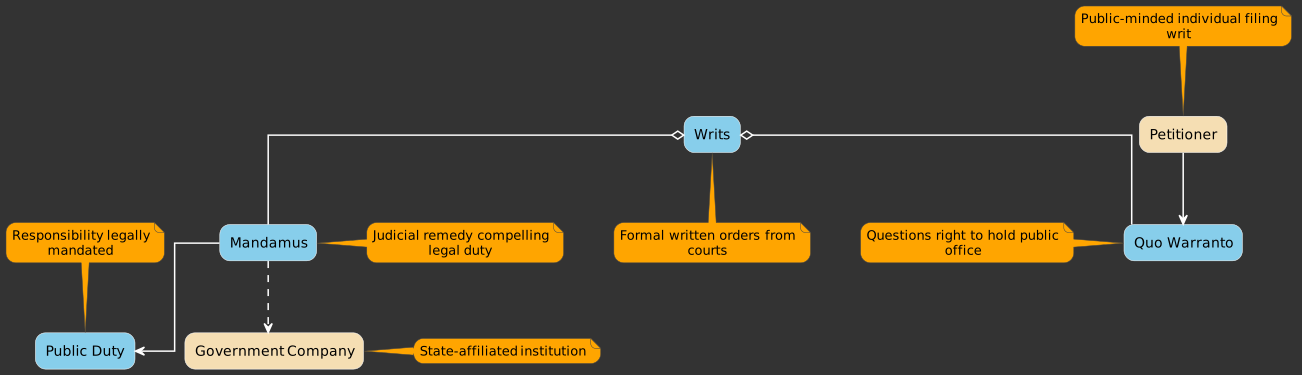
1. Mandamus will not lie against a private organisation unless it is entrusted with a public duty: Mandamus (meaning 'we command') is a writ issued by a superior court to a public authority, corporation, or inferior court, commanding it to perform a public or statutory duty that it has failed to perform. It generally does not lie against a private individual or a private organization, unless that private entity is performing a public function or duty. This statement is correct.
2. Mandamus will not lie against a Company even though it may be a Government Company: While mandamus primarily applies to public duties, a Government Company (e.g., a Public Sector Undertaking) is an instrumentality of the state and can be subjected to the writ of mandamus if it is performing public functions or duties and fails to do so. However, if a 'Company' is generally referred to as a private commercial entity or a government company acting purely in a commercial capacity without a specific public duty, mandamus typically would not lie for its purely commercial decisions. Given the answer key, this statement implies that in its general corporate form, a company, even if government-owned, is not automatically subject to mandamus unless a specific public duty is involved, thereby making it generally correct in a broad sense that it won't lie for *all* actions of such a company.
3. Any public minded person can be a petitioner to move the Court to obtain the writ of Quo Warranto: Quo Warranto (meaning 'by what authority') is a writ issued by the court to enquire into the legality of the claim of a person to a public office. Unlike other writs, for Quo Warranto, any interested person, even a public-minded citizen (not necessarily the aggrieved party), can apply to the High Court or Supreme Court to obtain this writ to prevent illegal usurpation of public office. This statement is correct.
CStrategy
For questions on writs, understand the specific purpose, scope, and conditions for issuing each of the five writs (Habeas Corpus, Mandamus, Prohibition, Certiorari, Quo Warranto). Pay attention to who can file the petition and against whom the writ can be issued, noting exceptions.
DSyllabus Analysis
This question falls under Indian Polity, specifically the Judiciary, fundamental rights, and constitutional remedies (writs).
EQuestion Analysis
Difficult. It requires a nuanced understanding of the applicability of writs, especially Mandamus against different types of entities.