
Question 62
AOptions
BSolution
Let's evaluate each statement concerning the Earth's atmosphere:
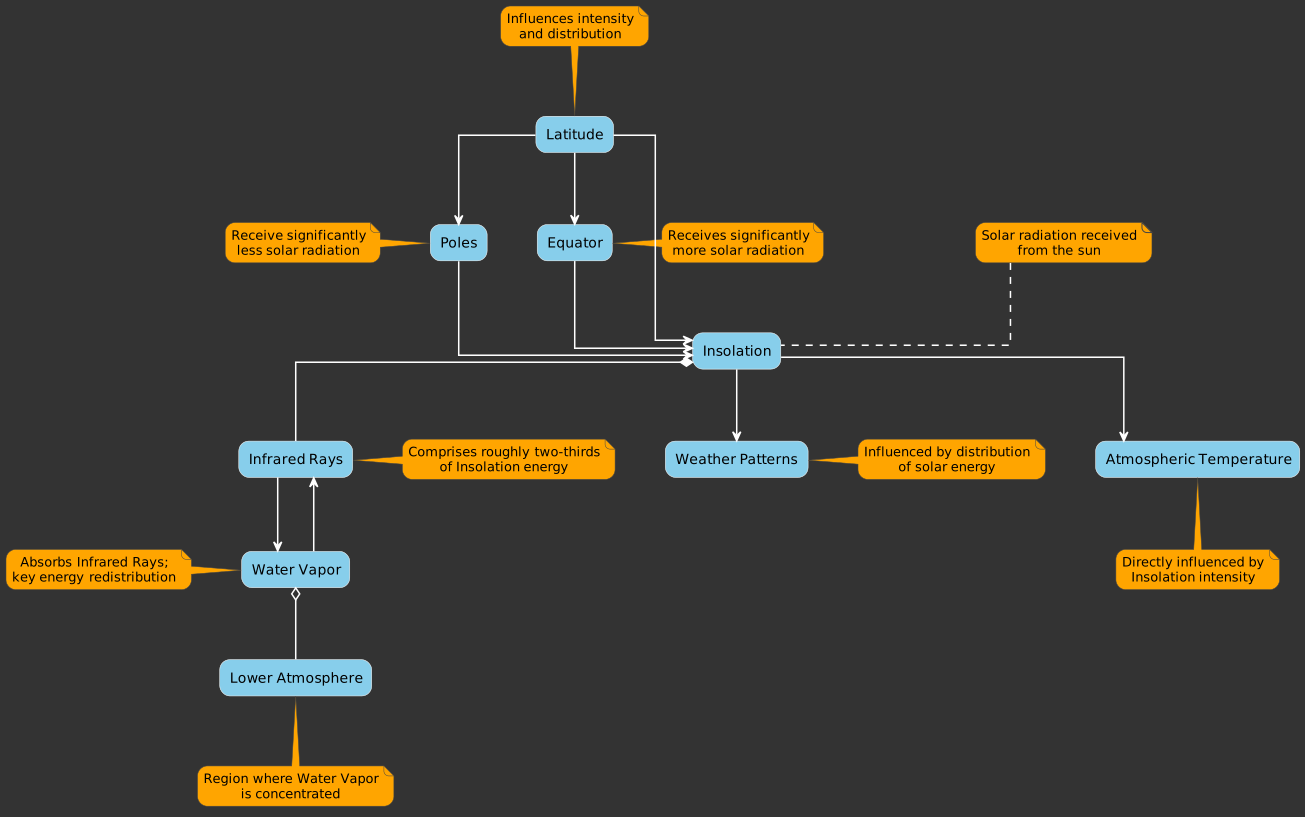
A) The total amount of insolation received at the equator is roughly about 10 times of that received at the poles. This statement is incorrect. While the equator receives significantly more insolation than the poles due to the angle of incidence, the difference is not as extreme as 10 times. Poles still receive insolation, particularly during their respective summers, and factors like albedo and atmospheric absorption play a role.
B) Infrared rays constitute roughly two-thirds of insolation. This statement is incorrect. The solar radiation (insolation) reaching Earth is composed of different wavelengths. Visible light accounts for about 45-50%, infrared (IR) radiation accounts for roughly 45%, and ultraviolet (UV) radiation for about 5-10%. Two-thirds (approx. 66%) is an overestimation for infrared.
C) Infrared waves are largely absorbed by water vapour that is concentrated in the lower atmosphere. This statement is correct. Water vapor is a potent greenhouse gas. It efficiently absorbs outgoing longwave infrared radiation emitted by the Earth's surface and atmosphere, trapping heat and contributing significantly to the greenhouse effect in the lower atmosphere (troposphere).
D) Infrared waves are a part of visible spectrum of electromagnetic waves of solar radiation. This statement is incorrect. The visible spectrum is a narrow band of electromagnetic radiation that the human eye can perceive. Infrared waves have longer wavelengths than visible light and are therefore outside the visible spectrum. They are part of the broader electromagnetic spectrum but not the visible portion.
Based on the analysis, statement C is the correct one.
CStrategy
For questions about the atmosphere and radiation, a fundamental understanding of atmospheric composition, the electromagnetic spectrum, and basic meteorological processes (like insolation, absorption, greenhouse effect) is crucial. Know the relative proportions of different types of radiation and the roles of key atmospheric gases.
DSyllabus Analysis
This question falls under 'Physical Geography - Climatology' in the UPSC Prelims syllabus, specifically focusing on atmospheric composition, solar radiation, and energy balance.
EQuestion Analysis
Medium. Requires knowledge of atmospheric physics and composition. Distinguishing between different types of radiation and their interactions with atmospheric gases is key.