
Question 31
AOptions
BSolution
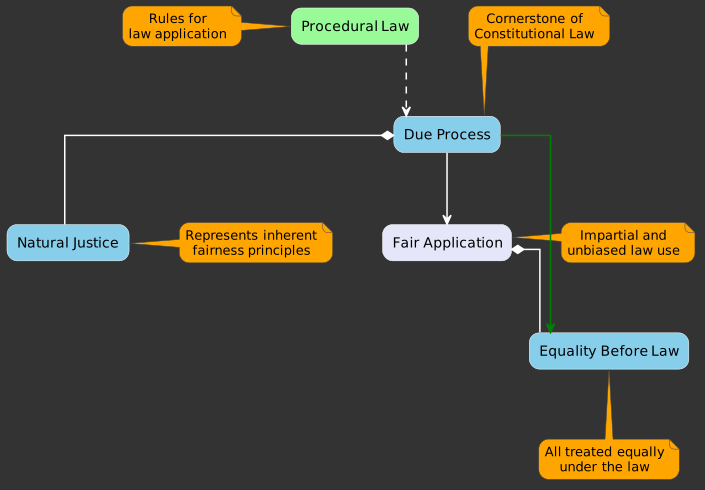
'Due Process of Law' is a concept that originated in the United States. In essence, it means that a person should not be deprived of life, liberty, or property without fair and just legal proceedings. It implies that not only should the procedure established by law be followed, but the law itself must also be fair, just, and reasonable. This is a broader concept than 'procedure established by law', which only checks if the prescribed procedure is followed, irrespective of the fairness of the law itself.
The principle of natural justice, which includes rules like 'Audi alteram partem' (hear the other side) and 'Nemo judex in causa sua' (no one should be a judge in their own cause), aligns very closely with 'due process of law' because both emphasize fairness, reasonableness, and impartiality in legal and administrative actions. Therefore, 'Due Process of Law' encompasses the spirit and application of natural justice to ensure that the law is not arbitrary and its application is equitable.
CStrategy
For conceptual questions in Polity, it's vital to grasp the core meaning and differentiate between similar-sounding terms. Understanding the historical context and evolution of legal principles, and comparing them with related concepts (e.g., 'procedure established by law' vs. 'due process of law'), helps in identifying the best description.
DSyllabus Analysis
This question pertains to Indian Polity, specifically Constitutional Principles, Fundamental Rights, and the concepts of justice and law.
EQuestion Analysis
Medium. Requires a nuanced understanding of constitutional terms and legal philosophy.