
Question 37
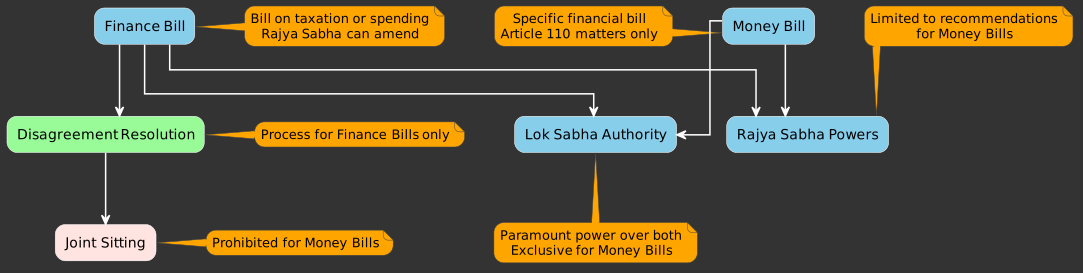
1. When the Lok Sabha transmits Finance Bill to the Rajya Sabha, it can amend or reject the Bill.
2. When the Lok Sabha transmits Money Bill to the Rajya Sabha, it cannot amend or reject the Bill, it can only make recommendations.
3. In the case of disagreement between the Lok Sabha and the Rajya Sabha, there is no joint sitting for Money Bill, but a joint sitting becomes necessary for Finance Bill.
How many of the above statements are correct?
AOptions
BSolution
Let's analyze each statement regarding Finance Bill and Money Bill:
1. When the Lok Sabha transmits Finance Bill to the Rajya Sabha, it can amend or reject the Bill. This statement is correct. A Finance Bill, which deals with revenue and expenditure, is usually introduced in the Lok Sabha. While some Finance Bills (specifically Finance Bill I under Article 110(1) (a) to (f)) are similar to Money Bills, other Finance Bills (Finance Bill II) are treated as ordinary bills regarding the powers of the Rajya Sabha. For such Finance Bills that are not exclusively Money Bills, the Rajya Sabha has the power to amend or reject them, similar to any ordinary bill.
2. When the Lok Sabha transmits Money Bill to the Rajya Sabha, it cannot amend or reject the Bill, it can only make recommendations. This statement is correct. This is a fundamental difference between Money Bills and other bills. Rajya Sabha has very limited powers over Money Bills; it can only make recommendations which the Lok Sabha may or may not accept. Rajya Sabha cannot reject or amend a Money Bill.
3. In the case of disagreement between the Lok Sabha and the Rajya Sabha, there is no joint sitting for Money Bill, but a joint sitting becomes necessary for Finance Bill. This statement is incorrect. The first part, 'there is no joint sitting for Money Bill', is correct because of the limited powers of the Rajya Sabha over Money Bills. However, the second part, 'a joint sitting becomes necessary for Finance Bill', is incorrect. A joint sitting (under Article 108) is possible for Finance Bills (which are considered ordinary bills in this context if they face a deadlock), but it is not 'necessary' or an automatic outcome in every case of disagreement. The President 'may' summon a joint sitting, it's not a mandatory step for every disagreement.
Therefore, only statements 1 and 2 are correct.
CStrategy
To tackle questions comparing parliamentary procedures (like Money Bills vs. Finance Bills), create a comparative table of their key features, especially regarding their introduction, passage, and the powers of Lok Sabha and Rajya Sabha. Pay attention to specific powers like amendment, rejection, and the applicability of joint sittings.
DSyllabus Analysis
This question falls under Indian Polity, specifically the functioning of the Parliament, legislative procedures, and the distinct characteristics of Money Bills and Finance Bills.
EQuestion Analysis
Medium to Difficult. Requires precise knowledge of parliamentary procedures and the nuanced differences between types of financial bills.