
Question 40
Statement-I: The Supreme Court of India has held in some judgements that the reservation policies made under Article 16(4) of the Constitution of India would be limited by Article 335 for maintenance of efficiency of administration.
Statement-II: Article 335 of the Constitution of India defines the term 'efficiency of administration'.
Which one of the following is correct in respect of the above statements?
AOptions
BSolution
Let's analyze the statements:
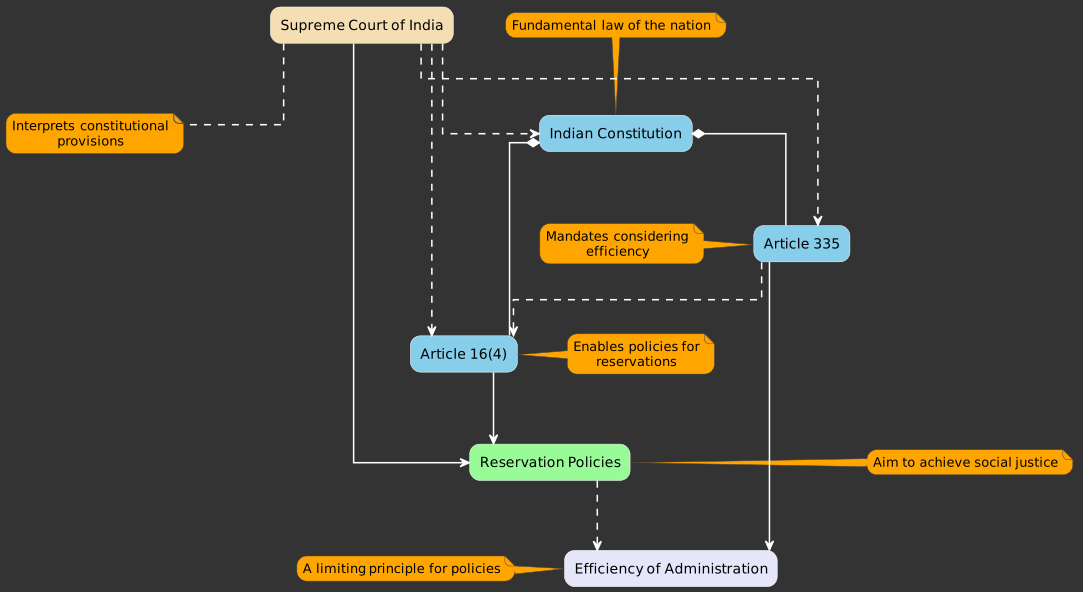
Statement-I: The Supreme Court of India has held in some judgements that the reservation policies made under Article 16(4) of the Constitution of India would be limited by Article 335 for maintenance of efficiency of administration. This statement is correct. The Supreme Court, in various landmark judgments (e.g., M. Nagaraj case, Jarnail Singh case), has consistently interpreted Article 16(4), which deals with reservations in public employment, in conjunction with Article 335. Article 335 emphasizes that the claims of Scheduled Castes and Scheduled Tribes to services and posts shall be taken into consideration 'consistently with the maintenance of efficiency of administration'. The Court has, therefore, held that while reservations are essential for social justice, they cannot be implemented in a manner that completely disregards the efficiency of public administration.
Statement-II: Article 335 of the Constitution of India defines the term 'efficiency of administration'. This statement is correct in its broader context, and serves as an explanation. While Article 335 does not provide a dictionary-style definition of 'efficiency of administration', it is the specific constitutional provision that introduces and constitutionalizes this concept in the context of reservations for Scheduled Castes and Scheduled Tribes in public services. By explicitly linking the consideration of their claims to the 'maintenance of efficiency of administration', Article 335 defines the constitutional framework and importance of this term in the reservation policy. This constitutional mandate serves as the basis for the Supreme Court's interpretations as mentioned in Statement-I.
Relationship between statements: Statement-II provides the constitutional provision (Article 335) that forms the basis for the Supreme Court's judgments mentioned in Statement-I. The Supreme Court's interpretation in Statement-I flows directly from the principle enshrined in Article 335. Thus, Statement-II correctly explains Statement-I.
CStrategy
For questions involving constitutional articles and judicial interpretations, understand the precise wording of the articles and the key pronouncements of the Supreme Court. When evaluating a statement-reason pair, assess if the second statement provides the foundational or explanatory context for the first, even if the 'definition' is implied rather than explicit.
DSyllabus Analysis
This question falls under Indian Polity, specifically Fundamental Rights (Article 16), Constitutional Articles (Article 335), and Judicial Review/Interpretations regarding reservations and administrative efficiency.
EQuestion Analysis
Difficult. Requires a deep and nuanced understanding of constitutional provisions and their judicial interpretations, especially the subtle meaning of 'defines' in the context of a constitutional article.