
33
Question 33
Which one of the following is synthesised in
human body that dilates blood vessels and
increases blood flow?
AOptions
A
A) Nitric oxide
B
B) Nitrous oxide
C
C) Nitrogen dioxide
D
D) Nitrogen pentoxide
BSolution
The correct answer is Nitric oxide (NO).
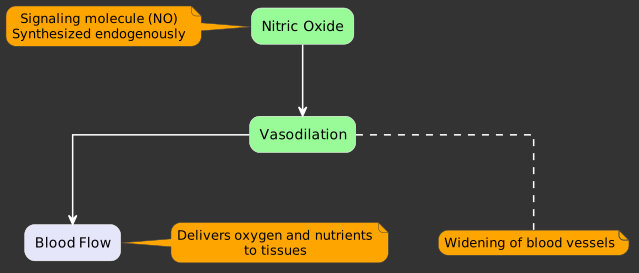
Nitric oxide is a crucial signaling molecule in the human body, playing a vital role in various physiological processes. One of its most important functions is its role as a vasodilator. It relaxes the smooth muscles in the walls of blood vessels, causing them to widen (dilate). This vasodilation leads to increased blood flow, which is essential for delivering oxygen and nutrients to tissues and organs, and for regulating blood pressure. Nitric oxide is synthesized in the body by the enzyme nitric oxide synthase (NOS).
* Nitrous oxide (N₂O): Known as 'laughing gas', used as an anesthetic, but not primarily for vasodilation in normal physiological processes. * Nitrogen dioxide (NO₂): A toxic gas, primarily an air pollutant. * Nitrogen pentoxide (N₂O₅): A chemical compound, not synthesized in the human body for physiological functions.
Therefore, Nitric oxide is the correct answer.
Nitric oxide is a crucial signaling molecule in the human body, playing a vital role in various physiological processes. One of its most important functions is its role as a vasodilator. It relaxes the smooth muscles in the walls of blood vessels, causing them to widen (dilate). This vasodilation leads to increased blood flow, which is essential for delivering oxygen and nutrients to tissues and organs, and for regulating blood pressure. Nitric oxide is synthesized in the body by the enzyme nitric oxide synthase (NOS).
* Nitrous oxide (N₂O): Known as 'laughing gas', used as an anesthetic, but not primarily for vasodilation in normal physiological processes. * Nitrogen dioxide (NO₂): A toxic gas, primarily an air pollutant. * Nitrogen pentoxide (N₂O₅): A chemical compound, not synthesized in the human body for physiological functions.
Therefore, Nitric oxide is the correct answer.
CStrategy
For questions on human physiology, focus on the roles of key biological molecules. Nitric oxide's role as a vasodilator is a significant concept in circulatory health. Differentiate between similar-sounding chemical compounds.
DSyllabus Analysis
Science & Technology: Biology (Human Physiology, Biochemistry), Chemistry.
EQuestion Analysis
This is a factual question from Biology/Physiology. Nitric oxide's role in vasodilation is a fundamental concept in human biology and medicine. The distractors are other nitrogen oxides, but only NO has this specific physiological function. Easy difficulty.