
32
Question 32
Consider the following statements:
Statement-I:
Giant stars live much longer than dwarf stars.
Statement-II :
Compared to dwarf stars, giant stars have a greater rate of nuclear reactions.
Which one of the following is correct in respect of the above statements?
Statement-I:
Giant stars live much longer than dwarf stars.
Statement-II :
Compared to dwarf stars, giant stars have a greater rate of nuclear reactions.
Which one of the following is correct in respect of the above statements?
AOptions
A
A) Both Statement-I and Statement-II are correct and Statement-II explains Statement-I
B
B) Both Statement-I and Statement-II are correct, but Statement-II does not explain Statement-I
C
C) Statement-I is correct, but Statement-II is incorrect
D
D) Statement-I is incorrect, but Statement-II is correct
BSolution
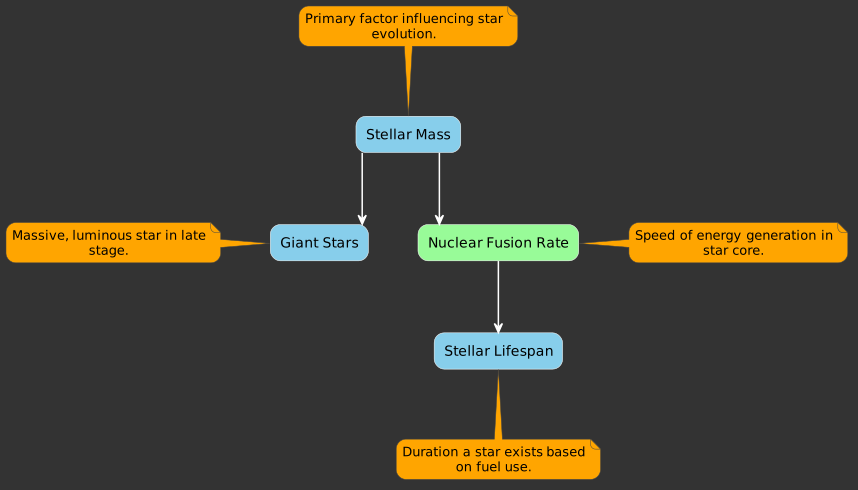
Statement-I is incorrect. Giant stars (which are typically more massive than dwarf stars like our Sun) actually live *much shorter* lives than dwarf stars. This is because more massive stars burn through their nuclear fuel (hydrogen) at a much faster rate due to higher core temperatures and pressures.
Statement-II is correct. Compared to dwarf stars, giant stars have a significantly greater rate of nuclear reactions in their cores. Their immense mass creates greater gravitational pressure, leading to higher core temperatures and densities. This accelerates the rate of nuclear fusion, causing them to consume their fuel more rapidly and emit far more energy, thus leading to their short but brilliant lives.
Since Statement-I is incorrect and Statement-II is correct, option D is the answer. Statement-II (higher rate of nuclear reactions) is actually the *reason* why giant stars have *shorter* lifespans, not longer.
Statement-II is correct. Compared to dwarf stars, giant stars have a significantly greater rate of nuclear reactions in their cores. Their immense mass creates greater gravitational pressure, leading to higher core temperatures and densities. This accelerates the rate of nuclear fusion, causing them to consume their fuel more rapidly and emit far more energy, thus leading to their short but brilliant lives.
Since Statement-I is incorrect and Statement-II is correct, option D is the answer. Statement-II (higher rate of nuclear reactions) is actually the *reason* why giant stars have *shorter* lifespans, not longer.
CStrategy
For questions on stellar evolution, remember the inverse relationship between a star's mass/size and its lifespan. More massive stars burn hotter and faster, leading to shorter lives. Understand that a higher rate of nuclear reactions implies faster fuel consumption.
DSyllabus Analysis
Science & Technology: Astronomy (Stellar Evolution, Types of Stars, Nuclear Fusion).
EQuestion Analysis
This is a conceptual question from Astronomy/Astrophysics. It tests fundamental knowledge about stellar evolution. Statement I contains a common misconception. Statement II accurately describes a key characteristic. Medium difficulty.