
42
Question 42
Consider the following statements :
1. In India, Non-Banking Financial Companies can access the Liquidity Adjustment Facility window of the Reserve Bank of India.
2. In India, Foreign Institutional Investors can hold the Government Securities (G-Secs).
3. In India, Stock Exchanges can offer separate trading platforms for debts.
Which of the statements given above is/are correct?
1. In India, Non-Banking Financial Companies can access the Liquidity Adjustment Facility window of the Reserve Bank of India.
2. In India, Foreign Institutional Investors can hold the Government Securities (G-Secs).
3. In India, Stock Exchanges can offer separate trading platforms for debts.
Which of the statements given above is/are correct?
AOptions
A
A) 1 and 2 only
B
B) 3 only
C
C) Both 1 and 2
D
D) 2 and 3 only
BSolution
Let's analyze each statement:
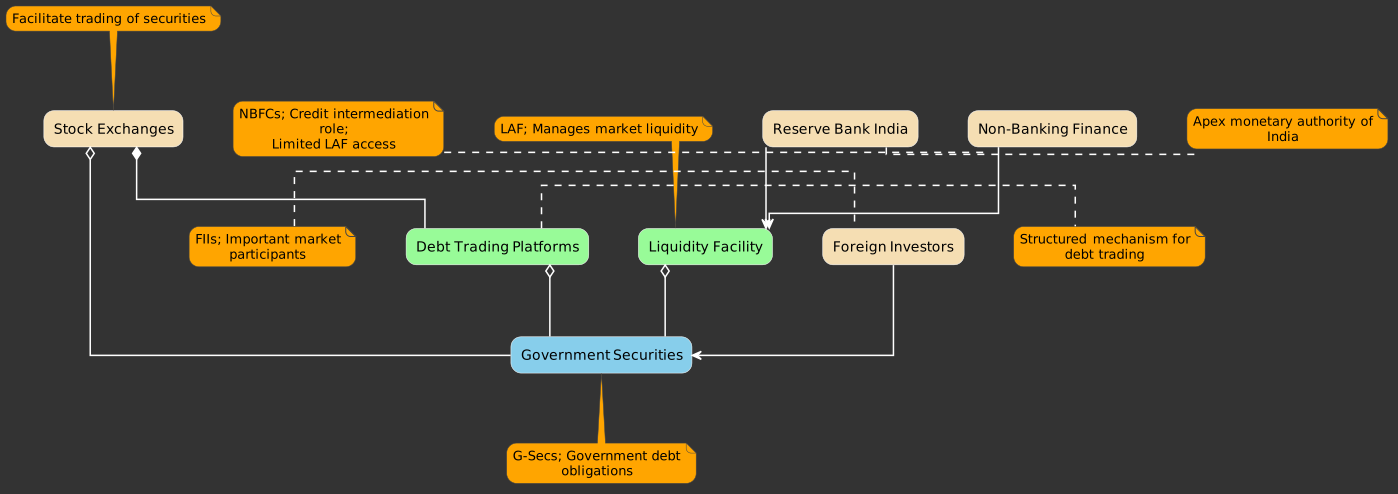
1. Statement 1 is incorrect. In India, generally, only commercial banks and primary dealers (PDs) are allowed to access the Reserve Bank of India's (RBI) Liquidity Adjustment Facility (LAF) windows (repo and reverse repo) for short-term liquidity management. Non-Banking Financial Companies (NBFCs) do not have direct access to the LAF. They meet their liquidity needs from banks or the money market.
2. Statement 2 is correct. Foreign Institutional Investors (FIIs), now primarily referred to as Foreign Portfolio Investors (FPIs), are allowed to invest in Government Securities (G-Secs) in India, subject to certain limits and regulations set by the RBI and SEBI. This is a common channel for foreign investment into Indian debt markets.
3. Statement 3 is correct. Yes, in India, stock exchanges like the National Stock Exchange (NSE) and Bombay Stock Exchange (BSE) do offer separate trading platforms for debt instruments (e.g., corporate bonds, government securities, municipal bonds). These platforms facilitate the buying and selling of debt securities outside of the equity market. For instance, NSE has the 'Wholesale Debt Market' segment and BSE has the 'Debt Segment'.
Therefore, statements 2 and 3 are correct.
1. Statement 1 is incorrect. In India, generally, only commercial banks and primary dealers (PDs) are allowed to access the Reserve Bank of India's (RBI) Liquidity Adjustment Facility (LAF) windows (repo and reverse repo) for short-term liquidity management. Non-Banking Financial Companies (NBFCs) do not have direct access to the LAF. They meet their liquidity needs from banks or the money market.
2. Statement 2 is correct. Foreign Institutional Investors (FIIs), now primarily referred to as Foreign Portfolio Investors (FPIs), are allowed to invest in Government Securities (G-Secs) in India, subject to certain limits and regulations set by the RBI and SEBI. This is a common channel for foreign investment into Indian debt markets.
3. Statement 3 is correct. Yes, in India, stock exchanges like the National Stock Exchange (NSE) and Bombay Stock Exchange (BSE) do offer separate trading platforms for debt instruments (e.g., corporate bonds, government securities, municipal bonds). These platforms facilitate the buying and selling of debt securities outside of the equity market. For instance, NSE has the 'Wholesale Debt Market' segment and BSE has the 'Debt Segment'.
Therefore, statements 2 and 3 are correct.
CStrategy
For questions on financial markets, understand who can participate in which segments. Distinguish between direct access to RBI facilities (banks/PDs) and investment avenues open to foreign entities (FIIs/FPIs). Recognize the broad functions of stock exchanges beyond equity trading.
DSyllabus Analysis
Economy: Financial Markets (Money Market, Debt Market, Capital Market), Banking and Finance (RBI's Role, NBFCs, FPIs), Stock Exchanges.
EQuestion Analysis
This is a factual question from Economics, specifically Indian financial markets. Statement 1 is a common point of confusion for NBFCs vs. banks regarding RBI access. Statements 2 and 3 are accurate regarding FII/FPI investment and stock exchange functions. Medium difficulty.