
45
Question 45
Consider the following materials :
1. Agricultural residues
2. Corn grain
3. Wastewater treatment sludge
4. Wood mill waste
Which of the above can be used as feedstock for producing Sustainable Aviation Fuel?
1. Agricultural residues
2. Corn grain
3. Wastewater treatment sludge
4. Wood mill waste
Which of the above can be used as feedstock for producing Sustainable Aviation Fuel?
AOptions
A
A) 1 and 2 only
B
B) 3 and 4 only
C
C) 1, 2, 3 and 4
D
D) 1, 3 and 4 only
BSolution
All four listed materials can be used as feedstock for producing Sustainable Aviation Fuel (SAF).
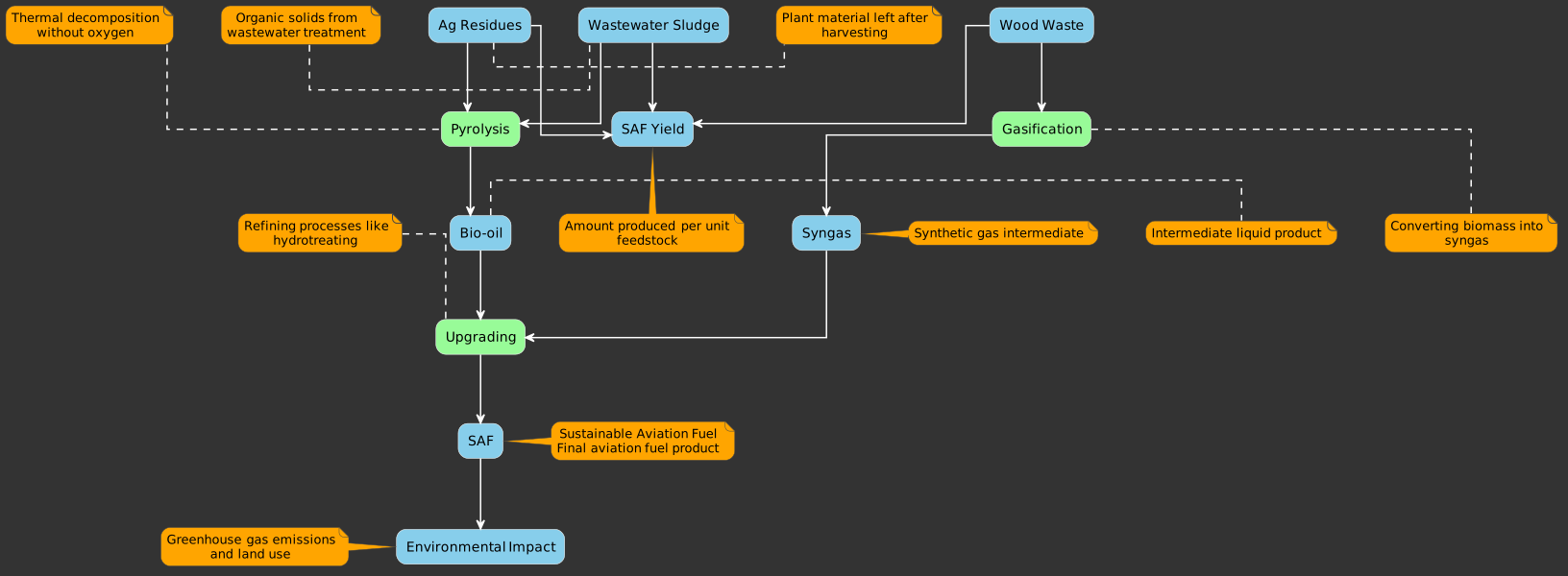
SAF is a biofuel used to power aircraft, designed to reduce carbon emissions from aviation. It can be produced from a variety of sustainable sources, which are broadly categorized as biomass, waste, or oils (non-food):
1. Agricultural residues: Correct. Crop residues (e.g., corn stover, wheat straw, bagasse) are lignocellulosic biomass and are a major source for SAF production, particularly through pathways like Biomass to Liquid (BtL) or Alcohol to Jet (AtJ).
2. Corn grain: Correct. Corn (and other sugar/starch crops) can be converted to ethanol, which can then be converted to SAF via the Alcohol-to-Jet (AtJ) pathway. While there are concerns about using food crops for fuel (food vs. fuel debate), it is technically a viable and currently used feedstock.
3. Wastewater treatment sludge: Correct. Municipal solid waste (MSW) and even some types of sewage sludge can be converted into SAF through thermochemical processes (e.g., gasification and Fischer-Tropsch synthesis) or other biochemical pathways. This is part of the 'waste-to-fuel' approach.
4. Wood mill waste: Correct. Forestry residues and wood waste (e.g., sawdust, wood chips, bark from sawmills and paper mills) are excellent lignocellulosic feedstocks for SAF production through similar processes as agricultural residues.
The development of SAF focuses on diversifying feedstocks to ensure sustainability and avoid competition with food production, thus embracing a wide range of biomass and waste materials.
SAF is a biofuel used to power aircraft, designed to reduce carbon emissions from aviation. It can be produced from a variety of sustainable sources, which are broadly categorized as biomass, waste, or oils (non-food):
1. Agricultural residues: Correct. Crop residues (e.g., corn stover, wheat straw, bagasse) are lignocellulosic biomass and are a major source for SAF production, particularly through pathways like Biomass to Liquid (BtL) or Alcohol to Jet (AtJ).
2. Corn grain: Correct. Corn (and other sugar/starch crops) can be converted to ethanol, which can then be converted to SAF via the Alcohol-to-Jet (AtJ) pathway. While there are concerns about using food crops for fuel (food vs. fuel debate), it is technically a viable and currently used feedstock.
3. Wastewater treatment sludge: Correct. Municipal solid waste (MSW) and even some types of sewage sludge can be converted into SAF through thermochemical processes (e.g., gasification and Fischer-Tropsch synthesis) or other biochemical pathways. This is part of the 'waste-to-fuel' approach.
4. Wood mill waste: Correct. Forestry residues and wood waste (e.g., sawdust, wood chips, bark from sawmills and paper mills) are excellent lignocellulosic feedstocks for SAF production through similar processes as agricultural residues.
The development of SAF focuses on diversifying feedstocks to ensure sustainability and avoid competition with food production, thus embracing a wide range of biomass and waste materials.
CStrategy
For questions on emerging technologies like SAF, remember the goal is sustainability, which implies using diverse, non-fossil, and often waste-derived feedstocks. Broaden your thinking beyond traditional biofuels to include various forms of biomass and waste.
DSyllabus Analysis
Science & Technology: Renewable Energy (Biofuels, Sustainable Aviation Fuel). Environment & Ecology: Climate Change (Decarbonization, Waste Management).
EQuestion Analysis
This is a current affairs-driven question from Science & Technology and Environment. The concept of SAF relies on diverse feedstocks, including various waste products and biomass. All options are valid. Medium difficulty.