
3
Question 3
Consider the following:
1. Pyroclastic debris
2. Ash and dust
3. Nitrogen compounds
4. Sulphur compounds
How many of the above are products of volcanic eruptions?
1. Pyroclastic debris
2. Ash and dust
3. Nitrogen compounds
4. Sulphur compounds
How many of the above are products of volcanic eruptions?
AOptions
A
A) Only one
B
B) Only two
C
C) Only three
D
D) All four
BSolution
All four listed items are products of volcanic eruptions:
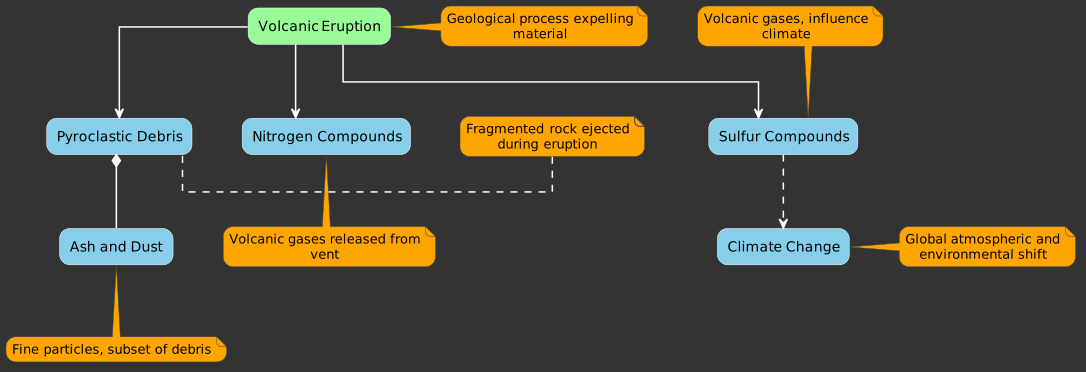
1. Pyroclastic debris: This refers to fragmented material ejected from a volcano during an explosive eruption, including rock fragments, ash, pumice, and volcanic bombs.
2. Ash and dust: Volcanic ash consists of tiny particles of pulverized rock, minerals, and volcanic glass, often ejected in large quantities during eruptions. Volcanic dust is even finer.
3. Nitrogen compounds: Volcanic gases include various compounds, and while water vapor and carbon dioxide are the most abundant, nitrogen (N₂) and minor nitrogen compounds (like NO, NO₂, NH₃) are also released. Nitrogen is the most abundant gas in Earth's atmosphere, and it is a constituent of the magmatic gases.
4. Sulphur compounds: Sulphur dioxide (SO₂), hydrogen sulfide (H₂S), and other sulphur compounds are significant components of volcanic gases. SO₂ is particularly known for its atmospheric effects, contributing to acid rain and influencing climate.
Therefore, all four are products of volcanic eruptions.
1. Pyroclastic debris: This refers to fragmented material ejected from a volcano during an explosive eruption, including rock fragments, ash, pumice, and volcanic bombs.
2. Ash and dust: Volcanic ash consists of tiny particles of pulverized rock, minerals, and volcanic glass, often ejected in large quantities during eruptions. Volcanic dust is even finer.
3. Nitrogen compounds: Volcanic gases include various compounds, and while water vapor and carbon dioxide are the most abundant, nitrogen (N₂) and minor nitrogen compounds (like NO, NO₂, NH₃) are also released. Nitrogen is the most abundant gas in Earth's atmosphere, and it is a constituent of the magmatic gases.
4. Sulphur compounds: Sulphur dioxide (SO₂), hydrogen sulfide (H₂S), and other sulphur compounds are significant components of volcanic gases. SO₂ is particularly known for its atmospheric effects, contributing to acid rain and influencing climate.
Therefore, all four are products of volcanic eruptions.
CStrategy
For questions on geological phenomena, a broad understanding of the outputs is important. For volcanoes, remember both solid ejecta (debris, ash) and gases (sulfur, nitrogen, CO2, water vapor). Even minor components can be products.
DSyllabus Analysis
Geography: Geomorphology (Volcanism, Volcanic Landforms, Volcanic Hazards).
EQuestion Analysis
This is a factual question about volcanic activity. While pyroclastic debris, ash, and sulphur compounds are commonly known, the inclusion of 'nitrogen compounds' might be less obvious but correct. It tests comprehensive knowledge. Easy to Medium difficulty.