
51
Question 51
Consider the following statements :
Statement-I :
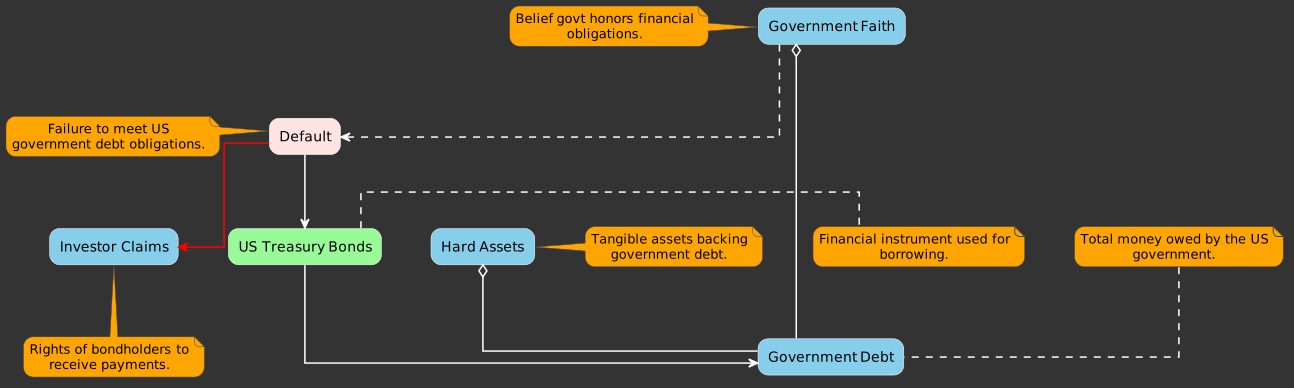
If the United States of America (USA) were to default on its debt, holders of US Treasury Bonds will not be able to exercise their claims to receive payment.
Statement-II :
The USA Government debt is not backed by any hard assets, but only by the faith of the Government.
Which one of the following is correct in respect of the above statements ?
Statement-I :
If the United States of America (USA) were to default on its debt, holders of US Treasury Bonds will not be able to exercise their claims to receive payment.
Statement-II :
The USA Government debt is not backed by any hard assets, but only by the faith of the Government.
Which one of the following is correct in respect of the above statements ?
AOptions
A
A) Both Statement-I and Statement-II are correct and Statement-II explains Statement-I
B
B) Both Statement-I and Statement-II are correct, but Statement-II does not explain Statement-I
C
C) Statement-I is correct, but Statement-II is incorrect
D
D) Statement-I is incorrect, but Statement-II is correct
BSolution
Statement-I is incorrect. If the USA were to default on its debt, it would mean the government is unable or unwilling to make payments on its bonds. In such a scenario, holders of US Treasury Bonds *would* still have claims to receive payment; the default simply means those claims are not being honored as per the original terms. They wouldn't lose their *claims*, but rather the payments on those claims would be disrupted or suspended. A default does not invalidate the claim itself, but it signifies the government's failure to meet its obligations, leading to severe financial repercussions for bondholders and the global financial system.
Statement-II is correct. The USA Government debt, particularly US Treasury securities, is often described as being backed by the 'full faith and credit' of the United States government. This implies that the government is committed to honoring its debt obligations, and its ability to do so relies on its power to tax, borrow, and print money, as well as the underlying strength and stability of the U.S. economy. Unlike corporate bonds that might be secured by specific assets, sovereign debt is typically not backed by 'hard assets' (like gold reserves, land, or physical property) in a direct, pledged manner. Its value derives from the confidence and trust in the government's ability and willingness to pay.
Therefore, Statement-I is incorrect, but Statement-II is correct.
Statement-II is correct. The USA Government debt, particularly US Treasury securities, is often described as being backed by the 'full faith and credit' of the United States government. This implies that the government is committed to honoring its debt obligations, and its ability to do so relies on its power to tax, borrow, and print money, as well as the underlying strength and stability of the U.S. economy. Unlike corporate bonds that might be secured by specific assets, sovereign debt is typically not backed by 'hard assets' (like gold reserves, land, or physical property) in a direct, pledged manner. Its value derives from the confidence and trust in the government's ability and willingness to pay.
Therefore, Statement-I is incorrect, but Statement-II is correct.
CStrategy
For economic statements, pay close attention to nuances in wording, especially with terms like 'claims' vs. 'receive payment'. Understand the backing of sovereign debt – it's generally based on the government's creditworthiness and economic capacity, not physical assets.
DSyllabus Analysis
Economy: Public Finance (Government Debt, Sovereign Bonds), International Economics.
EQuestion Analysis
This is a conceptual question from Economics related to sovereign debt and financial markets. Statement I tests the understanding of 'default' vs. 'claim'. Statement II tests the backing of government debt. Both are nuanced but fundamental concepts. Medium difficulty.