
83
Question 83
A Writ of Prohibition is an order issued by the
Supreme Court or High Courts to :
AOptions
A
A) a government officer prohibiting him from taking a particular action.
B
B) the Parliament/Legislative Assembly to pass a law on Prohibition.
C
C) the lower court prohibiting continuation of proceedings in a case.
D
D) the Government prohibiting it from following an unconstitutional policy.
BSolution
The correct answer is C) the lower court prohibiting continuation of proceedings in a case.
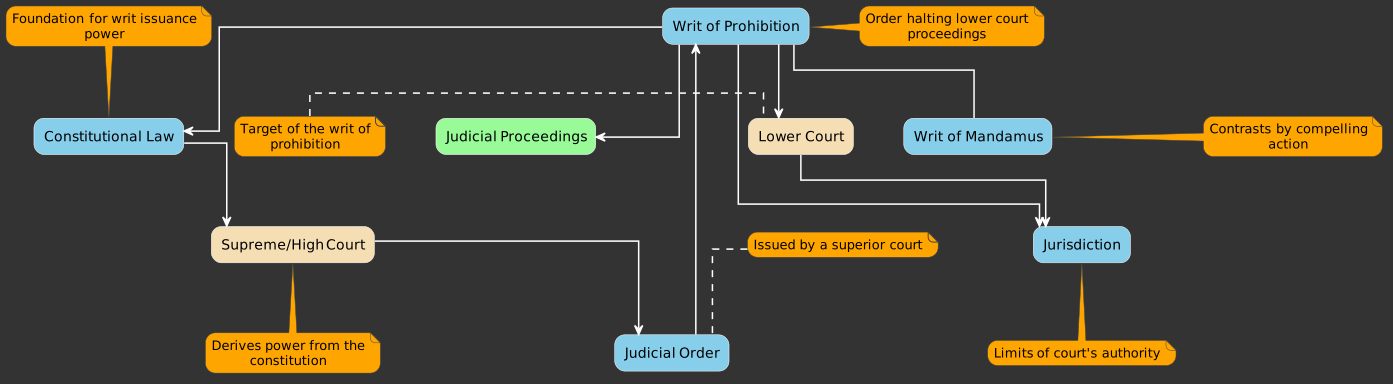
A Writ of Prohibition is a writ issued by a higher court (Supreme Court or High Court) to a lower court or tribunal to prevent the latter from exceeding its jurisdiction or usurping a jurisdiction that it does not possess. It is issued to stop an inferior court or quasi-judicial body from continuing proceedings that are *ultra vires* (beyond its legal power or authority).
Let's analyze the other options: * A) A government officer prohibiting him from taking a particular action: This is more characteristic of a Writ of Mandamus (to compel action) or possibly Quo Warranto (to challenge authority) if the action is without authority, but not Prohibition. * B) The Parliament/Legislative Assembly to pass a law on Prohibition: Courts generally cannot issue writs to legislatures to stop them from passing laws. The constitutionality of a law can only be challenged *after* it has been passed. * D) The Government prohibiting it from following an unconstitutional policy: While courts can strike down unconstitutional policies, a Writ of Prohibition is specifically directed at preventing an *inferior court or tribunal* from exceeding its jurisdiction, not at stopping the executive from following a policy in general (which might involve a writ of Mandamus or Quo Warranto, or simply striking down the policy through judicial review).
Therefore, Prohibition is preventive and issued against judicial or quasi-judicial bodies to stay within their bounds.
A Writ of Prohibition is a writ issued by a higher court (Supreme Court or High Court) to a lower court or tribunal to prevent the latter from exceeding its jurisdiction or usurping a jurisdiction that it does not possess. It is issued to stop an inferior court or quasi-judicial body from continuing proceedings that are *ultra vires* (beyond its legal power or authority).
Let's analyze the other options: * A) A government officer prohibiting him from taking a particular action: This is more characteristic of a Writ of Mandamus (to compel action) or possibly Quo Warranto (to challenge authority) if the action is without authority, but not Prohibition. * B) The Parliament/Legislative Assembly to pass a law on Prohibition: Courts generally cannot issue writs to legislatures to stop them from passing laws. The constitutionality of a law can only be challenged *after* it has been passed. * D) The Government prohibiting it from following an unconstitutional policy: While courts can strike down unconstitutional policies, a Writ of Prohibition is specifically directed at preventing an *inferior court or tribunal* from exceeding its jurisdiction, not at stopping the executive from following a policy in general (which might involve a writ of Mandamus or Quo Warranto, or simply striking down the policy through judicial review).
Therefore, Prohibition is preventive and issued against judicial or quasi-judicial bodies to stay within their bounds.
CStrategy
For questions on writs, know the specific purpose and target of each writ (Habeas Corpus, Mandamus, Prohibition, Certiorari, Quo Warranto). Prohibition is always preventive and aimed at lower judicial/quasi-judicial bodies.
DSyllabus Analysis
Polity: Fundamental Rights (Writs, Judicial Review).
EQuestion Analysis
This is a fundamental conceptual question from Indian Polity, specifically on writs. The function of the Writ of Prohibition is a core concept. The distractors attempt to misapply the writ to other government functions. Easy difficulty.