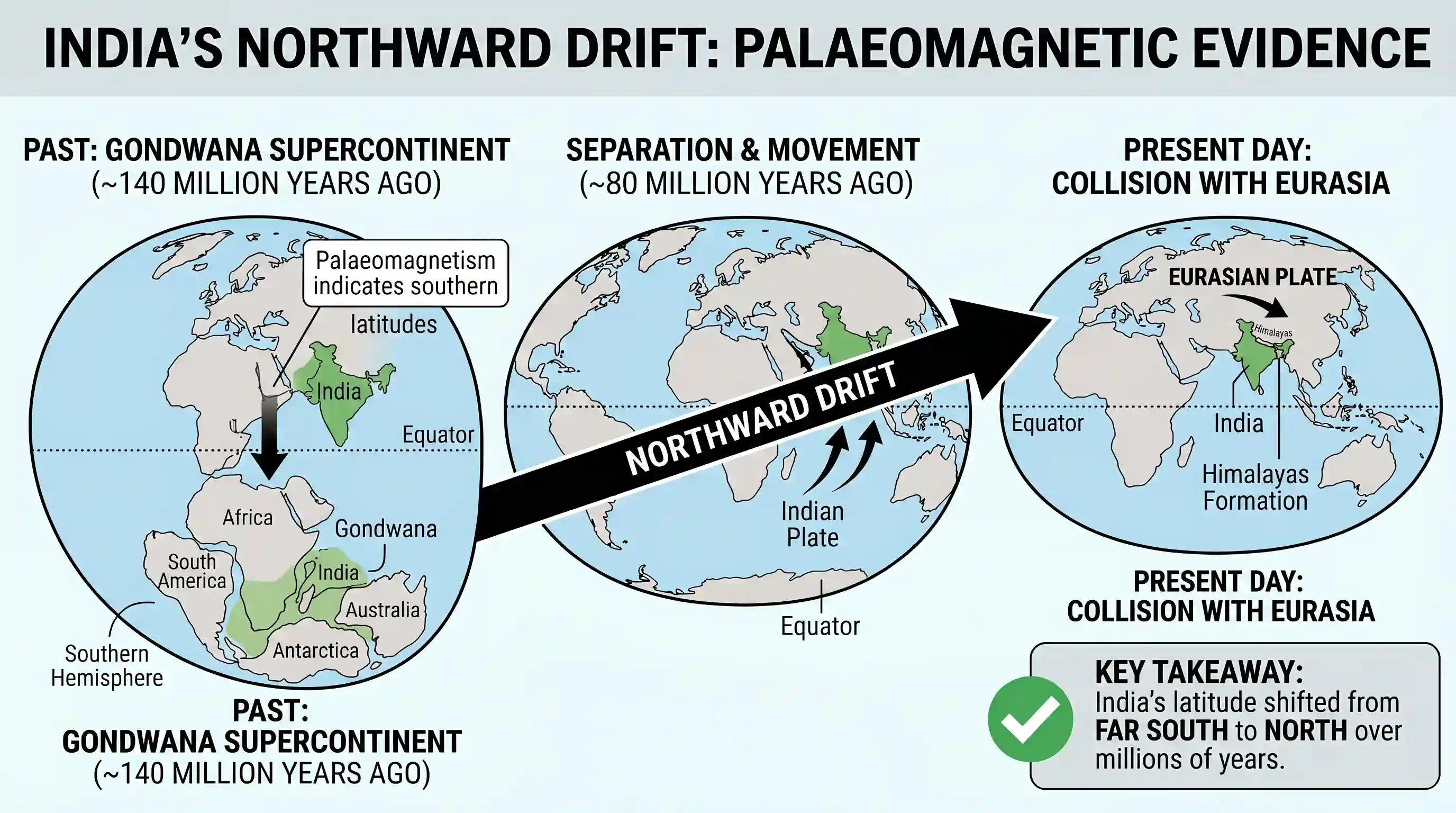
The palaeomagnetic results obtained from India indicate that in the past, the Indian land mass has moved

- AnorthwardCorrect
- Bsouthward
- Ceastward
- Dwestward
Explanation
The correct answer is A because of the theory of Continental Drift and Plate Tectonics. Approximately 200 million years ago, India was part of the supercontinent Gondwana, located in the Southern Hemisphere near Antarctica. Over millions of years, the Indian tectonic plate separated and moved in a northward direction across the equator. Palaeomagnetic studies analyze the alignment of iron minerals in ancient rocks, which act like fossil compasses. These studies confirm that the latitude of the Indian landmass has shifted from the far south to its current northern position, eventually colliding with the Eurasian plate to form the Himalayas.
Related questions
More UPSC Prelims practice from the same subject and topic.
- Prelims 1995GS1geography
The Indian subcontinent was originally part of a huge land mass called
- Prelims 1995GS1geography
A meteor is
- Prelims 1995GS1geography
The Alpine vegetation in the western Himalayas is found only up to a height of 3000 metres, while in the eastern Himalayas it is found up to a height of 4000 metres, The reason for this variation in t…
- Prelims 1995GS1geography
According to the 1991 Census, the highest percentage of population in India is to be found in the age group of
- Prelims 1995GS1geography
The standard time of the following countries is ahead or behind Greenwich Mean Time depending on whether they are east or west of the longitude passing through Greenwich: I. Cuba II. Greece III. Iraq …
- Prelims 1995GS1geography
Which one of the following is the continent with the highest mean elevation in the world?