“By weaving threads of physics, chemistry and biology into a rich tapestry, this remarkable scientist provided a unifying molecular view of the world… He touted the wonderful properties of Vitamin C first as a cure of common cold and later as a preventive agent against cancer.” One of science’s major figures of all time referred to above is

- AG.N. Lewis
- BLinus Carl PaulingCorrect
- CFritz London
- DWalter Heitler
Explanation
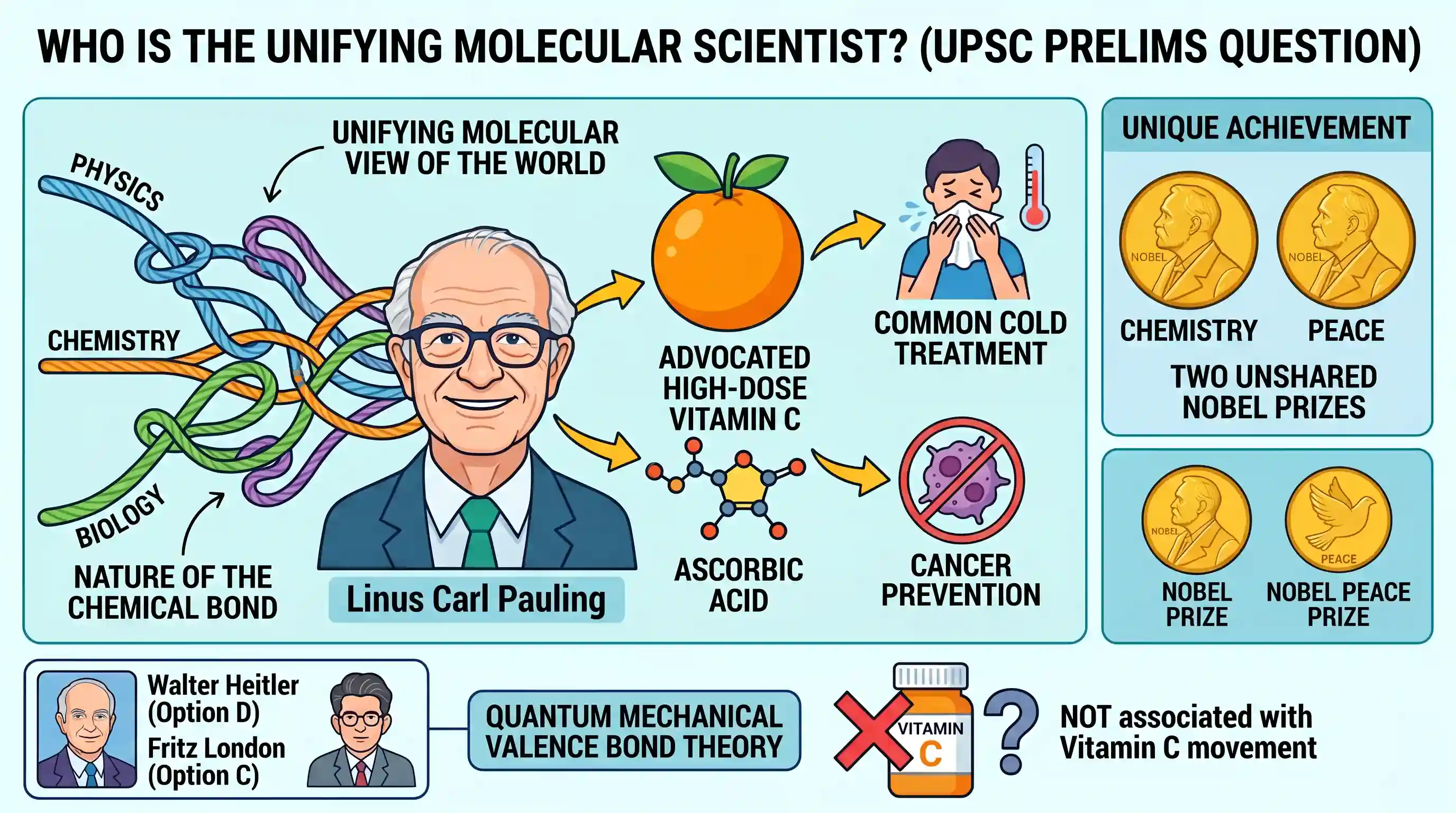
Linus Carl Pauling is the scientist famous for integrating physics, chemistry, and biology through his work on the nature of the chemical bond and molecular structures. He is most widely recognized in popular culture for his controversial and extensive advocacy for high doses of Vitamin C, claiming it could treat the common cold and prevent cancer. He is one of the few individuals to have won two unshared Nobel Prizes, one in Chemistry and one for Peace.
Walter Heitler, option D, worked on the quantum mechanical valence bond theory with Fritz London, but he is not associated with the Vitamin C movement described in the text. Based on the specific details regarding Vitamin C and the unifying molecular view, Linus Pauling is the only figure who fits this description perfectly.
Related questions
More UPSC Prelims practice from the same subject and topic.
- Prelims 1995GS1science-and-technology
The Nobel Prize for deciphering the language of bees was awarded to
- Prelims 1995GS1science-and-technology
Which one of the following is a mixed fertilizer?
- Prelims 1995GS1science-and-technology
The chemical used as a ‘fixer’ in photography is
- Prelims 1995GS1science-and-technology
Which one of the following can be used to confirm whether drinking water contains a gamma emitting isotope or not?
- Prelims 1995GS1science-and-technology
The normal temperature of human body on the Kelvin scale is
- Prelims 1995GS1science-and-technology
When the same note is played on a sitar and a flute, the sound produced can be distinguished from each other because of the difference in