Consider the series given below: 4/12/95, 1/1/96, 29/1/96, 26/2/96... The next term of the series is

- A24/3/96
- B25/3/96Correct
- C26/3/96
- D27/3/96
Explanation
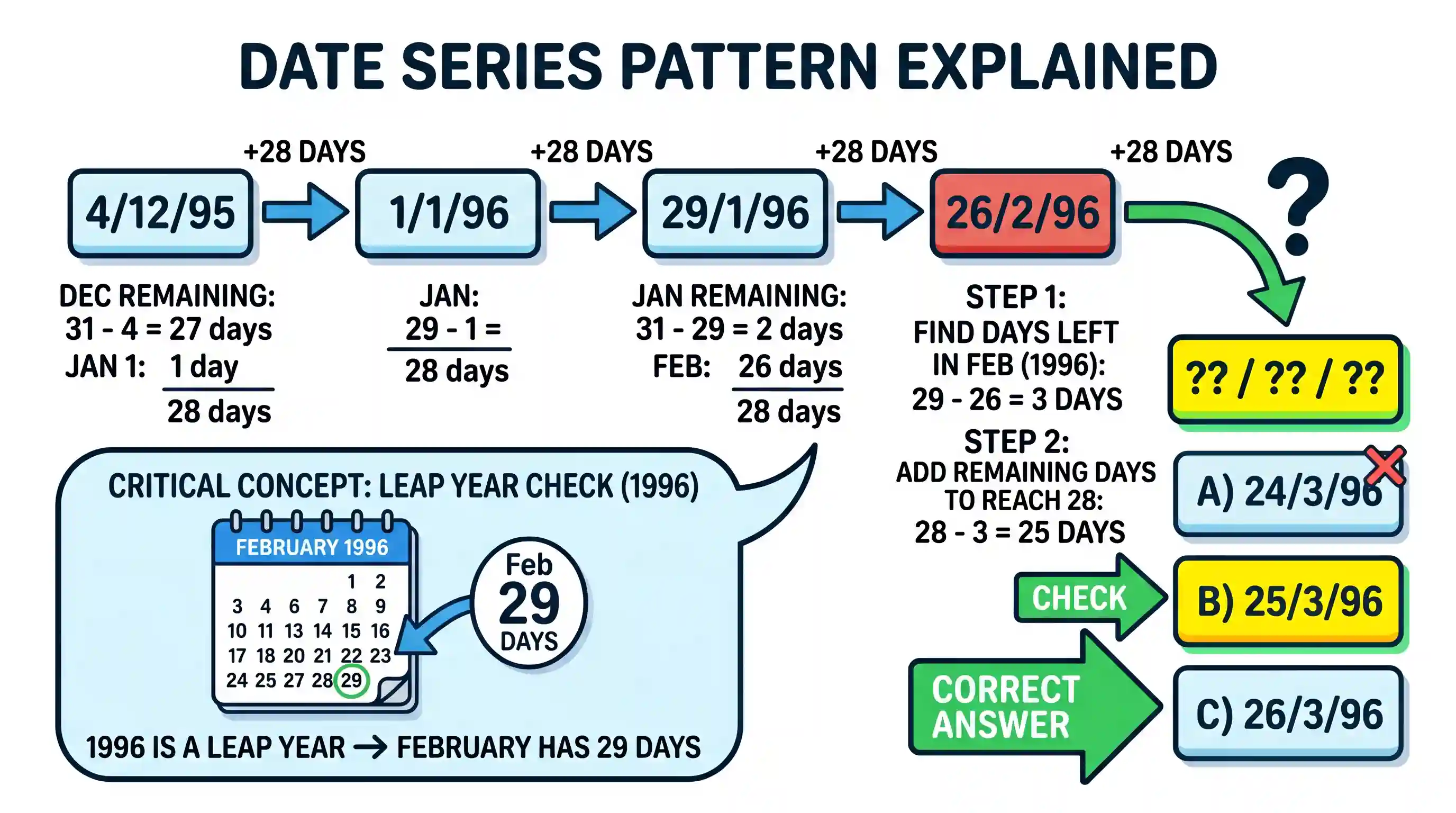
To find the next term, we need to determine the number of days between the consecutive dates in the series.
-
From 4/12/95 to 1/1/96: December has 31 days. Remaining days in December are 31 minus 4, which is 27. Adding the 1 day of January gives a total interval of 28 days.
-
From 1/1/96 to 29/1/96: 29 minus 1 equals 28 days.
-
From 29/1/96 to 26/2/96: January has 31 days. Remaining days in January are 31 minus 29, which is 2. Since 1996 is a leap year, February has 29 days. Adding 24 days of February to the 2 remaining days of January would not work, but adding the 26 days of February to the 2 days of January gives exactly 28 days.
The constant interval is 28 days. To find the next term, add 28 days to 26/2/96: February 1996 has 29 days. Remaining days in February are 29 minus 26, which is 3 days. To complete the 28 day interval, we need 25 more days (28 minus 3).
Therefore, 25 days into the next month is 25/3/96.
The correct option is B.
Related questions
More UPSC Prelims practice from the same subject and topic.
- Prelims 1995GS1science-and-technology
The Nobel Prize for deciphering the language of bees was awarded to
- Prelims 1995GS1science-and-technology
Which one of the following is a mixed fertilizer?
- Prelims 1995GS1science-and-technology
The chemical used as a ‘fixer’ in photography is
- Prelims 1995GS1science-and-technology
Which one of the following can be used to confirm whether drinking water contains a gamma emitting isotope or not?
- Prelims 1995GS1science-and-technology
The normal temperature of human body on the Kelvin scale is
- Prelims 1995GS1science-and-technology
When the same note is played on a sitar and a flute, the sound produced can be distinguished from each other because of the difference in