Which of the following can be inferred from the statement that ‘Either John is stupid or John is lazy’? I. John is lazy / therefore, John is not stupid. II. John is not lazy / therefore, John is stupid. III. John is not stupid / therefore, John is lazy. IV. John is stupid / therefore, John is not lazy. Choose the correct answer from the codes given below: Codes:

- AI and II
- BII and IIICorrect
- CIII and IV
- DI and IV
Explanation
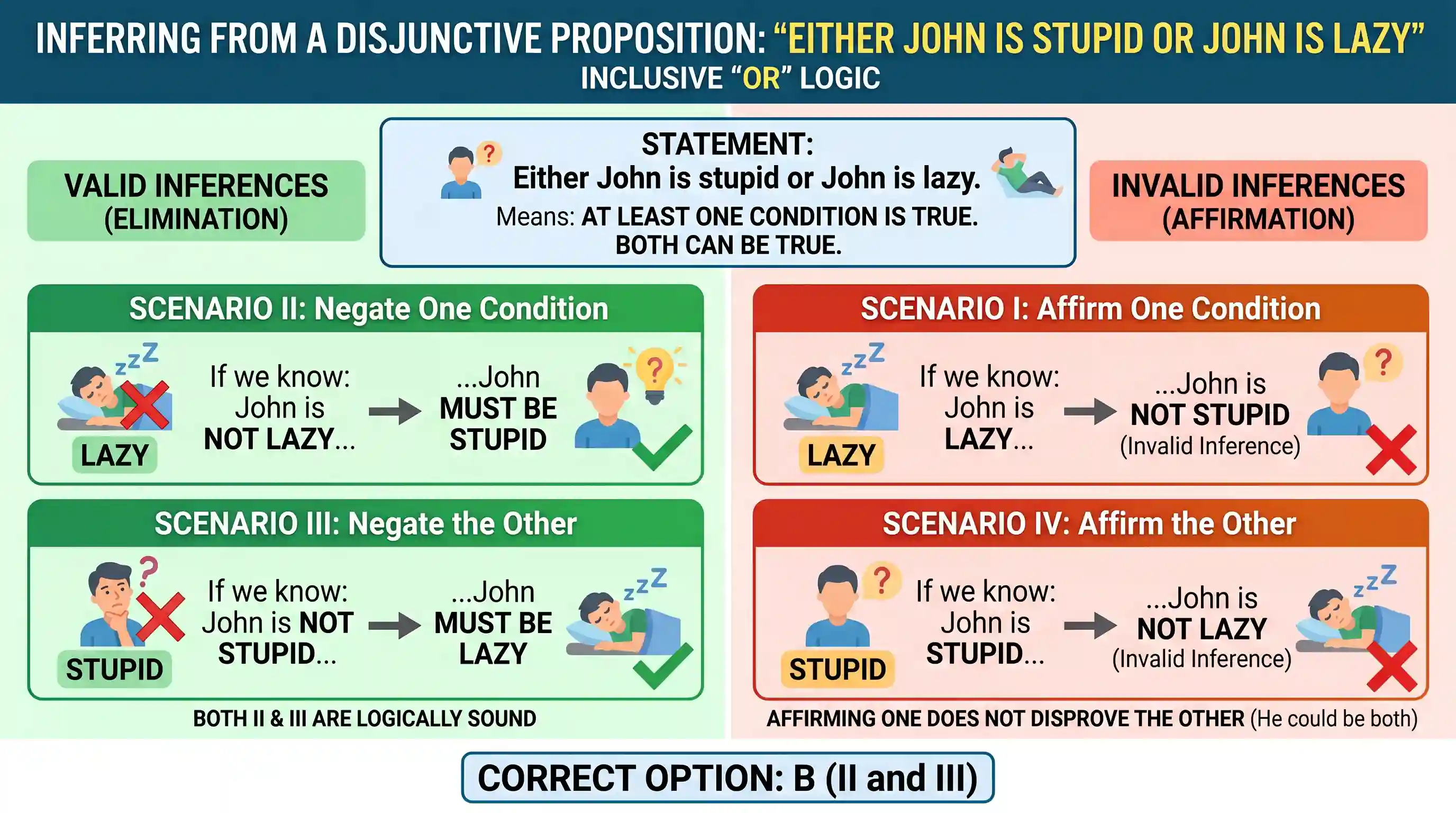
The statement Either John is stupid or John is lazy is a disjunctive proposition. In logic, this is typically treated as an inclusive or, meaning at least one of the conditions must be true.
To draw a valid inference from such a statement, you must use the process of elimination. If you negate one option, the other must necessarily be true to satisfy the original statement.
Looking at the options:
Statement II is valid because if we know John is not lazy, the only way for the original statement to remain true is if John is stupid.
Statement III is valid because if we know John is not stupid, he must be lazy to satisfy the condition.
Statements I and IV are invalid because proving one condition does not automatically disprove the other. In an inclusive or, John could potentially be both stupid and lazy.
Therefore, only II and III are logically sound inferences. The correct answer is B.
Related questions
More UPSC Prelims practice from the same subject and topic.
- Prelims 1995GS1science-and-technology
The Nobel Prize for deciphering the language of bees was awarded to
- Prelims 1995GS1science-and-technology
Which one of the following is a mixed fertilizer?
- Prelims 1995GS1science-and-technology
The chemical used as a ‘fixer’ in photography is
- Prelims 1995GS1science-and-technology
Which one of the following can be used to confirm whether drinking water contains a gamma emitting isotope or not?
- Prelims 1995GS1science-and-technology
The normal temperature of human body on the Kelvin scale is
- Prelims 1995GS1science-and-technology
When the same note is played on a sitar and a flute, the sound produced can be distinguished from each other because of the difference in