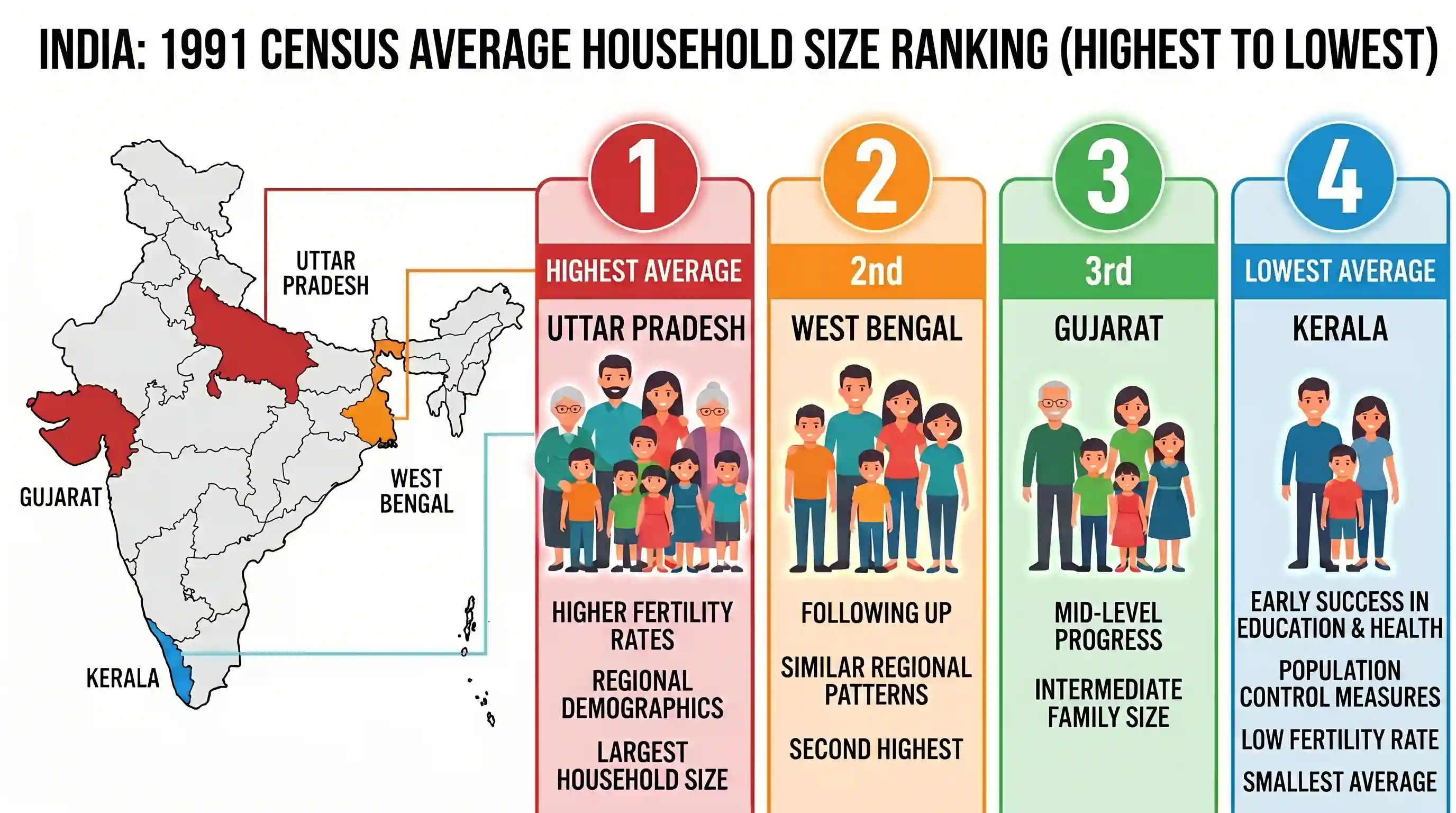
As per the 1991 Census, the average size of households in terms of number of persons per household in respect of the given states follows the sequence (highest first, lowest last).

- AHaryana, Uttar Pradesh, Kerala, Tamil Nadu
- BUttar Pradesh, West Bengal, Gujarat, KeralaCorrect
- CGujarat, Haryana, Uttar Pradesh, West Bengal
- DUttar Pradesh, West Bengal, Tamil Nadu, Kerala
Explanation
The correct answer is B because it reflects the demographic transition patterns in India as recorded in the 1991 Census. During that period, northern and eastern states generally had higher fertility rates leading to larger family sizes, while southern states had progressed further in family planning.
In the 1991 Census data, Uttar Pradesh had the highest average household size among the options, exceeding 6 persons per household. West Bengal followed with a slightly lower average. Gujarat occupied a middle position, while Kerala had the lowest average household size among these states due to its early success in education, healthcare, and population control measures. Therefore, the sequence Uttar Pradesh, West Bengal, Gujarat, Kerala correctly ranks them from the highest to the lowest average household size.
Related questions
More UPSC Prelims practice from the same subject and topic.
- Prelims 1996GS1geography
‘They are fantastically diverse. They speak hundreds of languages and dialects. They comprise scores of ethnic groups. They include highly industrialised economies and up-and-coming economies. They sp…
- Prelims 1996GS1geography
Which one of the following sets of commodities are exported to India by arid and semi-arid countries in the Middle East?
- Prelims 1996GS1geography
Which of the following pairs of states and their important crops are correctly matched? I. Kerala: Tapioca II. Maharashtra: Cotton III. W. Bengal: Jute IV. Gujarat: Groundnut Select the correct answer…
- Prelims 1996GS1geography
Which one of the following rivers thrice forks into two streams and reunites a few miles farther on, thus forming the islands of Srirangappattanam, Sivasamudram and Srirangam?
- Prelims 1996GS1geography
As per the 1991 Census, which one of the following states has a lower population density than the other three?
- Prelims 1996GS1geography
Which one of the following layers of the atmosphere is responsible for the deflection of radio waves?