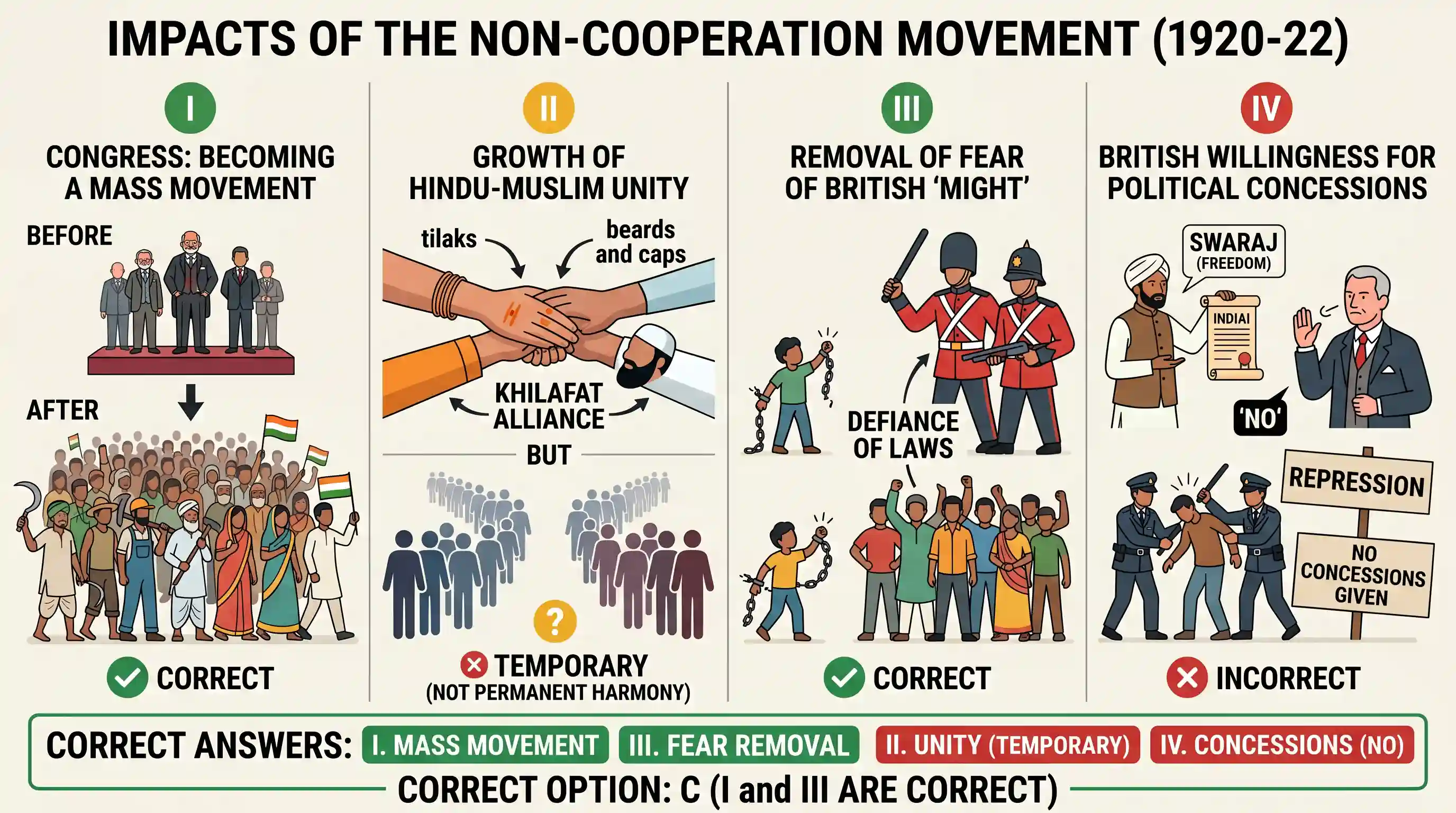
Consider the following statements: The Non-cooperation Movement led to the I. Congress becoming a mass movement for the first time. II. growth of Hindu Muslim unity. III. removal of fear of the British ‘might’ from the minds of the people. IV. British government’s willingness to grant political concessions to Indians. Of these statements

- AI, II, III and IV are correct
- BII and II are correct
- CI and III are correctCorrect
- DIII and IV are correct
Explanation
The Non cooperation Movement marked a significant shift in the Indian struggle for independence. Statement I is correct because Gandhi transformed the Congress from an elite group into a mass based organization by involving peasants and workers for the first time. Statement III is correct because the movement encouraged people to defy laws and face imprisonment, which effectively broke the psychological fear of British authority and their perceived invincibility.
Regarding the other points, while Hindu Muslim unity was visible during the movement due to the Khilafat alliance, it was temporary and did not lead to permanent communal harmony, making Statement II less definitive in a historical sense. Statement IV is incorrect because the British government did not show any immediate willingness to grant political concessions; instead, they responded with heavy repression and the movement ended without achieving its immediate goal of Swaraj. Therefore, Statements I and III are the primary and most accurate impacts of the movement.
Related questions
More UPSC Prelims practice from the same subject and topic.
- Prelims 1996GS1history
The meeting of Indian and British political leaders during 1930-32 in London has often been referred to as the First. Second and Third Round Table Conferences. It would be incorrect to refer to them a…
- Prelims 1996GS1history
Who among the following was a prominent leader of the Congress Socialist Party?
- Prelims 1996GS1history
Consider the following landmarks in Indian education: i) Hindu College, Calcutta ii) University of Calcutta iii) Adam’s Report iv) Wood’s Despatch The correct chronological order of these landmarks is
- Prelims 1996GS1history
Match List I with List II and select the correct answer by using the codes given below the lists: List I List II I. Surendranath Bannerjee A) Hind Swaraj II. M. K. Gandhi B) The Indian Struggle III. S…
- Prelims 1996GS1history
Consider the following statements about Jawaharlal Nehru: I. He was the President of the Congress Party in 1947. II. He presided over the Constituent Assembly. III. He formed the first Congress Minist…
- Prelims 1996GS1history
Which one of the following is not correct about the Cabinet Mission Plan?