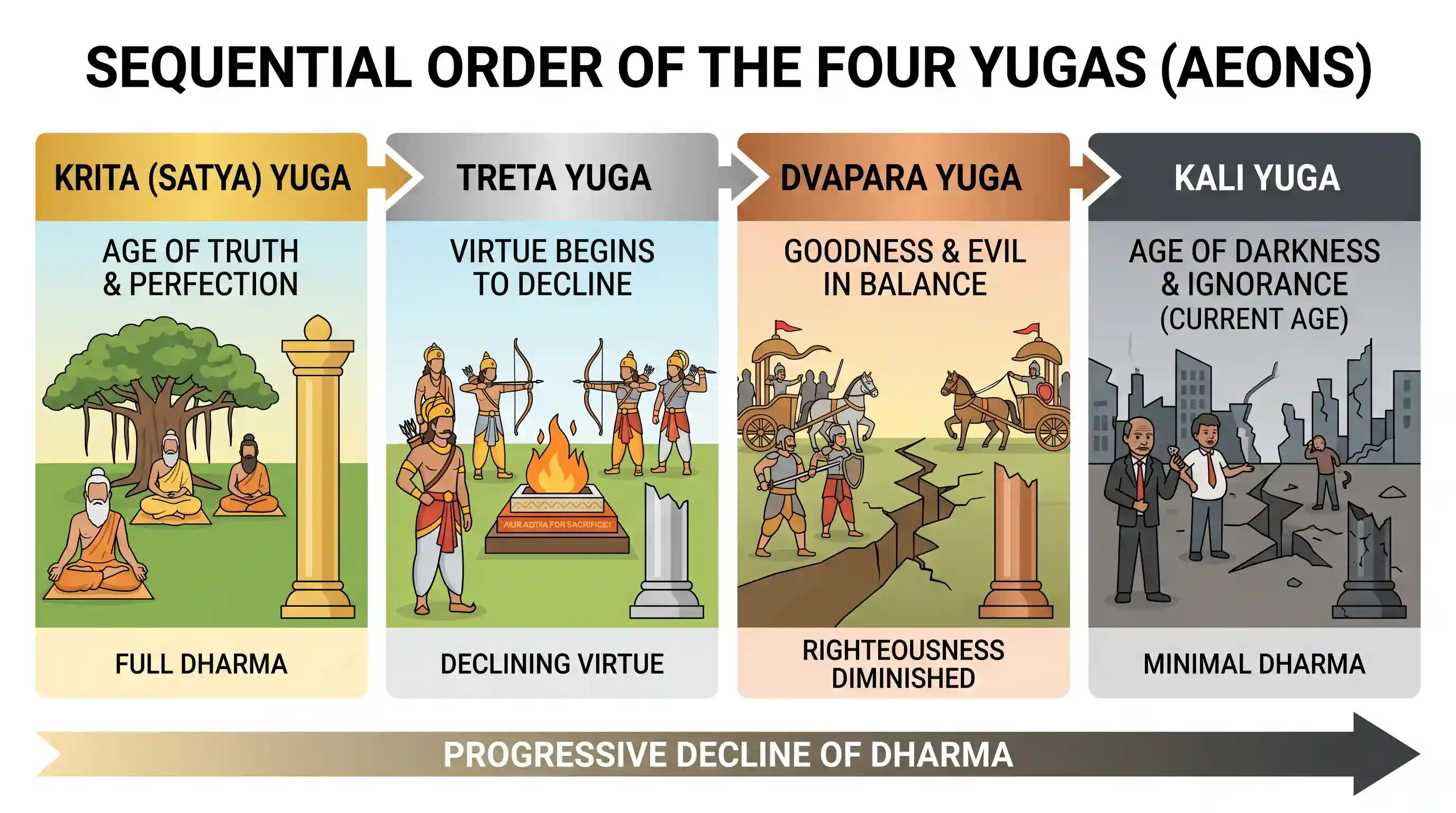
According to ancient Indian cosmogonic ideas the sequential order of the cycle of four aeons (Yugas) is

- ADvapara, Krita, Treta and Kali
- BKrita, Dvapara, Treta and Kali
- CKrita, Treta, Dvapara and KaliCorrect
- DTreta, Dvapara, Kali and Krita
Explanation
The correct answer is C because it follows the traditional chronological order of the four ages in a Maha Yuga as described in ancient Indian texts like the Puranas and the Laws of Manu.
The sequence begins with the Krita Yuga also known as Satya Yuga which is the age of truth and perfection. This is followed by the Treta Yuga where virtue begins to decline. Next is the Dvapara Yuga where goodness and evil are in balance. The cycle ends with the Kali Yuga which is the current age of darkness and ignorance.
The order is determined by the gradual decrease in dharma or righteousness across the four periods. Krita, Treta, Dvapara, and Kali represent the transition from the highest moral state to the lowest before the cycle resets.
Related questions
More UPSC Prelims practice from the same subject and topic.
- Prelims 1996GS1history
The river most mentioned in early Vedic literature is
- Prelims 1996GS1history
In the context of ancient Indian society, which one of the following terms does not belong to the category of the other three?
- Prelims 1996GS1history
Who among the following is known for his work on medicine during the Gupta period?
- Prelims 1996GS1history
Match List I with List II and select the correct answer by using the codes given below the lists: List I I. Visakhadatta II. Varahamihira III. Charaka IV. Brahmagupta List II A) Medicine B) Drama C) A…
- Prelims 1996GS1history
Which one of the following was a Saiva sect in ancient India?
- Prelims 1996GS1history
Which one of the following texts of ancient India allows divorce to a wife deserted by her husband?