The Eighth Five-Year Plan is different from the earlier ones. The critical difference lies in the fact that

- Ait has a considerably larger outlay compared to the earlier plans
- Bit has a major thrust on agricultural and rural development
- Cconsiderable emphasis is placed on infrastructure growthCorrect
- Dindustrial licensing has been abolished
Explanation
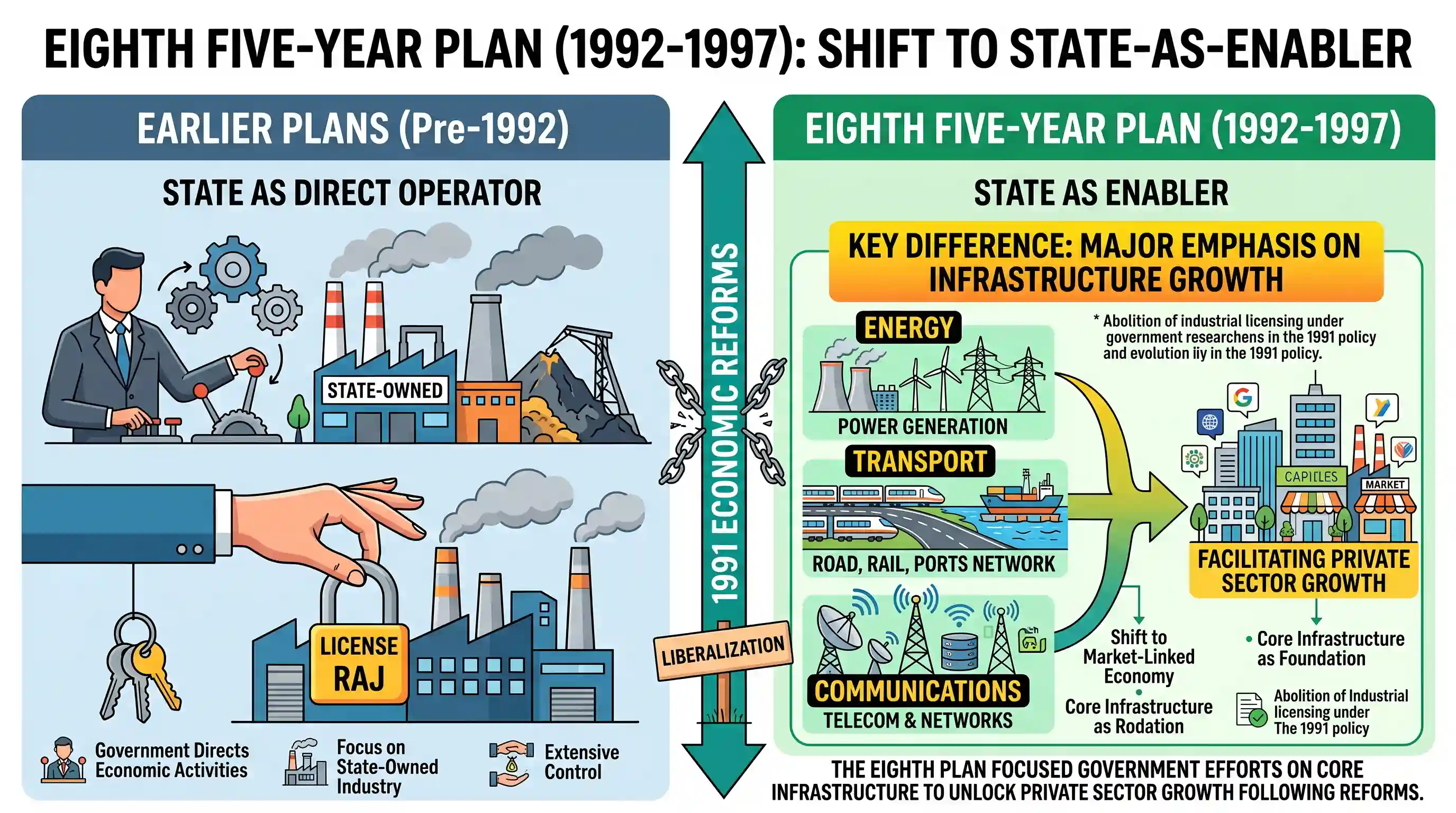
The Eighth Five Year Plan 1992 to 1997 was launched immediately after the 1991 economic reforms. While earlier plans focused heavily on direct government control over the industrial sector, the Eighth Plan shifted the state's role towards becoming an enabler.
The critical difference was the transition to a market linked economy where the government focused on developing core infrastructure such as energy, transport, and communications to facilitate private sector growth. While industrial licensing was indeed abolished during this period, that was a policy change under the 1991 New Economic Policy rather than a defining structural characteristic of the Eighth Plan itself. The plan specifically prioritized infrastructure as the foundation for the new liberalized economic model.
Related questions
More UPSC Prelims practice from the same subject and topic.
- Prelims 1996GS1economy
Which one of the following is correct regarding stabilization and structural adjustment as two components of the new economic policy adopted in India?
- Prelims 1996GS1economy
A redistribution of income in a country can be best brought about through
- Prelims 1996GS1economy
The following Table shows the percentage distribution of revenue expenditure of Government of India in 1989-90 and 1994-95: | Years | Defence | Interest | Subsidies | Grants to | | :--- | :--- | :--- …
- Prelims 1996GS1economy
Assertion (A): An important policy instrument of economic liberalization is reduction in import duties on capital goods. Reason (R): Reduction in import duties would help the local entrepreneurs to im…
- Prelims 1996GS1economy
One of the important goals of the economic liberalisation policy is to achieve full convertibility of the Indian rupee. This is being advocated because
- Prelims 1996GS1economy
The emerging trading blocs in the world, such as NAFTA, ASEAN and the like, are expected to