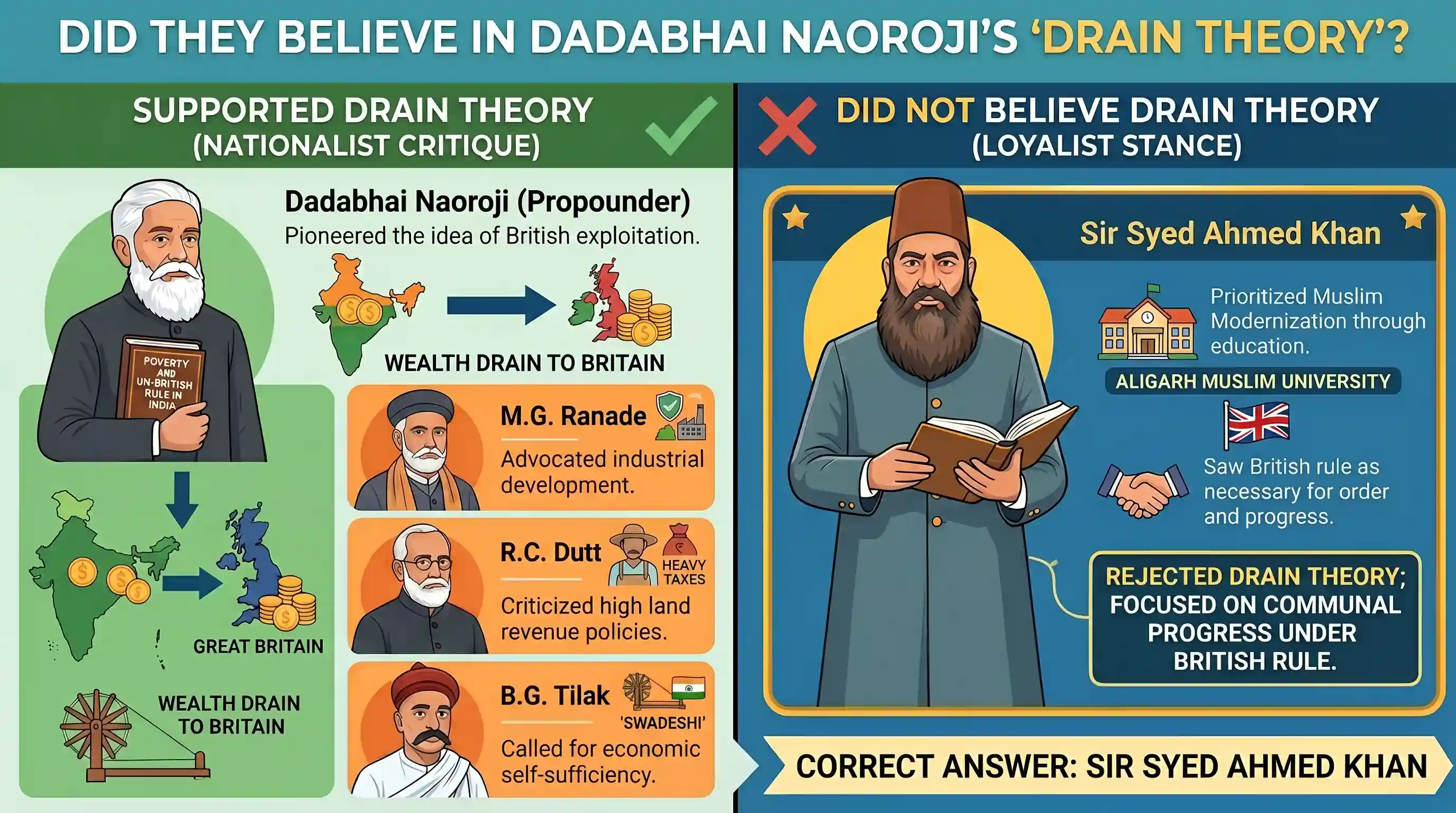
Who among the following leaders did not believe in the drain theory of Dadabhai Naoroji?

- AB.G. Tilak
- BR.C. Dutt
- CM.G. Ranade
- DSir Syed Ahmed KhanCorrect
Explanation
The correct answer is D because Sir Syed Ahmed Khan was a firm believer in the benefits of British rule for the modernization and progress of the Indian Muslim community. Unlike the nationalist leaders like Tilak, Dutt, and Ranade, who supported the economic critique of British rule, Sir Syed Ahmed Khan maintained a loyalist stance toward the British government. He believed that British presence was necessary for stability and feared that opposing British economic policies would be detrimental to the interests of Muslims. Therefore, he did not subscribe to the Drain Theory, which argued that Britain was systematically looting India's wealth.
Related questions
More UPSC Prelims practice from the same subject and topic.
- Prelims 1996GS1history
The meeting of Indian and British political leaders during 1930-32 in London has often been referred to as the First. Second and Third Round Table Conferences. It would be incorrect to refer to them a…
- Prelims 1996GS1history
Who among the following was a prominent leader of the Congress Socialist Party?
- Prelims 1996GS1history
Consider the following landmarks in Indian education: i) Hindu College, Calcutta ii) University of Calcutta iii) Adam’s Report iv) Wood’s Despatch The correct chronological order of these landmarks is
- Prelims 1996GS1history
Match List I with List II and select the correct answer by using the codes given below the lists: List I List II I. Surendranath Bannerjee A) Hind Swaraj II. M. K. Gandhi B) The Indian Struggle III. S…
- Prelims 1996GS1history
Consider the following statements about Jawaharlal Nehru: I. He was the President of the Congress Party in 1947. II. He presided over the Constituent Assembly. III. He formed the first Congress Minist…
- Prelims 1996GS1history
Which one of the following is not correct about the Cabinet Mission Plan?