Assertion (A): The word ‘minority’ is not defined in the Constitution of India. Reason (R): The Minorities Commission is not a constitutional body. In the context of the above two statements, which one of the following is correct?

- ABoth A and R are true and R is the correct explanation of A
- BBoth A and R are true but R is not a correct explanation of ACorrect
- CA is true but R is false
- DA is false but R is true
Explanation
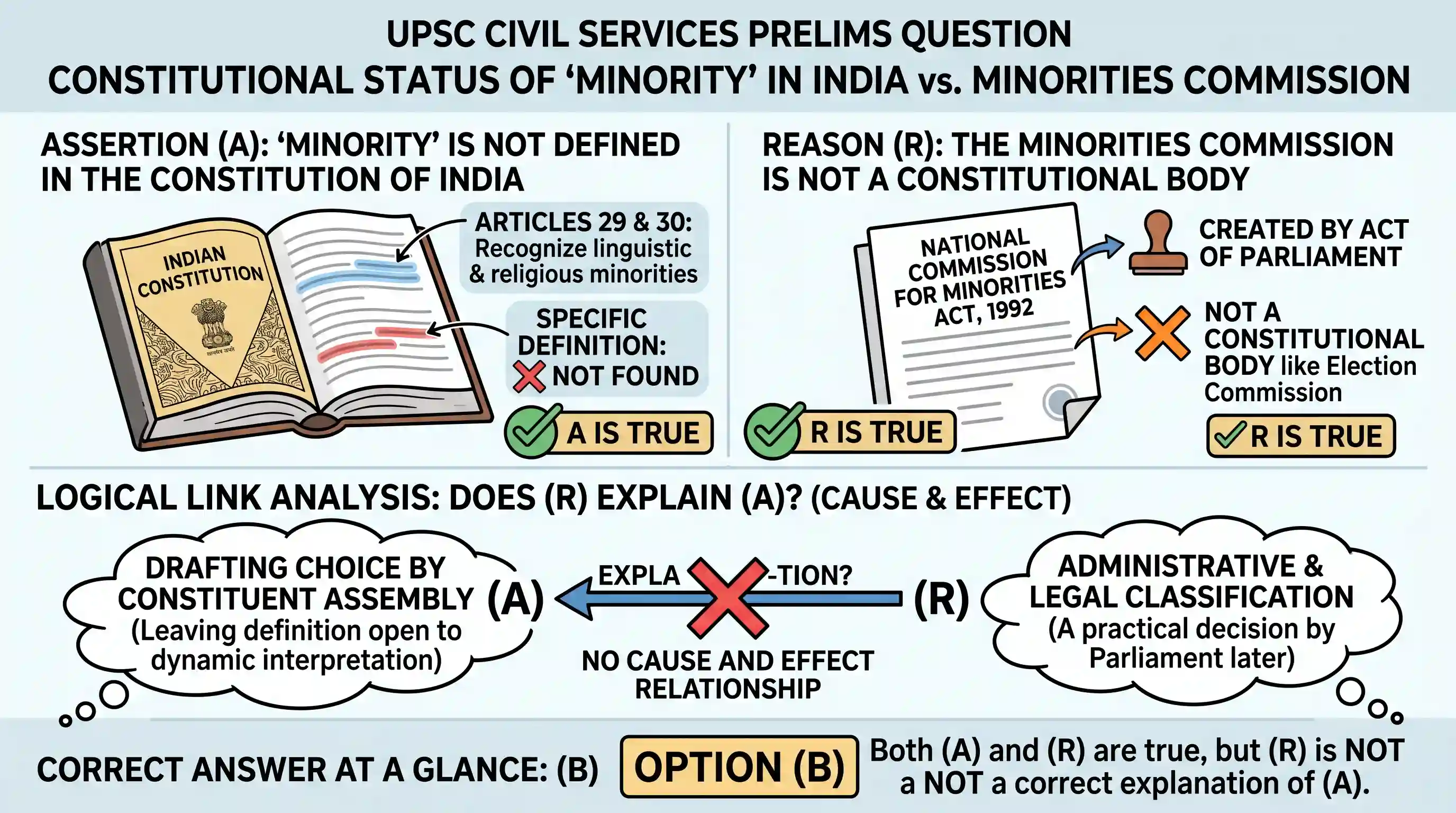
Statement A is true because while the Constitution of India mentions linguistic and religious minorities in Article 29 and Article 30, it does not provide a specific definition for the word minority.
Statement R is also true because the National Commission for Minorities is a statutory body created by an Act of Parliament in 1992, rather than a constitutional body established by an Article within the Constitution.
However, B is the correct answer because the status of the Commission as a non-constitutional body does not explain why the term remains undefined in the Constitution. The lack of a definition is a drafting choice of the constituent assembly, while the nature of the Commission is a matter of administrative and legal classification. There is no cause and effect relationship between the two facts.
Related questions
More UPSC Prelims practice from the same subject and topic.
- Prelims 1996GS1polity-and-governance
If the number of seats allocated to a state in the Lok Sabha is 42, then the number of seats reserved for the Scheduled Castes in that state will be
- Prelims 1996GS1polity-and-governance
What is the system of governance in the Panchayati Raj setup?
- Prelims 1996GS1polity-and-governance
Which one of the following has legalised euthanasia?
- Prelims 1996GS1polity-and-governance
The average of X1, X2 and X3 is 14. Twice the sum of X2 and X3 is 30. What is the value of X1?
- Prelims 1996GS1polity-and-governance
In the Indian context the term De-notified tribes refers to
- Prelims 1996GS1polity-and-governance
The power of the Supreme Court of India to decide disputes between the Centre and the States falls under its