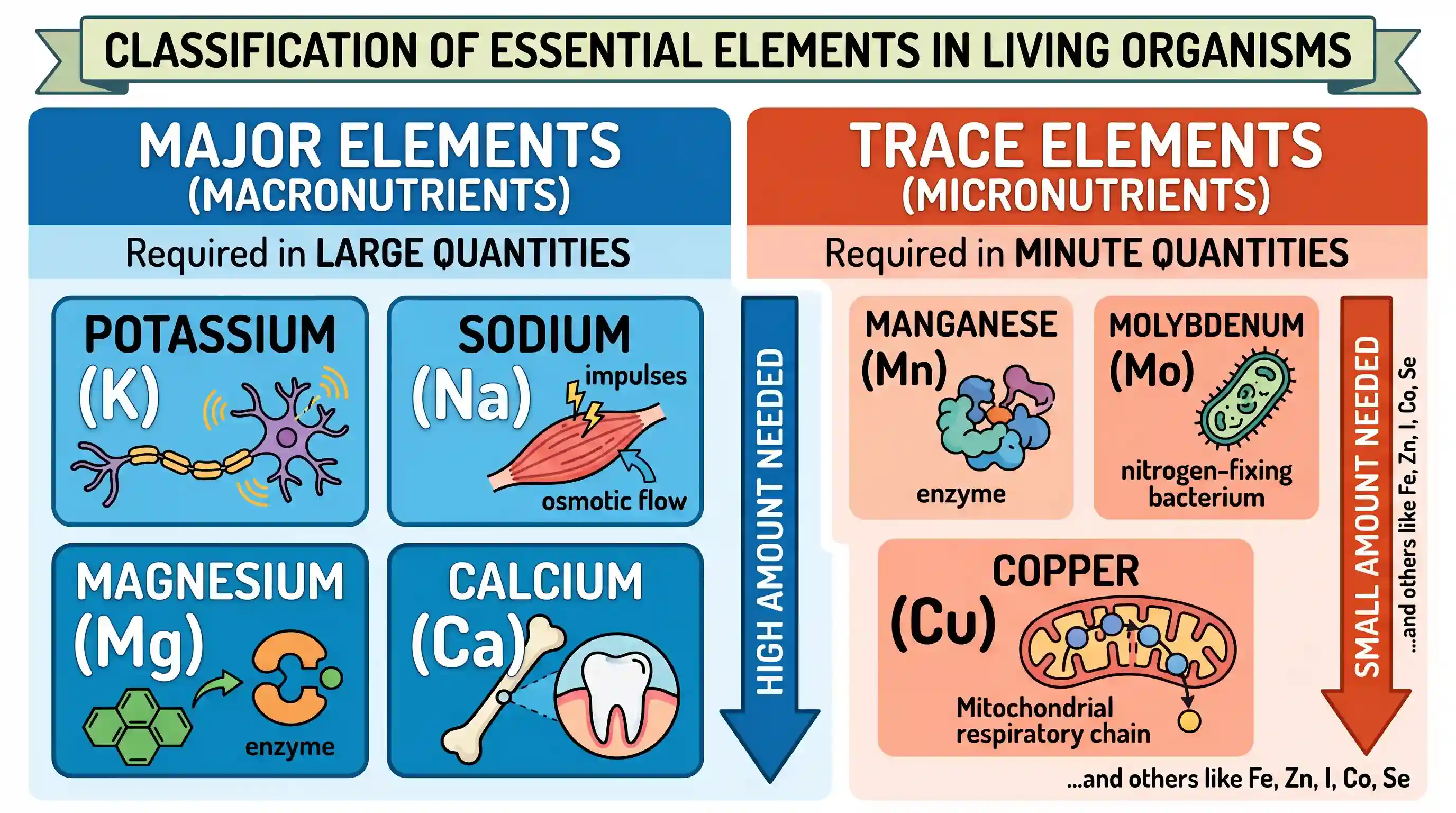
Living organisms require at least 27 elements of which 15 are metals. Among these, those required in major quantities include

- APotassium, Manganese, Molybdenum | Calcium
- BPotassium, Molybdenum, Copper | Calcium
- CPotassium, Sodium, Magnesium | CalciumCorrect
- DSodium, Magnesium, Copper | Manganese
Explanation
The correct option is C because it lists elements categorized as macronutrients or major elements required by living organisms.
In biological systems, elements like Potassium, Sodium, Magnesium, and Calcium are needed in relatively large amounts to maintain cellular functions, osmotic balance, and structural integrity.
The other options are incorrect because they include elements like Manganese, Molybdenum, and Copper. These are classified as micronutrients or trace elements, which are required by the body in very minute quantities. Therefore, Option C is the only group consisting entirely of major elements.
Related questions
More UPSC Prelims practice from the same subject and topic.
- Prelims 1996GS1science-and-technology
Which one of the following is a modified stem?
- Prelims 1996GS1science-and-technology
Fat present below the skin surface in our body, acts as a barrier against
- Prelims 1996GS1science-and-technology
Which of the following professional (s) are more likely to run the risk of a permanent change in their cell’s DNA? I. Researchers using carbon-14 isotope II. X-ray technician III. Coal miner IV. Dyer …
- Prelims 1996GS1science-and-technology
Which one of the following is not an essential micronutrient for plants?
- Prelims 1996GS1science-and-technology
Of the four landmarks in medical history given below, which one was the first to take place?
- Prelims 1996GS1science-and-technology
Match List I with List II and select the correct answer by using codes given below the lists: List I I. Vitamin A) Pepsin II. Enzyme B) Carotene III. Hormone C) Keratin IV. Protein D) Progesterone Cod…