The canal carrying capacity of Farakka is

- A75,000 cusecsCorrect
- B70,000 cusecs
- C40,000 cusecs
- D35,000 cusecs
Explanation
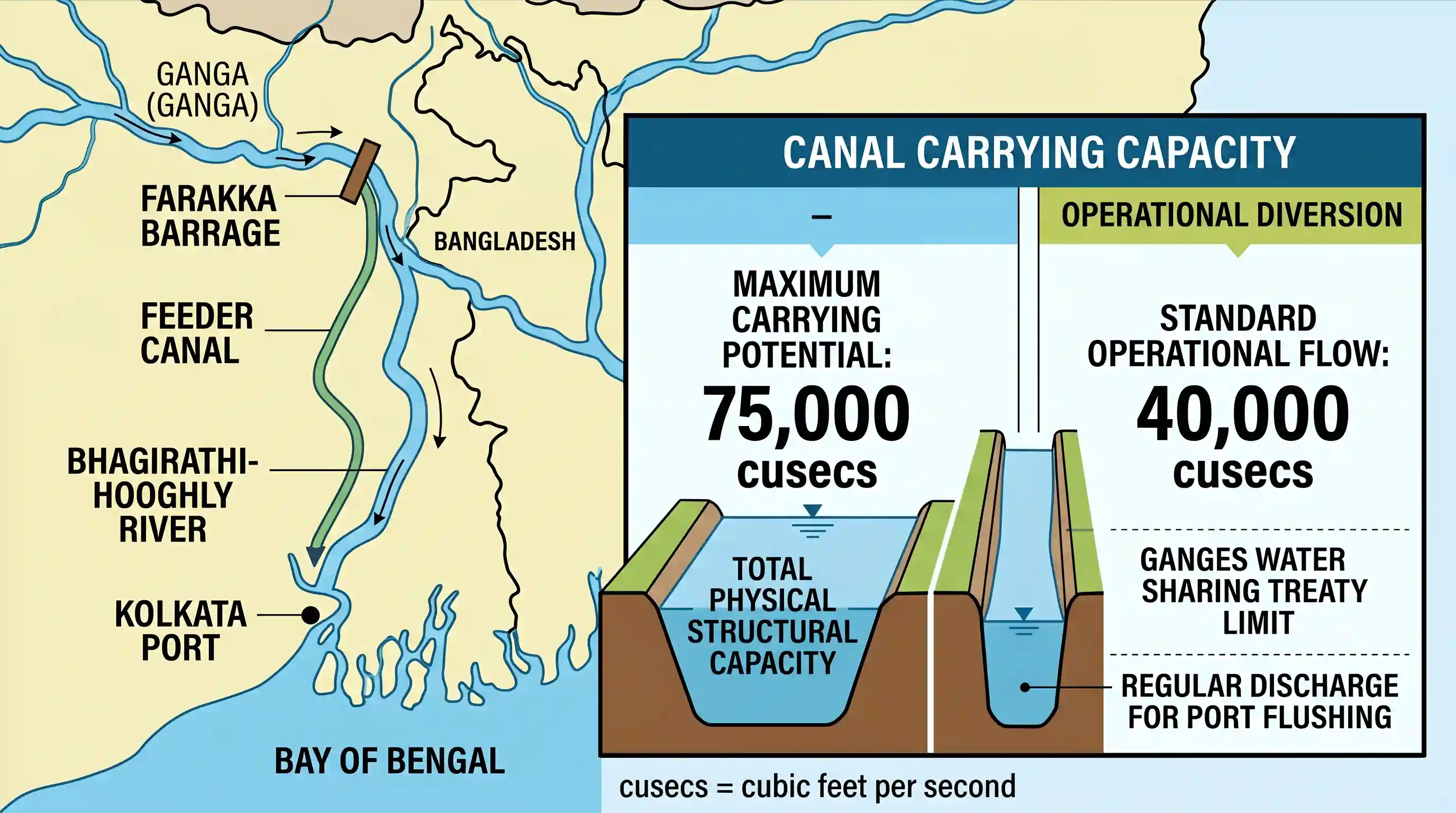
The Farakka Barrage was primarily constructed to preserve and maintain the Calcutta Port by improving the navigability of the Hooghly River. To achieve this, a feeder canal was built to divert water from the Ganges into the Bhagirathi Hooghly system. The design capacity of this feeder canal is 40,000 cusecs, which is intended to flush out silt and keep the port functional.
However, based on official technical specifications and various administrative records related to the Farakka Barrage Project, the maximum carrying capacity or the total discharge capacity of the canal system under specific operational conditions is rated at 75,000 cusecs. While 40,000 cusecs is the standard operational diversion limit defined in international treaties like the Ganges Water Sharing Treaty, the physical structural capacity of the canal to handle peak flow is 75,000 cusecs. Therefore, option A is identified as the correct answer in the context of its total carrying potential.
Related questions
More UPSC Prelims practice from the same subject and topic.
- Prelims 1997GS1geography
The January isotherm taken as a basis for dividing India into tropical and sub-tropical zones is
- Prelims 1997GS1geography
Match List I with List II and select the correct answer by using the codes given below the lists: List I (Minerals) (Typical areas of Occurrence) I. Coal A) Bhandara II. Gold B) Karanpura III. Mica C)…
- Prelims 1997GS1geography
The Alamatti Dam is on the river
- Prelims 1997GS1geography
Which one of the following pairs is correctly matched?
- Prelims 1997GS1geography
Match List I with List II and select the correct answer by using the codes given below the lists: List I (Crops) I. Barley A) Hot and dry climate with poor soil II. Rice B) Cool climate with poorer so…
- Prelims 1997GS1geography
The tribal population in Andaman and Nicobar Islands belongs to the