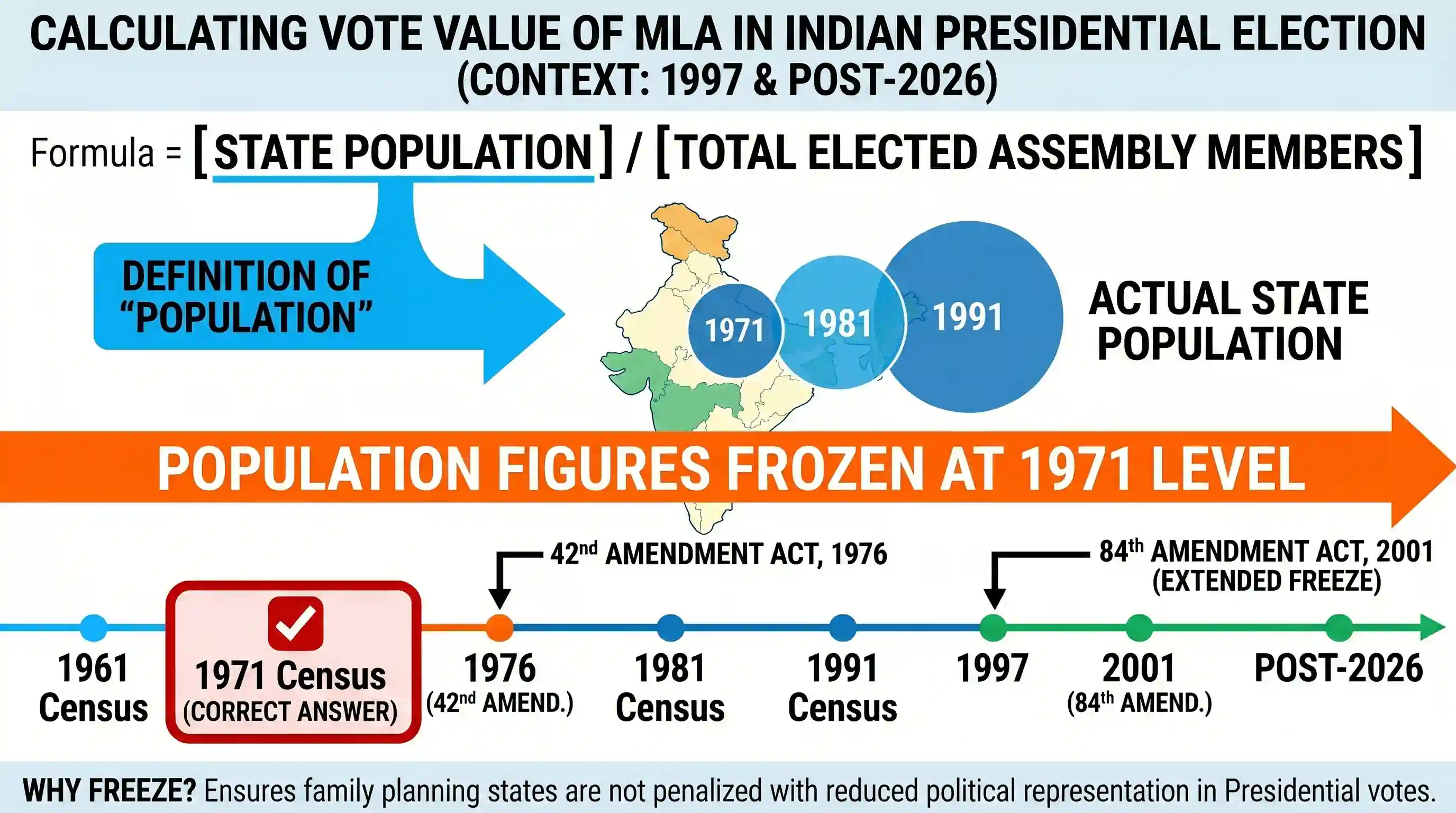
In the Presidential election in India, every elected member of the Legislative Assembly of a State shall have as many votes as there are multiples of one thousand in the quotient obtained by dividing the population of the State by the total number of the elected members of the Assembly. As at present (1997) the expression “population” here means the population as ascertained by the

- A1991 Census
- B1981 Census
- C1971 CensusCorrect
- D1961 Census
Explanation
The correct answer is C because of the 42nd Amendment Act of 1976. This amendment froze the population figures used for calculating the value of votes in Presidential elections at the 1971 Census level. This was done to ensure that states implementing family planning measures were not penalized with a decrease in political representation. Although the question refers to 1997, this freeze was later extended until the first census after 2026 by the 84th Amendment Act of 2001. Therefore, the 1971 Census remains the current standard for defining population in this context.
Related questions
More UPSC Prelims practice from the same subject and topic.
- Prelims 1997GS1polity-and-governance
M.C. Setalvad, B.N. Rao and Alladi Krishnaswamy Iyer were distinguished members of the
- Prelims 1997GS1polity-and-governance
Assertion (A): The reservation of thirty-three per cent of seats for women in Parliament and State Legislatures does not require Constitutional amendment. Reason (R): Political parties contesting elec…
- Prelims 1997GS1polity-and-governance
Which one of the following are/is stated in the Constitution of India? I. The President shall not be a member of either House of Parliament. II. The Parliament shall consist of the President and two H…
- Prelims 1997GS1polity-and-governance
Match List I with List II and select the correct answer by using the codes given below the lists: List I List II (Functionaries) (Oaths or affirmations) I. President of India A) Secrecy of Information…
- Prelims 1997GS1polity-and-governance
In the following quotation, “WE, THE PEOPLE OF INDIA, having solemnly resolved to constitute India into a Sovereign Socialist Secular Democratic Republic and to secure to all its citizens: JUSTICE, so…
- Prelims 1997GS1polity-and-governance
In which of the following countries will the no confidence motion to bring down the government passed by the legislature be valid only when the legislature is able to find simultaneously a majority to…