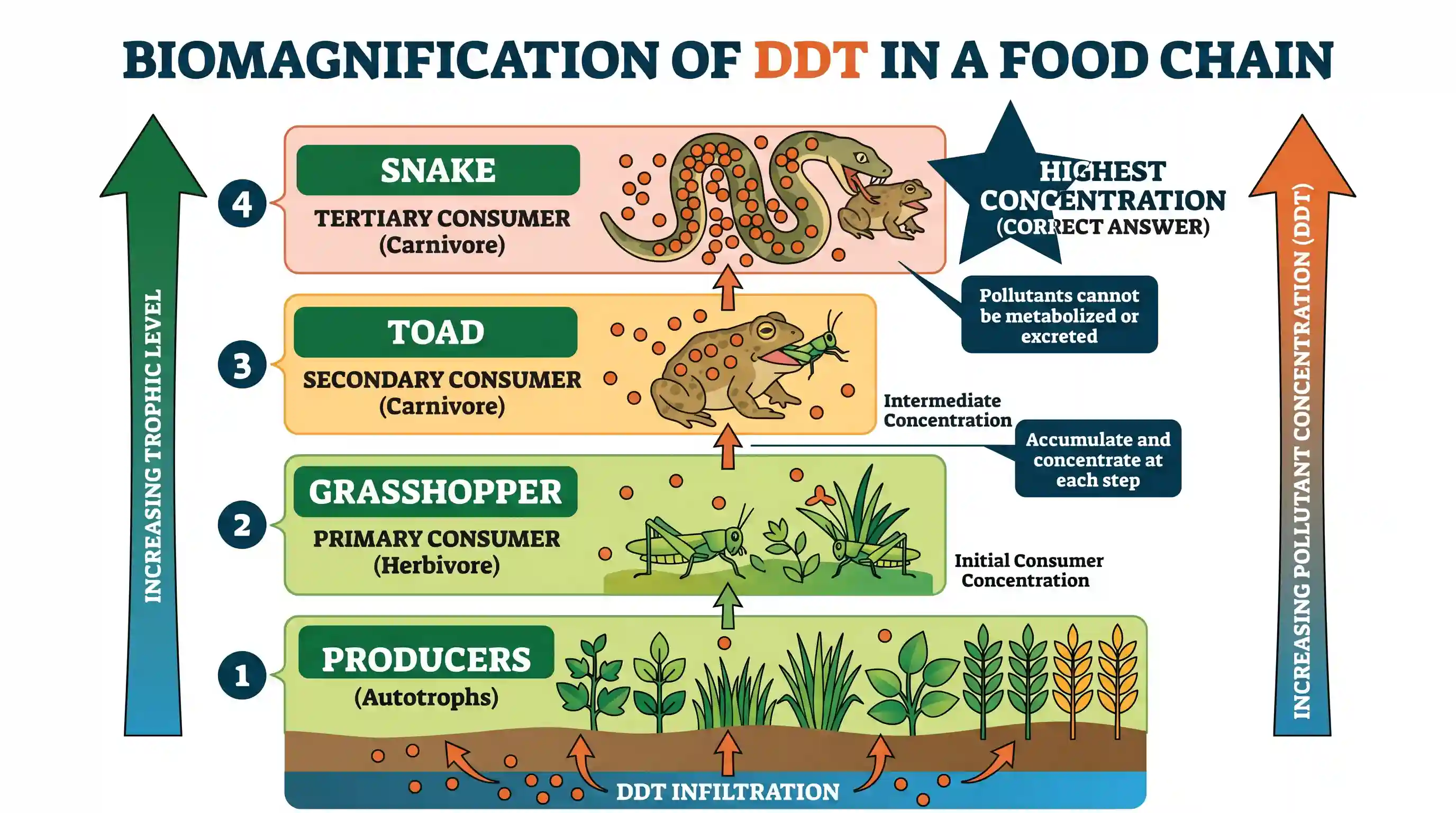
Which one of the following organisms is likely to show the highest- concentration of DDT once it has been introduced into the ecosystem?

- AGrasshopper
- BToad
- CSnakeCorrect
- DCattle
Explanation
This is explained by the process of biomagnification. When a non-biodegradable pollutant like DDT enters a food chain, its concentration increases at each successive trophic level because the pollutant cannot be metabolized or excreted by organisms.
In this specific food chain, the grasshopper is a primary consumer that eats plants. The toad is a secondary consumer that eats the grasshopper. The snake is a tertiary consumer that eats the toad. Since the snake occupies the highest trophic level among the options provided, it would naturally accumulate the highest concentration of DDT.
Related questions
More UPSC Prelims practice from the same subject and topic.
- Prelims 1997GS1geography
About 50% of the world population is concentrated between the latitudes of
- Prelims 1997GS1geography
Match List I with List II and select the correct answer by using the codes given below the lists: List I List II (Climatic Conditions) (Reasons) I. Chennai is warmer than Calcutta A) North-east Monsoo…
- Prelims 1997GS1geography
Match List I with List II and select the correct answer using the codes given below the lists: List I List II I. Deccan Traps A) Late Cenozoic II. Western Ghats B) Pre-Cambrian III. Aravalli C) Cretac…
- Prelims 1997GS1geography
The January isotherm taken as a basis for dividing India into tropical and sub-tropical zones is
- Prelims 1997GS1geography
“……They are people of yellow complexion, oblique eyes, high cheek bones, sparse hair and medium height.” The reference here is to
- Prelims 1997GS1geography
What is the correct sequence of the descending order of the following States in respect of female literacy rates as per the 1991 Census? I. Mizoram II. Kerala III. Goa IV. Nagaland Choose the correct …