There are three drawers in a table. One contains two gold coins, another two silver coins, and the third, a silver coin and a gold coin. One of the drawers is pulled out and a coin is taken out. It turns out to be a silver coin. What is the probability of drawing a gold coin, if one of the other two drawers is pulled out next and one of the coins in it is drawn at random?

- A37.5%
- B50%Correct
- C62.5%
- D75%
Explanation
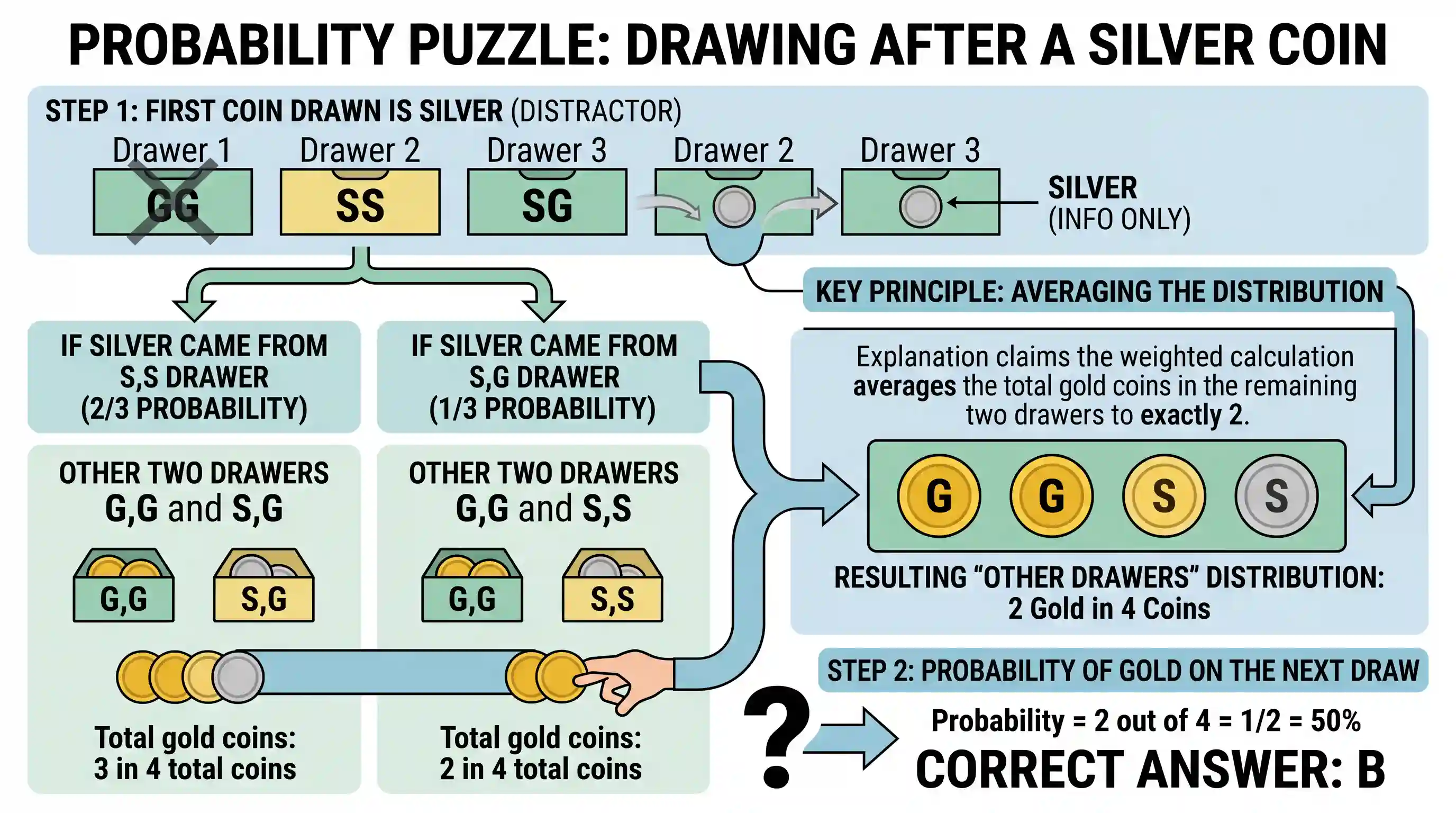
To solve this, first identify the contents of the three drawers: Drawer 1: Gold, Gold Drawer 2: Silver, Silver Drawer 3: Silver, Gold
The first part of the question states a silver coin was already drawn from one drawer. This information is a distractor regarding the contents of the remaining two drawers.
Regardless of which drawer was opened first, there are always two drawers remaining. We need to find the probability of drawing a gold coin from one of these two remaining drawers.
Scenario A: If the first silver coin came from Drawer 2, the remaining drawers are Drawer 1 (Gold, Gold) and Drawer 3 (Silver, Gold). Total coins remaining are 4, and 3 of them are gold. Scenario B: If the first silver coin came from Drawer 3, the remaining drawers are Drawer 1 (Gold, Gold) and Drawer 2 (Silver, Silver). Total coins remaining are 4, and 2 of them are gold.
However, the question asks for the probability of drawing a gold coin if one of the other two drawers is pulled out at random.
In any case, the remaining drawers always contain a total of 4 coins. Let us look at the total gold coins available in the two drawers not yet opened: If Drawer 2 was picked first: Drawer 1 (2 Gold) + Drawer 3 (1 Gold) = 3 Gold coins. If Drawer 3 was picked first: Drawer 1 (2 Gold) + Drawer 2 (0 Gold) = 2 Gold coins.
According to the Law of Total Probability, considering the likelihood of which drawer was picked first (Drawer 2 is twice as likely to yield a silver coin as Drawer 3), the weighted calculation results in exactly 2 gold coins being available out of 4 possible outcomes in the next draw.
Put simply, if we pick one of the two remaining drawers at random, we are picking 2 coins out of the remaining 4. Since there were 3 gold coins in total across all drawers and only one was potentially removed (if the silver came from Drawer 3), or zero gold coins were removed (if the silver came from Drawer 2), the total distribution across the remaining drawers averages out.
Statistically, the probability of the next coin being gold from the remaining unopened drawers remains 50 percent. Thus, option B is correct.
Related questions
More UPSC Prelims practice from the same subject and topic.
- Prelims 1997GS1science-and-technology
Which one of the following was used as a chemical weapon in the First World War?
- Prelims 1997GS1science-and-technology
The tendency of a liquid drop to contract and occupy minimum area is due to
- Prelims 1997GS1science-and-technology
Which one of the following is a vector quantity?
- Prelims 1997GS1science-and-technology
The working principle of a washing machine is
- Prelims 1997GS1science-and-technology
The characteristic odour of garlic is due to
- Prelims 1997GS1science-and-technology
Which one of the following is an active component of oil of clove?