In a group of persons travelling in a bus, 6 persons can speak Tamil, 15 can speak Hindi and 6 can speak Gujarati. In that group none can speak any other language. If 2 persons in the group can speak two languages and one person can speak all the three languages, then how many persons are there in the group?

- A21
- B22
- C23Correct
- D24
Explanation
To find the total number of persons in the group, we use the principle of set theory for three languages: Tamil, Hindi, and Gujarati.
The formula for the total number of unique individuals is the sum of those speaking each language minus those counted twice plus those counted three times. However, a simpler way is to categorize the individuals:
- One person speaks all three languages. This person is included in the counts for Tamil, Hindi, and Gujarati.
- Two persons speak exactly two languages. These two individuals are each included in the counts for two different languages.
- The remaining individuals speak only one language.
To avoid double or triple counting, we subtract the overlaps from the total sum of the language speakers: Total = (Sum of individual language speakers) minus (Number of people speaking two languages) minus (2 multiplied by the number of people speaking three languages).
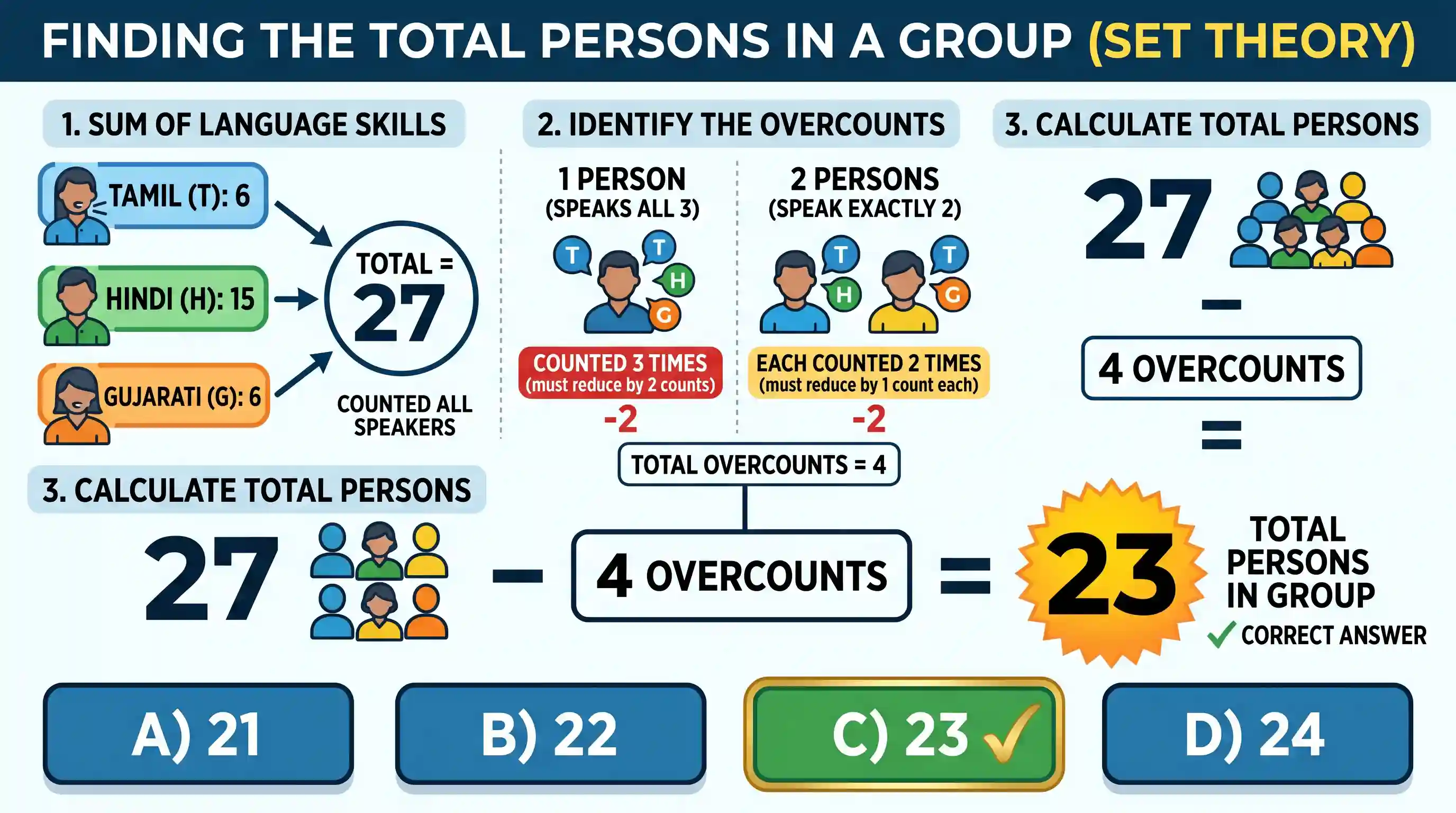
Calculation: Total sum of speakers = 6 (Tamil) + 15 (Hindi) + 6 (Gujarati) = 27. Number of people speaking exactly two languages = 2. Number of people speaking all three languages = 1.
Since the person speaking three languages is counted 3 times in the sum of 27, we subtract them twice to count them only once. Since the two people speaking two languages are counted twice, we subtract them once to count them only once.
Total persons = 27 minus 2 minus (2 multiplied by 1) Total persons = 27 minus 2 minus 2 = 23.
Therefore, there are 23 persons in the group. Correct option is C.
Related questions
More UPSC Prelims practice from the same subject and topic.
- Prelims 1997GS1science-and-technology
Which one of the following was used as a chemical weapon in the First World War?
- Prelims 1997GS1science-and-technology
The tendency of a liquid drop to contract and occupy minimum area is due to
- Prelims 1997GS1science-and-technology
Which one of the following is a vector quantity?
- Prelims 1997GS1science-and-technology
The working principle of a washing machine is
- Prelims 1997GS1science-and-technology
The characteristic odour of garlic is due to
- Prelims 1997GS1science-and-technology
Which one of the following is an active component of oil of clove?