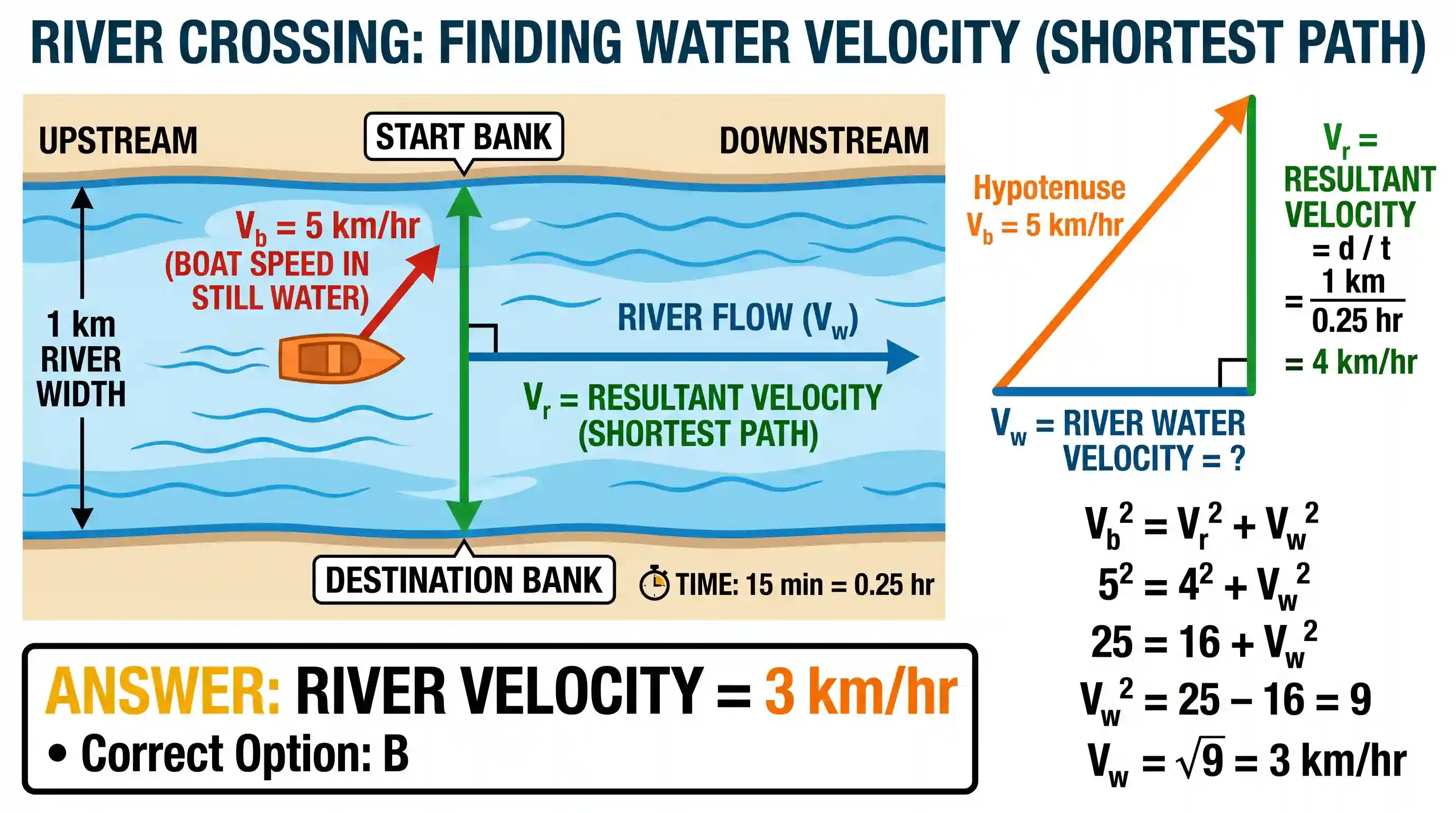
A boat which has a speed of 5 km/hr in still water crosses a river of width 1 km along the shortest possible path in 15 minutes. The velocity of the river water in km/hr is

- A1
- B3Correct
- C4
- D2
Explanation
To find the velocity of the river, we first calculate the resultant velocity of the boat. The boat covers a width of 1 km in 15 minutes. Since 15 minutes is 0.25 hours, the resultant velocity is 1 divided by 0.25, which equals 4 km per hour.
For the shortest possible path, the boat moves perpendicular to the river flow. This creates a right-angled triangle where the speed in still water (5 km/hr) is the hypotenuse, the resultant velocity (4 km/hr) is one side, and the river velocity is the other side.
According to the Pythagorean theorem, the square of the hypotenuse (25) equals the sum of the squares of the other two sides. Subtracting the square of the resultant velocity (16) from 25 gives 9. The square root of 9 is 3. Therefore, the river velocity is 3 km/hr.
Related questions
More UPSC Prelims practice from the same subject and topic.
- Prelims 1997GS1geography
The tail of a comet is directed away from the sun because
- Prelims 1997GS1geography
“From Aceh in the far north-west to Torres Strait in the east is 5000 miles, almost as far as from London to Baghdad. The Archipelago has 14,000 islands, some mere equatorial rocks, others some of the…
- Prelims 1997GS1geography
The group of small pieces of rock revolving round the sun between the orbits of Mars and Jupiter are called
- Prelims 1997GS1geography
If the earth’s direction of rotation is reversed, what would be the 1ST when it is noon at the International Date Line?
- Prelims 1997GS1geography
Which one of the following stars is nearest to the earth?
- Prelims 1997GS1geography
Which one of the following conditions is most relevant for the presence of life on Mars?