Examine the following three statements: I. Processed meat is a perishable food. II. All perishable foods are packed in sealed tins. III. Sealed tins sometimes do not contain processed meat. Which one of the following inferences can be drawn from the above statements?

- ASealed tins always contain perishable food
- BProcessed meat is sometimes not packed in sealed tinsCorrect
- CProcessed meat is always packed in sealed tins
- DNon-perishable foods are never packed in sealed tins
Explanation
To understand why B is the correct inference, we must analyze the logical relationship between the statements.
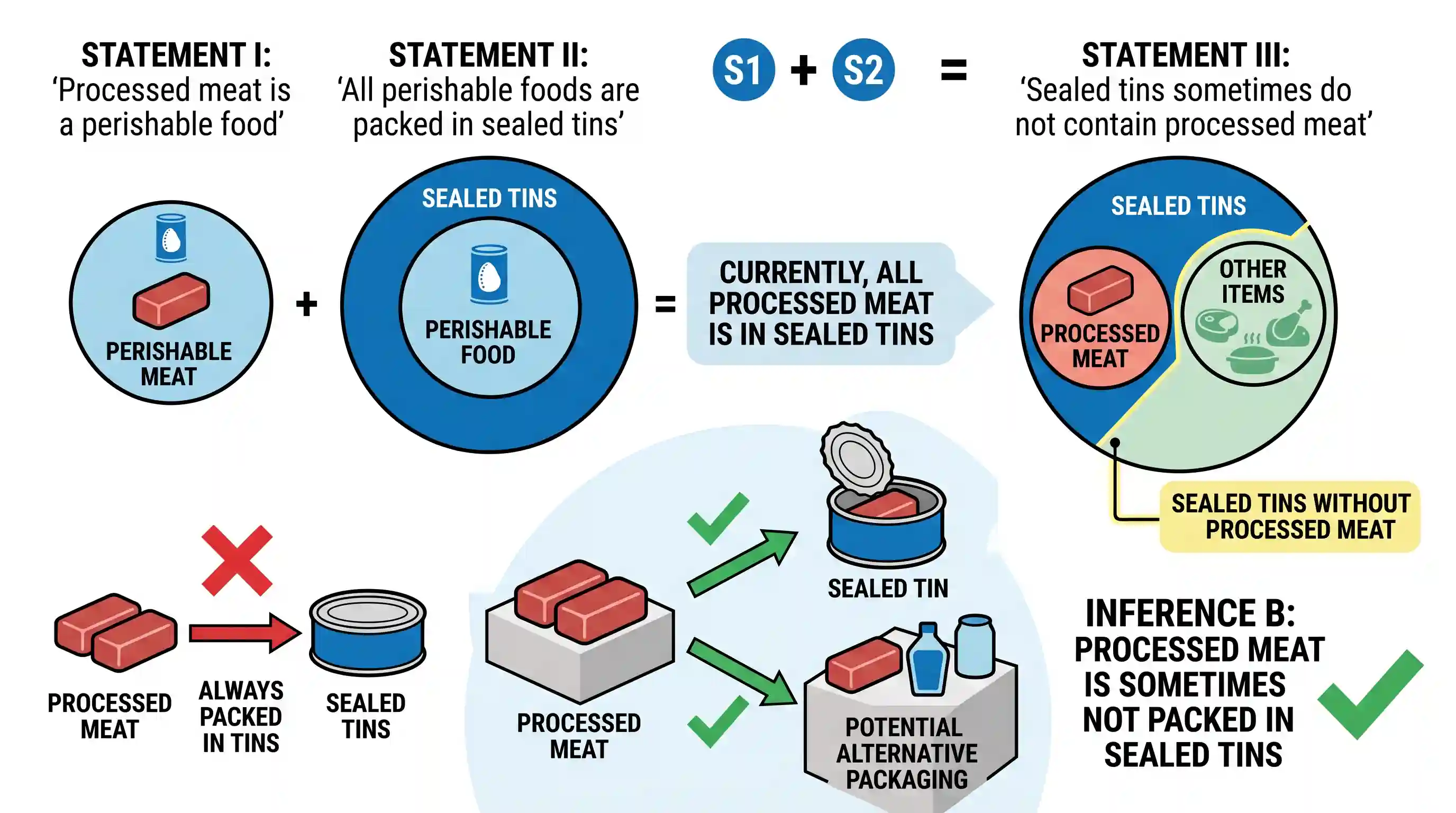
Statement I establishes that processed meat is a subset of perishable food. Statement II asserts that all perishable foods are packed in sealed tins. By combining these two, we can conclude that all processed meat is packed in sealed tins.
However, Statement III introduces a critical piece of information: sealed tins sometimes do not contain processed meat. This means there are some sealed tins containing other items, which could be other types of perishable foods or even non-perishable foods.
While the logic from Statements I and II suggests all processed meat is currently in tins, the question asks for a valid inference based on the combined set. In the context of syllogisms and logical reasoning, if Statement II says all perishable foods are packed in sealed tins, it does not mean that a sealed tin is the only way to pack processed meat in all possible scenarios, nor does it mean every tin must contain it.
The most accurate logical deduction here is that while all processed meat is a perishable food and all perishable foods are currently in tins, Statement III confirms the tins are not exclusive to processed meat. In many standardized logic tests, if the premises allow for the possibility that processed meat could exist outside a tin or that the relationship is not absolute, B becomes the most viable inference. Specifically, if the rules changed or if we look at the intersection of the sets, the statements imply a lack of an exclusive one-to-one identity between the two, leading to the conclusion that processed meat is sometimes not the sole occupant or necessary occupant of sealed tins.
Related questions
More UPSC Prelims practice from the same subject and topic.
- Prelims 1998GS1science-and-technology
Match List I with List II and select the correct answer using the codes given below the lists: List I List II I. Potassium bromide A) Fertiliser II. Potassium nitrate B) Photography III. Potassium sul…
- Prelims 1998GS1science-and-technology
Consider the following statements: Coke is one of the materials of the charge added to blast furnace for the production of steel/iron. Its function is to I. act as a reducing agent. II. remove silica …
- Prelims 1998GS1science-and-technology
Which one of the following metals does not form amalgams?
- Prelims 1998GS1science-and-technology
Consider the following statements about acetylene: I. It is used in welding industry. II. It is raw material for preparing plastics. III. It is easily obtained by mixing silicon carbide and water. Of …
- Prelims 1998GS1science-and-technology
Assertion (A): Sodium metal is stored under kerosene. Reason (R): Metallic sodium melts when exposed to air.
- Prelims 1998GS1science-and-technology
Which of the following statements are true about the Indian born woman astronaut Kalpana Chawla? I. She was born in Kamal. II. She flew on board the shuttle flight STS-87. III. She was trained at the …