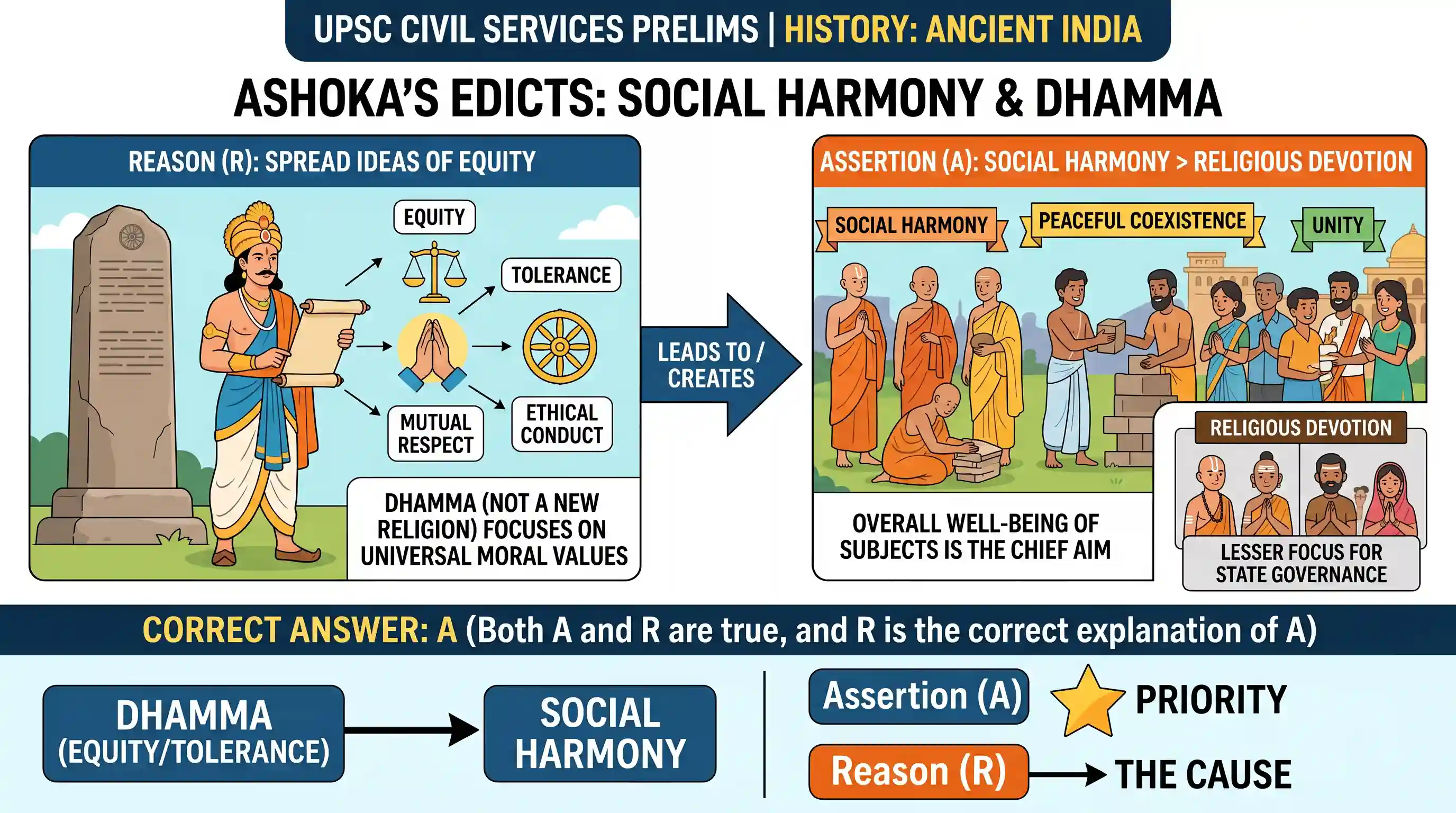
Assertion (A): According to Asoka’s edicts social harmony among the people was more important than religious devotion. Reason (R): He spread ideas of equity instead of promotion of religion.

- ABoth A and R are true, and R is the correct explanation of ACorrect
- BBoth A and R are true, but R is NOT a correct explanation of A
- CA is true, but R is false
- DA is false, but R is true
Explanation
The correct answer is A because both statements are true and the reason directly explains the assertion.
Ashoka’s edicts, particularly Major Rock Edict XII, emphasize the importance of restraint in speech and honoring all religious sects to maintain social harmony. He believed that the growth of the essentials of all religions was more vital than mere individual devotion to one's own faith.
To achieve this harmony, Ashoka promoted the concept of Dhamma, which was not a new religion but a code of ethical conduct based on ideas of equity, tolerance, and mutual respect. Since he focused on spreading these universal moral values rather than promoting a specific religious dogma, his actions directly served the goal of ensuring social stability and harmony among his subjects. Thus, the reason correctly explains why social harmony took precedence over religious devotion in his administration.
Related questions
More UPSC Prelims practice from the same subject and topic.
- Prelims 1998GS1history
Which of the following pairs are correctly matched? I. Lothal: Ancient dockyard II. Sarnath: First Sermon of Buddha III. Rajgir: Lion capital of Asoka IV. Nalanda: Great seat of Buddhist learning Sele…
- Prelims 1998GS1history
Which one of the following ancient Indian records is the earliest royal order to preserve food grains to be utilised during the crises in the country?
- Prelims 1998GS1history
Many of the Greeks, Kushanas and Shakas embraced Buddhism rather than Hinduism because
- Prelims 1998GS1history
The Asokan major rock edicts which tell us about the Sangam Kingdom include rock edicts
- Prelims 1998GS1history
Which of the following pairs are correctly matched? I. Mrichchhakatikam — Shudraka II. Buddhacharita — Vasuvandhu III. Mudrarakshasha — Vishakhadatta IV. Harshacharita — Banabhatta Select the correct …
- Prelims 1998GS1history
What is the correct chronological order in which the following appeared in India? I. Gold coins II. Punch marked silver coins III. Iron plough IV. Urban culture Select the correct answer using the cod…