A, B, C, D, E and F, not necessarily in that order are sitting on six chairs regularly placed around a round table. It is observed that A is between D and F, C is opposite D, and D and E are not on neighbouring chairs. Which one of the following pairs must be sitting on neighbouring chairs?

- AA and B
- BC and ECorrect
- CB and F
- DA and C
Explanation
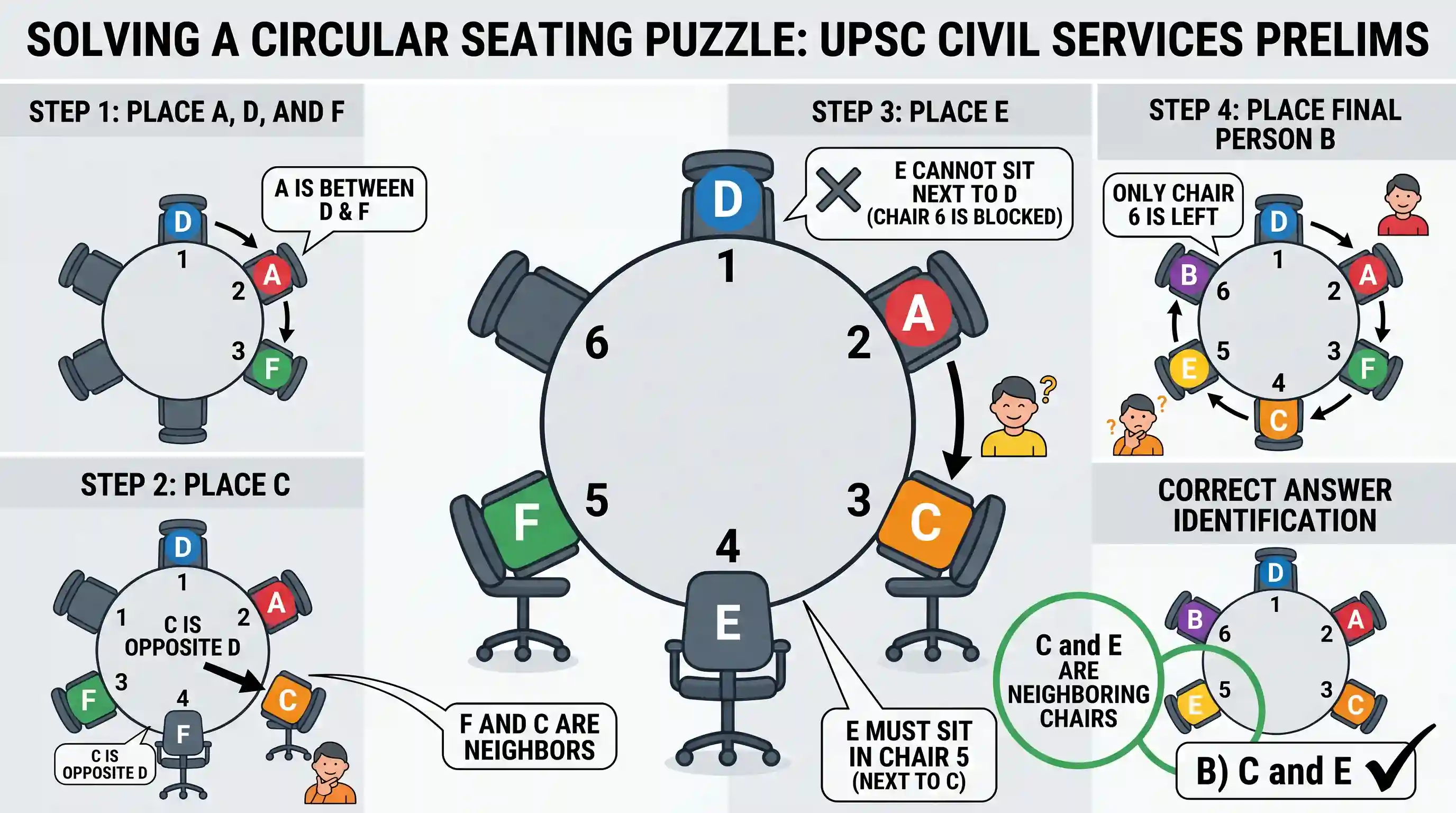
To solve this, we place the six people around the circular table based on the given conditions.
First, place D and F with A sitting between them. This establishes a sequence of D, A, F.
Second, place C opposite D. In a six-chair arrangement, being opposite means there are two chairs between the individuals. Counting two chairs away from D in either direction puts C opposite D. This places C next to F.
Third, we are told D and E are not on neighboring chairs. D is already next to A. The only other chair next to D is currently empty. Since E cannot sit there, E must sit in the only remaining chair that is not next to D. This position is between C and F.
Finally, the only person left is B. The only available chair for B is the one next to D.
The final clockwise or counter-clockwise arrangement is D, A, F, E, C, B.
Looking at the options, C and E are sitting on neighboring chairs in this arrangement. Therefore, option B is correct.
Related questions
More UPSC Prelims practice from the same subject and topic.
- Prelims 1998GS1polity-and-governance
Which of the following Parties were not a part of the United Front which was in power during ‘96-97’? I. Bahujan Samaj Party II. Samata Party III. Haryana Vikas Party IV. Asom Gana Parishad Select the…
- Prelims 1998GS1polity-and-governance
he meeting of G-15 countries held in Malayasia in 1997 was attended by
- Prelims 1998GS1polity-and-governance
Which one of the following was the venue for the preliminary talks between the Sri Lankan Government and representatives of Tamil United Liberation Front and other militant groups?
- Prelims 1998GS1polity-and-governance
‘MERCOSUR’ consists of group of countries of
- Prelims 1998GS1polity-and-governance
Assertion (A): The United States of America has threatened to ask the World Trade Organisation (WTO) to apply sanctions against the developing countries for the no observance of ILO conventions. Reaso…
- Prelims 1998GS1polity-and-governance
The recent Land Mines Conference to sign the historic treaty was held in the Capital city of