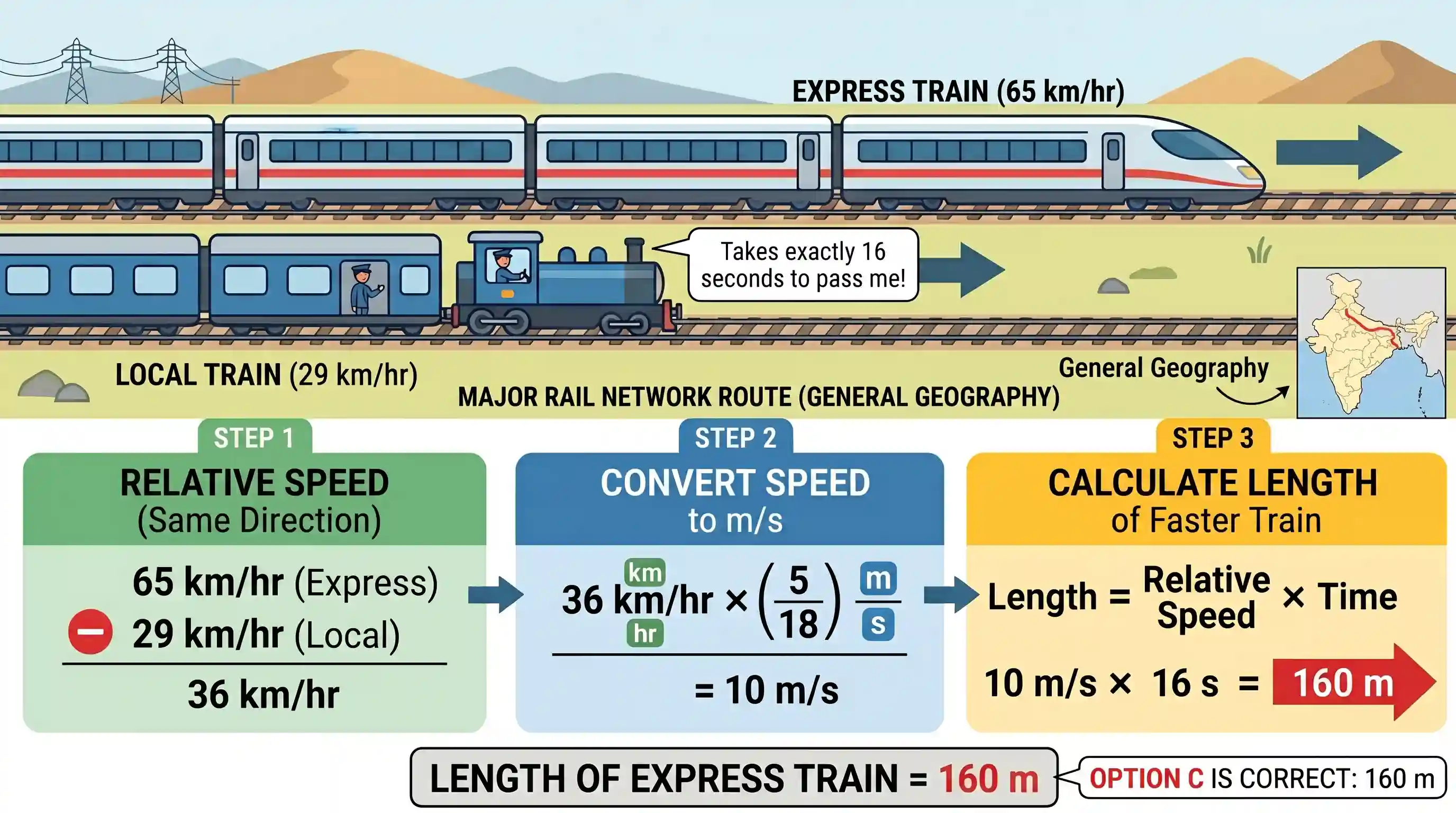
One local and another express train were proceeding in the same direction on parallel tracks at 29 km/hour and 65 km/hour respectively. The driver of the former noticed that it took exactly 16 seconds for the faster train to pass by him. What is the length of the faster train?

- A60 m
- B120 m
- C160 mCorrect
- D240 m
Explanation
To find the length of the faster train, we follow these simple steps:
-
Calculate Relative Speed: Since both trains are moving in the same direction, subtract the slower speed from the faster speed. Relative Speed = 65 km/hr - 29 km/hr = 36 km/hr.
-
Convert Speed to Meters per Second: To match the time given in seconds, convert km/hr to m/s by multiplying by 5/18. 36 multiplied by 5/18 = 10 m/s.
-
Calculate Length: The faster train passes the driver of the slower train, which means it covers its own length at the relative speed. Length = Speed multiplied by Time Length = 10 m/s multiplied by 16 seconds = 160 meters.
Therefore, the length of the faster train is 160 m. The correct option is C.
Related questions
More UPSC Prelims practice from the same subject and topic.
- Prelims 1998GS1geography
Olympics 2000 is to be held in
- Prelims 1998GS1geography
When there is noon at G. M.T. meridian people on another place of the Earth are taking their 6 o’clock morning tea. The longitude of the place is
- Prelims 1998GS1geography
The satellites of which one of the following countries have helped in the preparation of a detailed and complete map of Antarctica?
- Prelims 1998GS1geography
Consider the following statements regarding asteroids: I. Asteroids are rocky debris of varying sizes orbiting the Sun. II. Most of the asteroids are small but some have diameter as large as 1000 km. …
- Prelims 1998GS1geography
Match List I with List II and select the correct answer by using the codes given below the lists: List I List II (Special Characteristic) (Name of Planet) I. Farthest planet from the sun A) Mercury II…
- Prelims 1998GS1geography
One Astronomical Unit is the average distance between