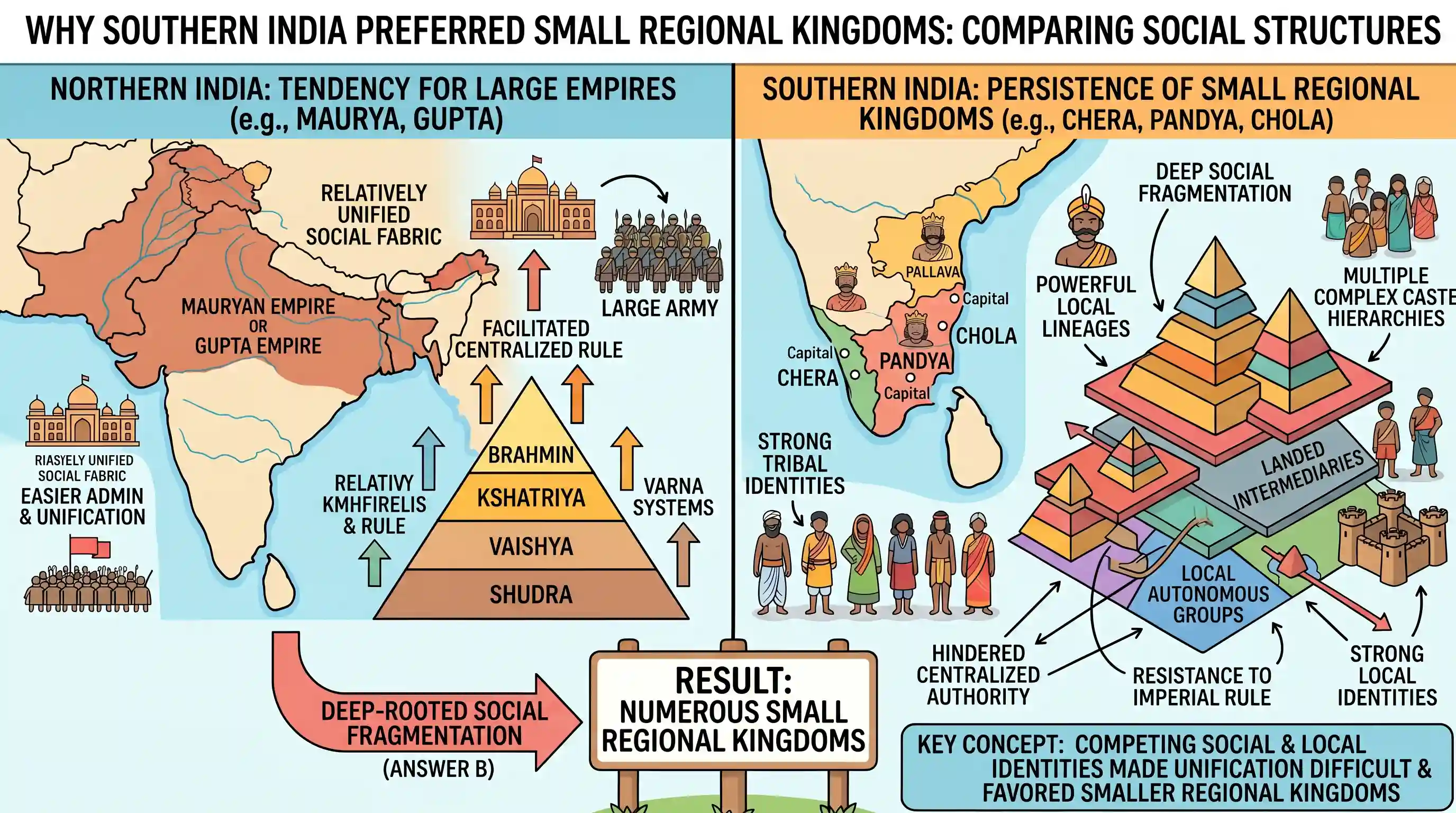
One consistent feature found in the history of southern India was the growth of small regional kingdoms rather than large empires because of

- Athe absence of minerals like iron
- Btoo many divisions in the social structureCorrect
- Cthe absence of vast areas of fertile land
- Dthe scarcity of manpower
Explanation
The correct answer is B because the social structure in southern India was characterized by numerous divisions, including complex caste hierarchies and strong tribal identities. Unlike northern India, where the varna system was more standardized, the south had a unique social fabric with powerful local lineages and landed intermediaries. These deep-rooted divisions and the presence of many local autonomous groups made it difficult for a single ruler to centralize authority over a long period. This social fragmentation hindered the formation of a unified, large-scale empire and instead favored the growth of smaller, regional kingdoms that were more aligned with specific local social and cultural identities.
Related questions
More UPSC Prelims practice from the same subject and topic.
- Prelims 1999GS1history
The term ‘Aryan’ denotes
- Prelims 1999GS1history
Which one of the following ports handled the north Indian trade during the Gupta period?
- Prelims 1999GS1history
From the third century AD when the Hun invasion ended the Roman Empire, the Indian merchants relied more and more on the
- Prelims 1999GS1history
The following persons came to India at one time or another: I. Fa-Hien II. I-Tsing III. Megasthenese IV. Hieun-Tsang The correct chronological sequence of their visits is:
- Prelims 1999GS1history
Which one of the following was initially the most powerful city state of India in the 6th century B.C.?
- Prelims 1999GS1history
The Indo-Greek kingdom set up in north Afghanistan in the beginning of the second century BC was