Which one of the following statements regarding the levying, collecting and distribution of Income Tax is correct?

- AThe Union levies, collects and distributes the proceeds of income tax between itself and the StatesCorrect
- BThe Union levies, collects and keeps all the proceeds of income tax to itself
- CThe Union levies and collects the tax but all the proceeds are distributed among the States
- DOnly the surcharge levied on income tax is shared between the Union and the States
Explanation
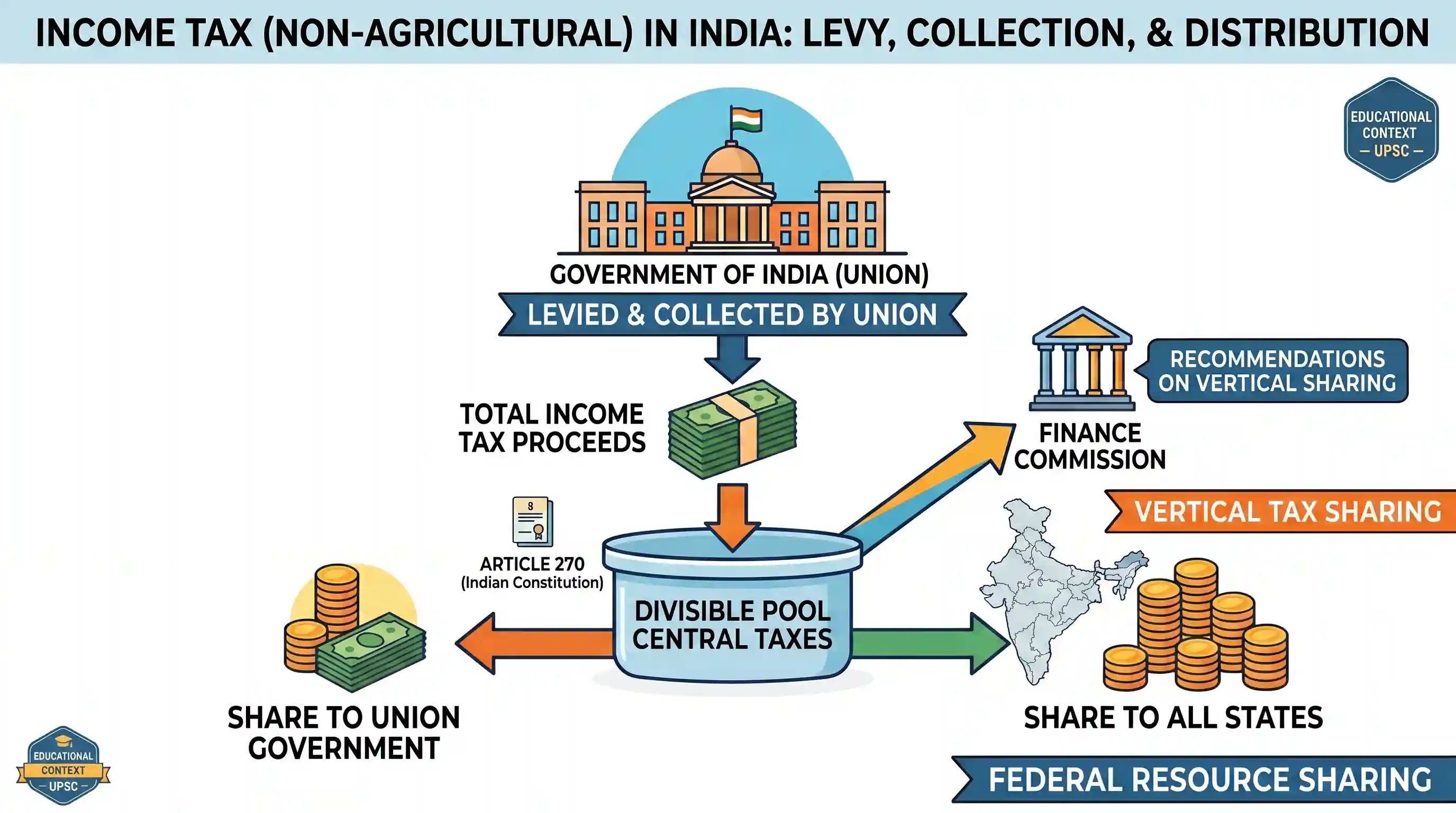
The correct answer is A because of the provisions laid down in Article 270 of the Indian Constitution. According to this article, taxes on income other than agricultural income are levied and collected by the Government of India. However, the proceeds from these taxes do not belong solely to the Union. Instead, they are distributed between the Union and the States based on the recommendations of the Finance Commission. This ensures a vertical sharing of resources within the federal structure. Options B and C are incorrect because the revenue is neither kept entirely by the Union nor given entirely to the States. Option D is incorrect because surcharges and cesses are generally kept exclusively by the Union and are not part of the divisible pool shared with the States.
Related questions
More UPSC Prelims practice from the same subject and topic.
- Prelims 1999GS1polity-and-governance
The Constitution of India recognises
- Prelims 1999GS1polity-and-governance
In the new Panchayati Raj Bill enacted in 1993, there are several fresh provisions deviating from the past. Which one of the following is not one such provision?
- Prelims 1999GS1polity-and-governance
Consider the following statements: An amendment of the Constitution of India can be initiated by the I. Lok Sabha. II. Rajya Sabha. III. State Legislatures. IV. President. Which of the above statement…
- Prelims 1999GS1polity-and-governance
Consider the following statements about the recent amendments to the Election Law by the Representation of the People (Amendment) Act, 1996: I. Any conviction for the offence of insulting the Indian N…
- Prelims 1999GS1polity-and-governance
Among which one of the following sets of social/religious groups is the extent of poverty the highest, as per Government statistics for the nineties?
- Prelims 1999GS1polity-and-governance
Which one of the following statements is correct?