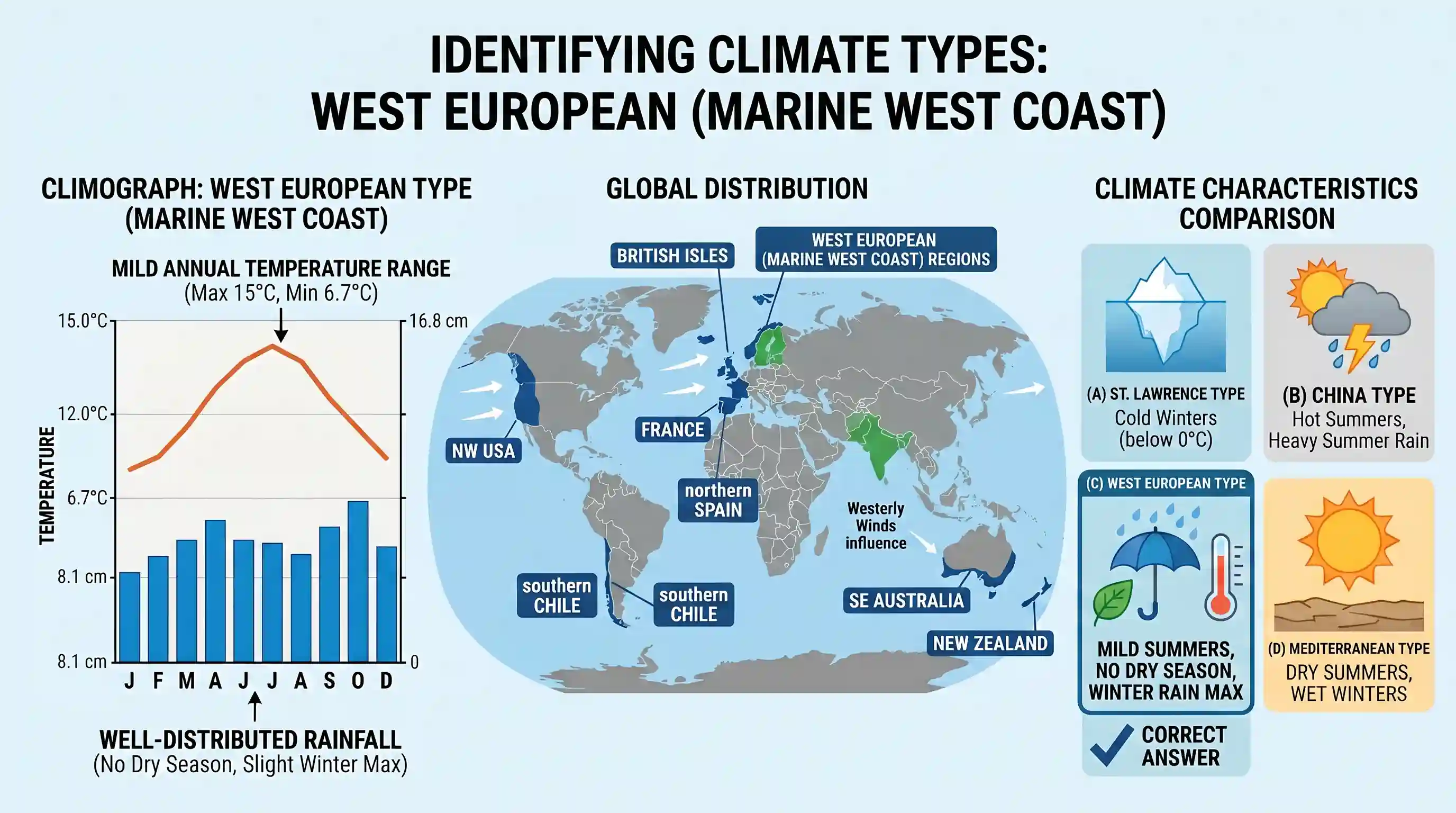
Consider the following temperature and rainfall data: Month Temperature °C Rainfall cm January 6.7 14.0 February 6.7 13.2 March 7.2 11.4 April 8.9 9.4 May 11.1 8.1 June 13.9 8.1 July 15.0 9.6 August 15.0 12.2 September 13.9 10.4 October 11.1 14.4 November 8.9 14.0 December 7.8 16.8 The climate to which this data pertains is

- ASt. Lawrence type
- BChina type
- CWest European typeCorrect
- DMediterranean type
Explanation
The data represents a West European type climate, also known as the Marine West Coast climate, based on three key observations.
First, the temperature range is mild throughout the year. The coldest month is around 6.7 degrees Celsius and the warmest is 15 degrees Celsius. This indicates a moderate maritime influence with no extreme winters or hot summers.
Second, the rainfall is well distributed throughout the year. There is no distinct dry season. Every month receives significant precipitation, ranging from 8.1 cm to 16.8 cm.
Third, there is a slight maximum of rainfall during the winter months, such as October to January. This pattern is characteristic of regions like the British Isles and Western Europe, where westerly winds and cyclonic activity bring consistent moisture year round.
The other options are incorrect because Mediterranean climates have dry summers, China type has hot summers with heavy summer rain, and St. Lawrence type has much colder winters with temperatures often falling below freezing.
Related questions
More UPSC Prelims practice from the same subject and topic.
- Prelims 1999GS1geography
If it is 10.00 a.m. I.S.T., then what would be the local time at Shillong on 92°E longitude?
- Prelims 1999GS1geography
A ship sailing from the eastern extremity of the Aleutian Islands to Dutch harbour crosses 180° meridian at 23.30 hrs on January 1, 1999. What time and date will be recorded by the captain of the ship…
- Prelims 1999GS1geography
Match List I with List II and select the correct answer using the codes given below the Lists: List I (Volcanic Mountain) (Country) I. Mt. Rainier A) Italy II. Etna B) Mexico III. Paricutin C) Philipp…
- Prelims 1999GS1geography
The Ravva offshore block, with great potential for oil, is located in
- Prelims 1999GS1geography
Tourism industry in India is quite small compared to many other countries in terms of India’s potential and size. Which one of the following statements is correct in this regard?
- Prelims 1999GS1geography
Match List I with List II and select the correct answer using the codes given below the Lists: List I (Timber) (Country) I. Cedar A) Myanmar II. Douglas Fir B) Canada III. Mahogany C) Mexico IV. Teak …