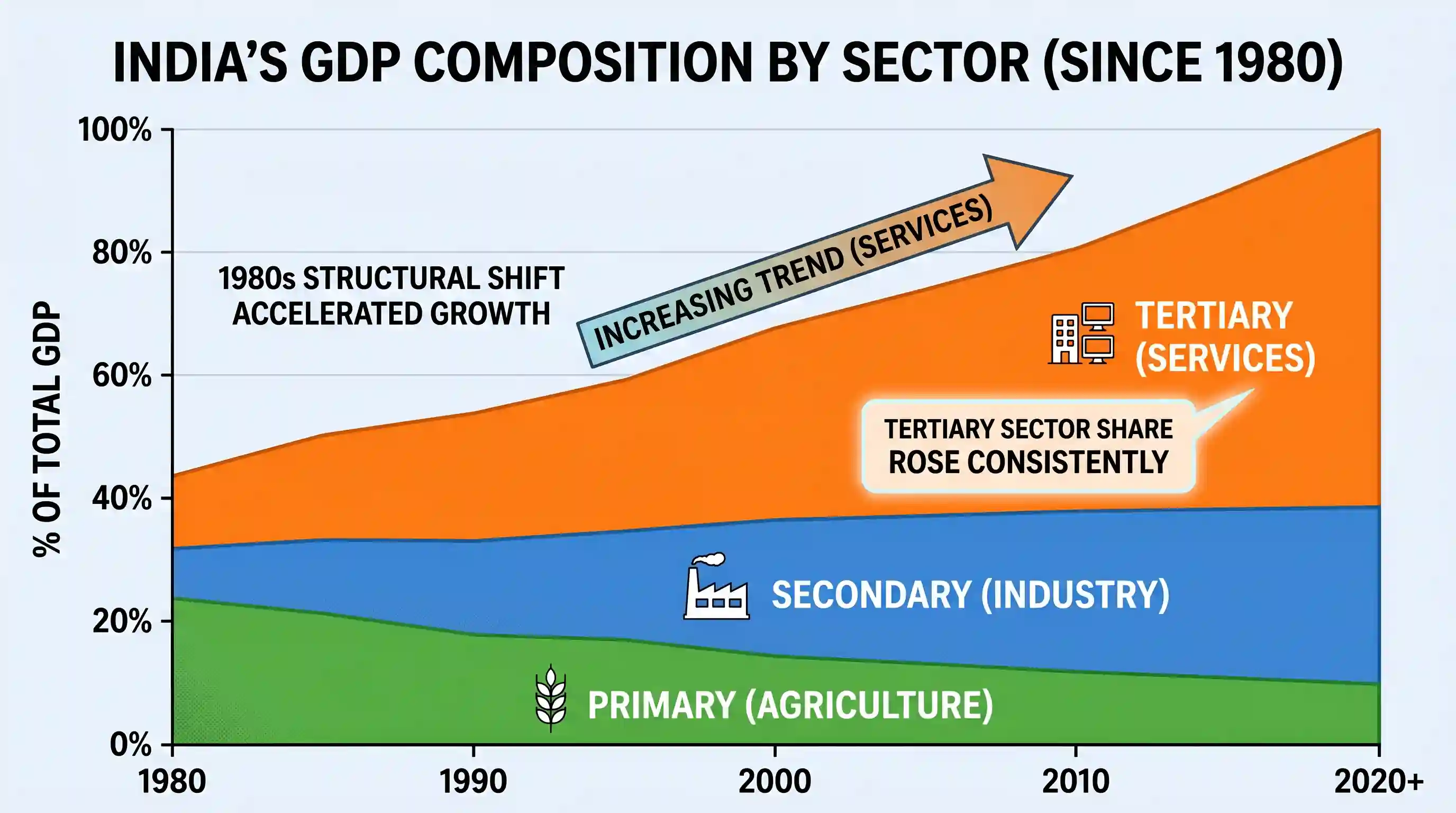
Since 1980, the share of the tertiary sector in the total GDP of India has

- Ashown an increasing trendCorrect
- Bshown a decreasing trend
- Cremained constant
- Dbeen fluctuating
Explanation
The correct answer is A because since the 1980s, the Indian economy has undergone a structural shift where the service or tertiary sector has grown much faster than the primary and secondary sectors. While the share of agriculture in the total GDP has consistently declined, the share of services has steadily risen. By the early 2000s, the tertiary sector became the largest contributor to India's GDP, now accounting for over 50 percent of the total economic output. This consistent rise over the decades represents a clear increasing trend.
Related questions
More UPSC Prelims practice from the same subject and topic.
- Prelims 1999GS1economy
Persons below the poverty line in India are classified as such based on whether
- Prelims 1999GS1economy
Consider the following statements: Regional disparities in India are high and have been rising in recent years because I. there is persistent investment over time only in select locales. II. some area…
- Prelims 1999GS1economy
Consider the following statements: Industrial development in India, to an extent, is constrained by I. lack of adequate entrepreneurship and leadership in business. II. lack of savings to invest. III.…
- Prelims 1999GS1economy
The Employment Assurance Scheme envisages financial assistance to rural areas for guaranteeing employment to at least
- Prelims 1999GS1economy
Consider the following statements: Small-scale industries are, in most cases, not as efficient and competitive as the large-scale ones. Yet the Government provides preferential treatment and reservati…
- Prelims 1999GS1economy
The farmers are provided credit from a number of sources for their short and long- term needs. The main sources of credit to the farmers include