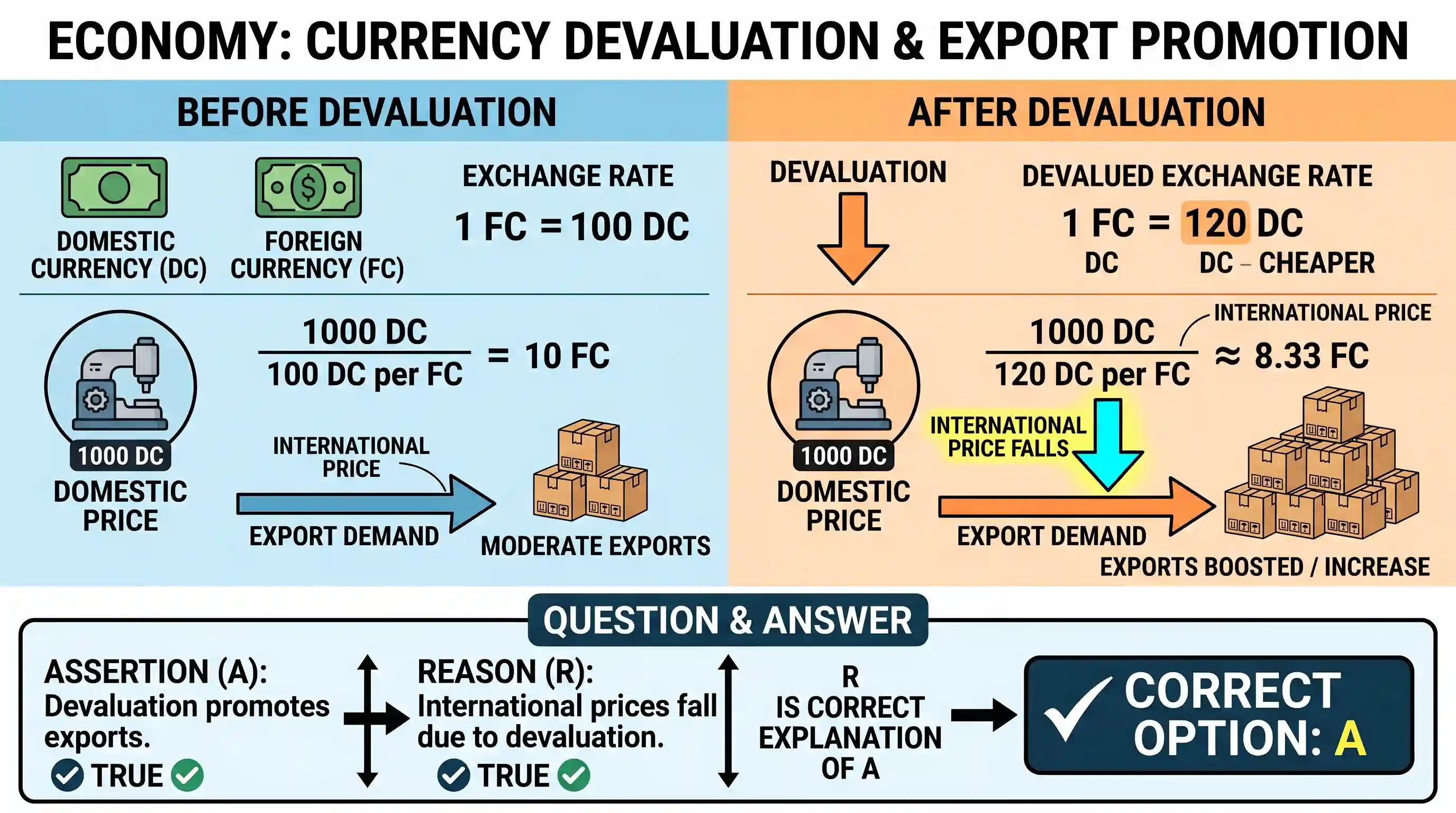
Assertion (A): Devaluation of a currency may promote export. Reason (R): Price of the country’s products in the international market may fall due to devaluation.

- ABoth A and R are true, and R is the correct explanation of ACorrect
- BBoth A and R are true, but R is not a correct explanation of A
- CA is true, but R is false
- DA is false, but R is true
Explanation
The correct option is A because devaluation directly impacts the relative pricing of a countrys goods abroad.
When a country devalues its currency, its value decreases compared to foreign currencies. This means foreign buyers need less of their own currency to purchase the same amount of the devalued currency, making the countrys products cheaper in international markets.
Because the products become more price competitive, the demand for these goods typically increases, which promotes and boosts exports. Therefore, the reason provided directly explains the mechanism behind the assertion.
Related questions
More UPSC Prelims practice from the same subject and topic.
- Prelims 1999GS1economy
The economic crisis in the latter half of 1990s most seriously affected Indonesia, Thailand, Malaysia and South Korea. The cause of the crisis was
- Prelims 1999GS1economy
Match List I with List II and select the correct answer using the codes given below the Lists: List I List II I. WTO A) Provides loans to address short-term balance of payment problems II. IDA B) Mult…
- Prelims 1999GS1economy
From the balance sheet of a company, it is possible to
- Prelims 1999GS1economy
Persons below the poverty line in India are classified as such based on whether
- Prelims 1999GS1economy
Consider the following statements: Regional disparities in India are high and have been rising in recent years because I. there is persistent investment over time only in select locales. II. some area…
- Prelims 1999GS1economy
Consider the following statements: Industrial development in India, to an extent, is constrained by I. lack of adequate entrepreneurship and leadership in business. II. lack of savings to invest. III.…