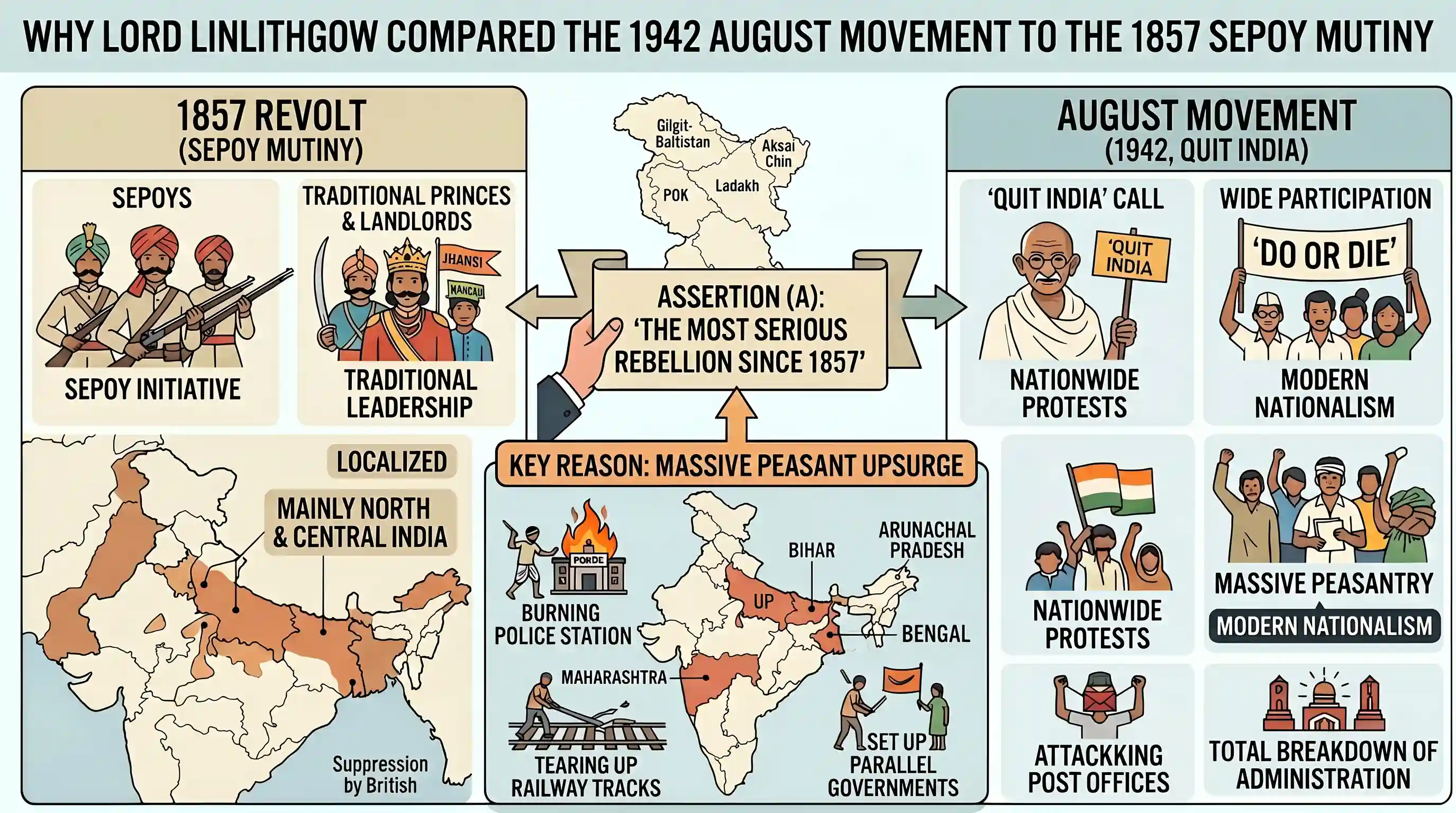
Assertion (A): Lord Linlithgow described the August Movement of 1942 as the most serious rebellion since Sepoy Mutiny. Reason (R): There was massive upsurge of the peasantry in certain areas.

- ABoth A and R are true, and R is the correct explanation of ACorrect
- BBoth A and R are true, but R is not a correct explanation of A
- CA is true, but R is false
- DA is false, but R is true
Explanation
The correct answer is A because both statements are historically accurate and the reason directly explains the assertion.
The assertion is true because Lord Linlithgow, the then Viceroy of India, wrote a personal letter to Winston Churchill describing the Quit India Movement also known as the August Movement as the most serious rebellion since 1857. This was due to the widespread violence and the total breakdown of British authority in several districts.
The reason is true and provides the correct explanation because the intensity of the movement was driven by a massive and violent upsurge of the peasantry. In regions like Bihar, Eastern Uttar Pradesh, Bengal, and Maharashtra, peasants attacked police stations, post offices, and railway lines. This large scale rural participation transformed a political protest into a formidable armed rebellion, leading Linlithgow to compare its severity to the 1857 Mutiny.
Related questions
More UPSC Prelims practice from the same subject and topic.
- Prelims 1999GS1history
The first venture of Gandhi in all India politics was the
- Prelims 1999GS1history
The Congress policy of pray and petition ultimately came to an end under the guidance of
- Prelims 1999GS1history
Match List I with List II and select the correct answer using the codes given below the Lists: List I (Persons) (Journals) I. Shyamji Krishna Varma A) Bande Mataram II. Madame Bhikaji Cama B) Indian S…
- Prelims 1999GS1history
There was no independent development of industries in India during British rule because of the
- Prelims 1999GS1history
‘Abhinav Bharat’ a secret society of revolutionaries was organised by
- Prelims 1999GS1history
The most short-lived of all of Britain’s constitutional experiments in India was the