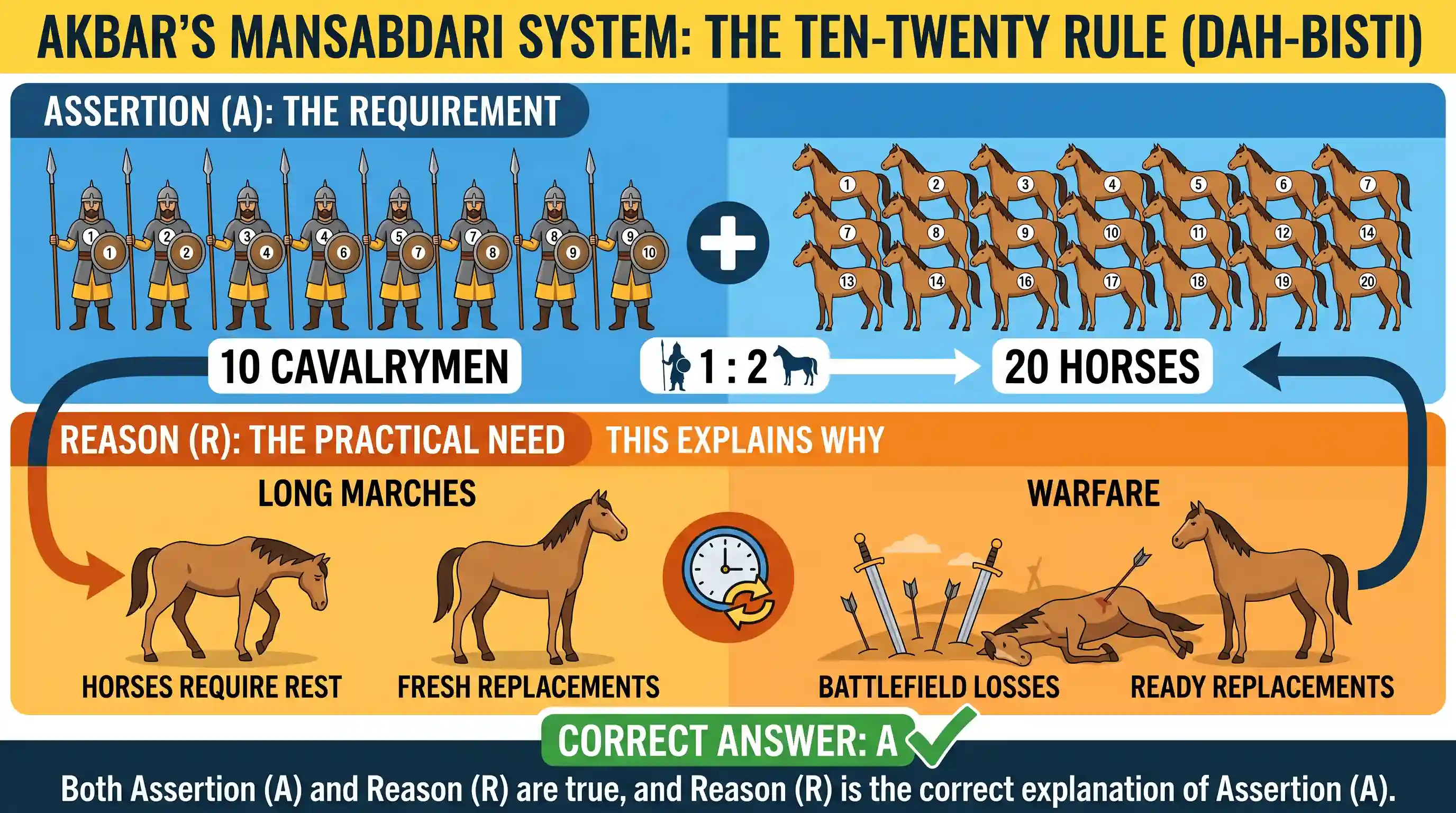
Assertion (A): During the time of Akbar, for every ten cavalrymen, the mansabdars had to maintain twenty horses. Reason (R): Horses had to be rested while on march and replacements were necessary in times of war.

- ABoth A and R are true, and R is the correct explanation of ACorrect
- BBoth A and R are true, but R is not a correct explanation of A
- CA is true, but R is false
- DA is false, but R is true
Explanation
The correct answer is A because both the statement and the reason are historically accurate and logically linked.
Under the Mansabdari system established by Akbar, the Dah-Bisti rule or ten-twenty rule was implemented. This rule required a mansabdar to maintain two horses for every single cavalryman. The primary reason for this requirement was practical necessity. During long marches and military expeditions, horses would often get exhausted, injured, or die in battle. Having a ratio of two horses per soldier ensured that a fresh replacement was always available, keeping the cavalry mobile and effective during warfare. Since the reason provided directly explains why the specific ratio mentioned in the assertion was maintained, A is the correct option.
Related questions
More UPSC Prelims practice from the same subject and topic.
- Prelims 1999GS1history
“The king was freed from his people and they from their king”. On whose death did Badauni comment thus?
- Prelims 1999GS1history
Which one of the following pairs is correctly matched?
- Prelims 1999GS1history
One consistent feature found in the history of southern India was the growth of small regional kingdoms rather than large empires because of
- Prelims 1999GS1history
The first venture of Gandhi in all India politics was the
- Prelims 1999GS1history
The term ‘Aryan’ denotes
- Prelims 1999GS1history
The Congress policy of pray and petition ultimately came to an end under the guidance of