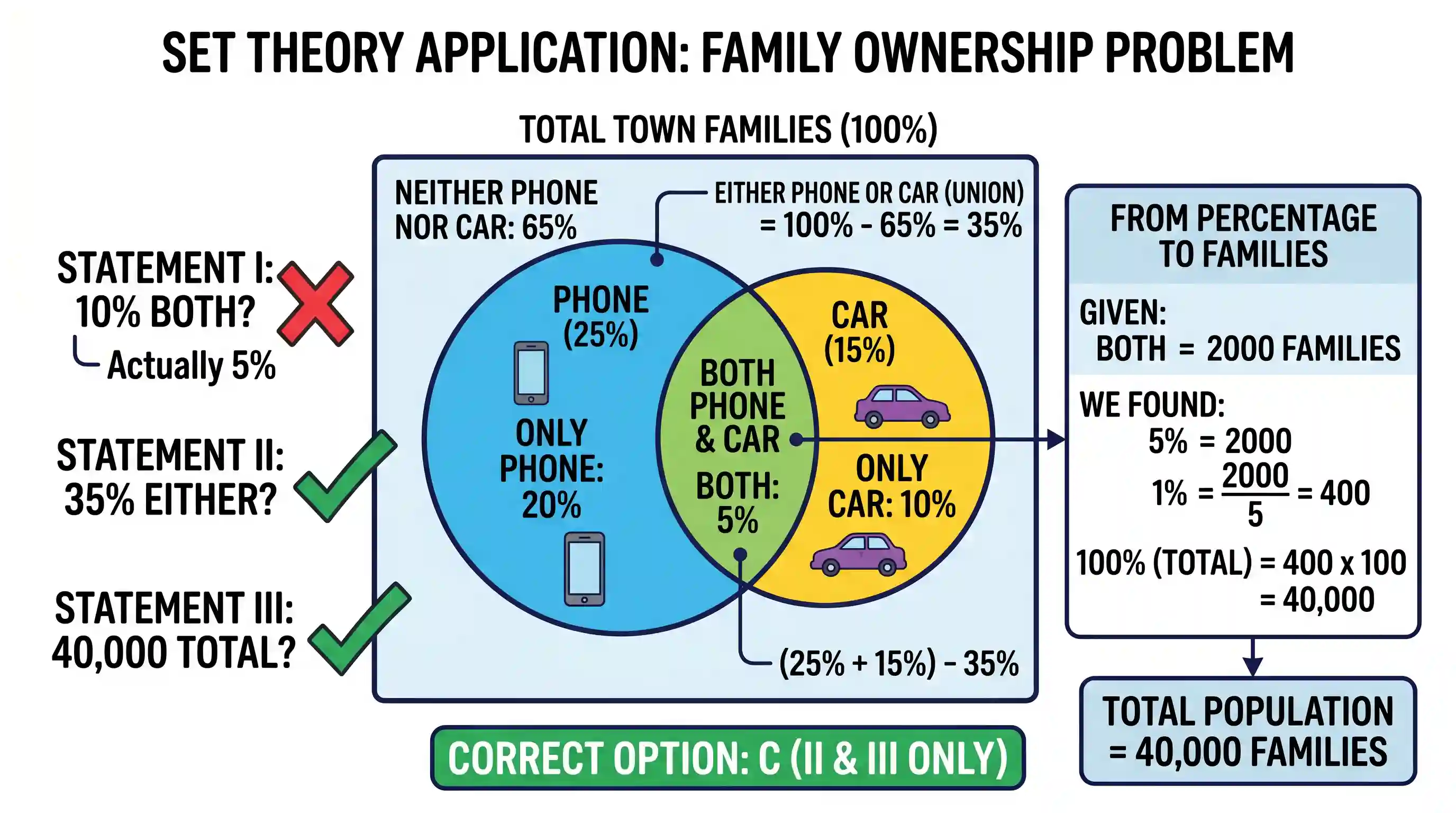
In a town 25% families own a phone and 15% own a car. 65% families own neither a phone nor a car. 2000 families own both a car and a phone. Consider the following statements in this regard: I. 10% families own both a car and a phone. II. 35% families own either a car or a phone. III. 40,000 families live in the town. Which of the above statements are correct?

- AI and II
- BI and III
- CII and IIICorrect
- DI, II and III
Explanation
To solve this, we use the principle of sets.
Let the total number of families be 100 percent. The percentage of families owning at least one item either a phone or a car is 100 percent minus 65 percent which equals 35 percent. This confirms Statement II is correct.
Now, use the formula for the union of two sets: Total owning at least one equals Families with Phone plus Families with Car minus Families with Both. 35 percent equals 25 percent plus 15 percent minus Families with Both. 35 percent equals 40 percent minus Families with Both. Therefore, Families with Both equals 5 percent. This proves Statement I is incorrect because it claims 10 percent.
To find the total population, we know that 5 percent of the total families equals 2000. If 5 percent is 2000, then 1 percent is 400. The total 100 percent is 400 multiplied by 100, which equals 40,000. This confirms Statement III is correct.
Since statements II and III are correct and statement I is incorrect, the correct option is C.