The average speed of a train in the onward journey is 25% more than that of the return journey. The train halts for one hour on reaching the destination. The total time taken for the complete to and for journey is 17 hours covering a distance of 800 km. The speed of the train in the onward journey is

- A45 km per hour
- B47.06 km per hour
- C50.00 km per hour
- D56.25 km per hourCorrect
Explanation
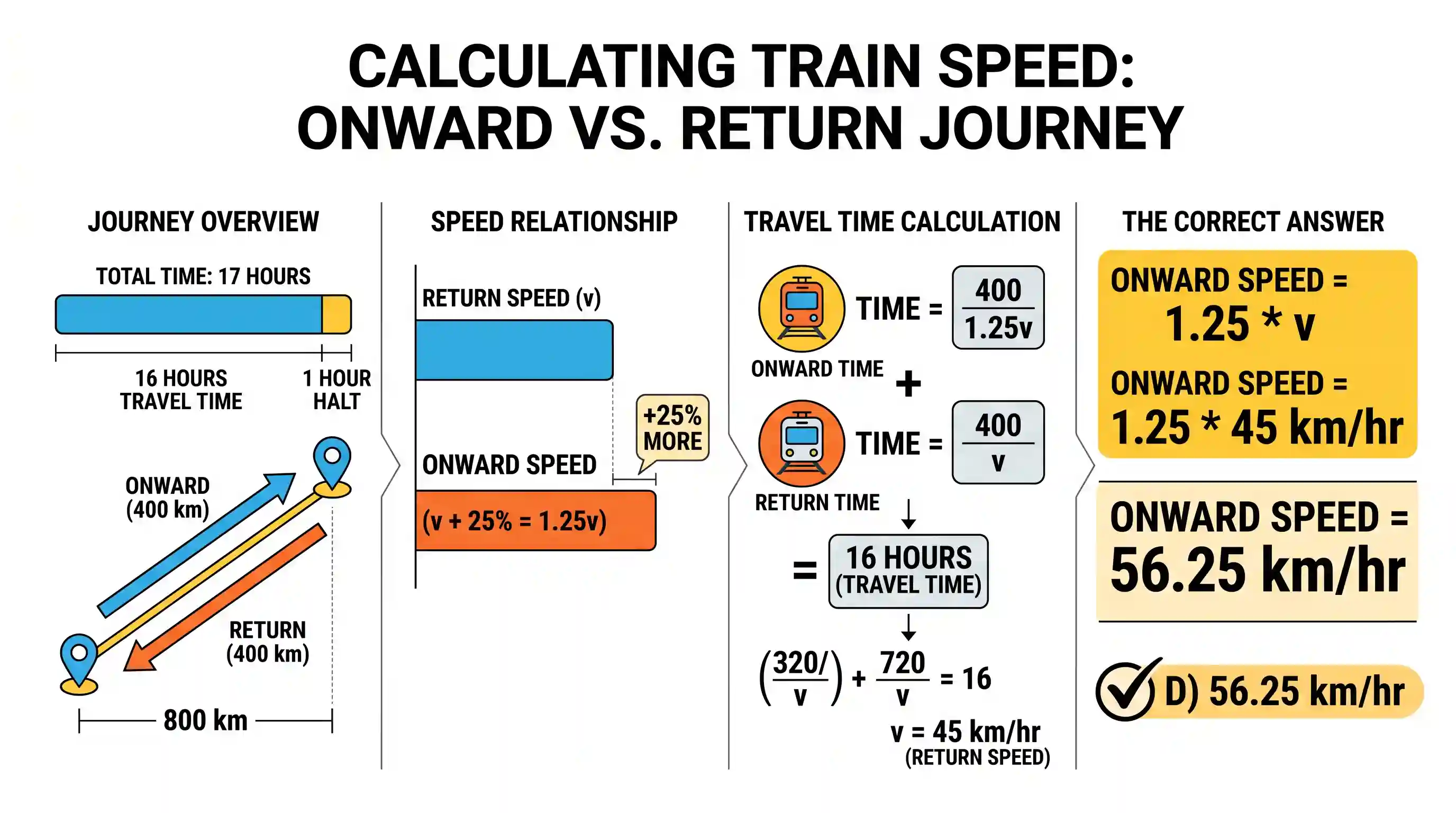
Total distance for the round trip is 800 km, so the distance for the onward journey is 400 km and the return journey is 400 km.
The total time for the trip is 17 hours, which includes a 1 hour halt. Therefore, the actual travel time is 16 hours.
Let the speed of the return journey be v. The speed of the onward journey is 25 percent more, which is 1.25v or 5/4 v.
Time is distance divided by speed. The equation for total travel time is: (400 divided by 1.25v) plus (400 divided by v) equals 16.
Simplifying this: (320 divided by v) plus (400 divided by v) equals 16. 720 divided by v equals 16. v equals 720 divided by 16, which is 45 km per hour.
The speed of the onward journey is 1.25 times v. 1.25 multiplied by 45 equals 56.25 km per hour.
Thus, option D is the correct answer.
Related questions
More UPSC Prelims practice from the same subject and topic.
- Prelims 1999GS1economy
From the balance sheet of a company, it is possible to
- Prelims 1999GS1economy
Which one of the following statements is not correct? Dinar/New dinar is the currency of
- Prelims 1999GS1economy
In a business concern, there are four functions, namely, Production (PR), Finance (FN), Personnel (PS) and Marketing (MK). The Customer (C) may also play a role in the prosperity of the concern. Match…
- Prelims 1999GS1economy
Persons below the poverty line in India are classified as such based on whether
- Prelims 1999GS1economy
Consider the following statements: Regional disparities in India are high and have been rising in recent years because I. there is persistent investment over time only in select locales. II. some area…
- Prelims 1999GS1economy
Consider the following statements: Industrial development in India, to an extent, is constrained by I. lack of adequate entrepreneurship and leadership in business. II. lack of savings to invest. III.…